Showing posts with label British cinema. Show all posts

The Third Man


Harry Lime. Harry Lime. Harry Lime. The name is spoken so frequently in Carol Reed's The Third Man that it becomes a mantra, a way of signifying the continuing importance of a man whose absence defines the film and drives its plot. The war is over, and as the pseudo-documentary introduction describes it, the city of Vienna is in turmoil, bombed-out and divided, split into sectors by the victorious Allied powers (just getting ready for the colder war to follow) and rife with corruption and black market dealings. The pulp fiction writer Holly Martins (Joseph Cotten) arrives in the city at the behest of his friend Harry, who has offered him a job, but virtually the first thing that Holly learns when he arrives in Vienna is that Harry is dead, the victim of a strangely suspicious traffic accident. Harry's left behind Anna (Alida Valli), the beautiful girl who loves him, plus a string of business associates who seem very shady and evasive, and a dogged police inspector (Trevor Howard) whose interest in Harry's illegal activities hasn't quite faded now that the man himself is beyond his jurisdiction.

So Holly — who Anna instinctively and repeatedly calls Harry, evidence of Harry's ubiquity and also a suggestion that she's already beginning to think of this newcomer as a possible replacement — stumbles into a shadowy, foggy Vienna where sinister dealings are obviously happening down every dark alley and in every night club. The people Holly meets, his friend Harry's former associates, like the solicitous "baron" Kurtz (Ernst Deutsch), radiate menace and sinister intentions, drawling out seemingly banal dialogue that barely disguises the unspoken threats and insinuations hiding just behind their friendly surfaces. It's instantly obvious that something strange surrounds Harry's mysterious death, something much more sinister than the traffic accident that everyone insists it was, and Holly becomes particularly obsessed with discovering the identity of an unknown "third man" who carried his friend's body away from the accident along with the baron and his fellow conspirator Popescu (Siegfried Breuer).

Interestingly, this mystery, which gives the film its title, ultimately seems incidental to what's really going on here, and isn't even resolved explicitly within the film. The film's first half is driven by mystery and investigation, but the specifics of this mystery don't seem nearly as important as the general sense of tension and intrigue generated by Holly's attempts to discover the truth. The script, adapted by Graham Greene from his own novel, crackles with suggestive, potent dialogue, particularly in the exchanges between the mourning Anna and Holly, who is clearly falling in love with his dead friend's girlfriend even as he probes deeper and deeper into the sordid truth about Harry Lime. Although Harry himself is the central, unseen presence for much of the movie, Anna and Holly (with his strange name so resonant with Harry's) get most of the screen time, dealing with Harry's absence and trying to make sense of life now that he's gone. In one great scene, a tearful Anna asks Holly to tell her things about Harry when he was younger, and Holly tells a series of incomplete, faltering stories that amount to moments and glimpses rather than full scenes in themselves. It seems even when he was alive, Harry was a somewhat enigmatic figure, difficult to understand or describe. (Much like the "third man," who is described by the one person who saw him as entirely normal and non-descript.)
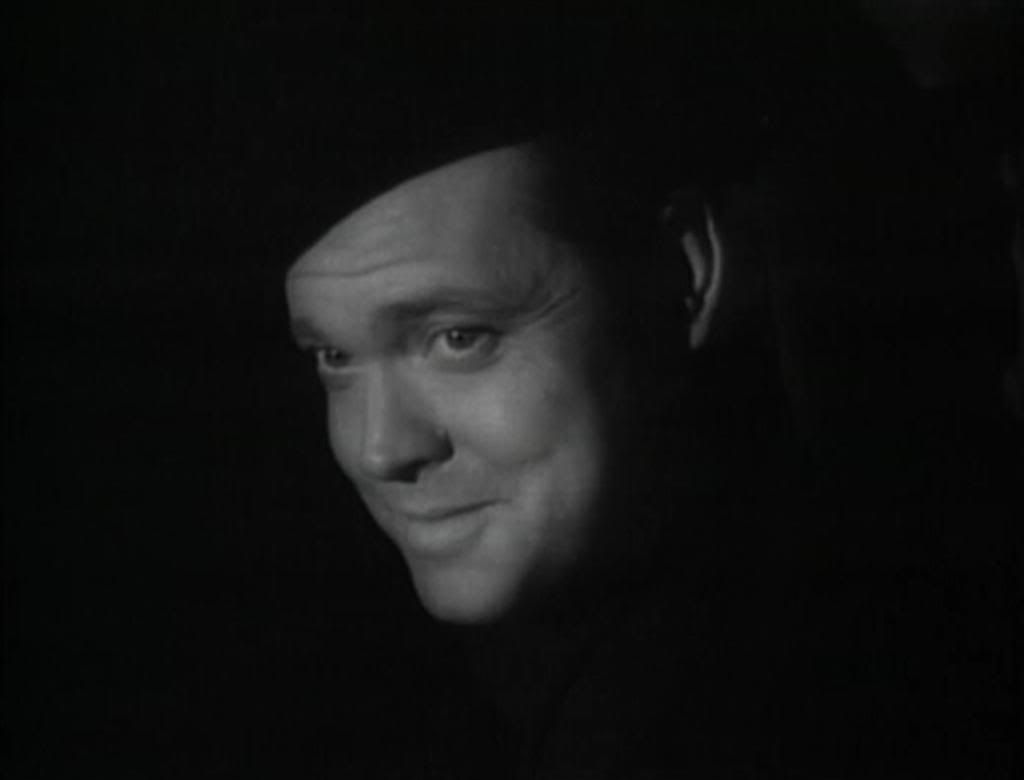

Of course, in the movie's final third it turns out that everything is not as Holly and Anna had thought, and after being an unseen presence/absence for over an hour, Harry Lime himself finally makes his first appearance, incarnated in the smug smirk and cheery eyes of Orson Welles. Harry's first appearance is iconic and unforgettable, first as a shadow in the night, a pair of shoes standing in the shade of a doorway, the rest of his body vanishing into the surrounding shadows. Then a light comes on and illuminates his face, and there's that playful smile, those twinkling eyes, devilish and rakish, a sinister face hovering in the darkness. Having an actor as powerful and iconic as Welles play Harry, and holding back his first appearance for so long, really intensifies the effect. The audience is as stunned as Holly is, in a way, because just as Holly is shocked to find his friend alive, the audience, who might have suspected as much, is simply shocked by the impact of Welles' arrival and the oversized charm that he brings to Harry.

That's even truer in the subsequent scene, later in the film, where Harry finally gets his first lines — and is revealed not as the loving boyfriend idealized by Anna or the fun, steadfast friend described by Holly, but an amoral sociopath who willingly snuffs out lives just to make some money. Harry feels no guilt that the black market medication he was selling killed many and drove others mad. As he and Holly ride a ferris wheel, he looks down and speaks as though he's a god, as though other people are simply abstract dots to him, their lives and deaths of no import to his schemes. Harry is a real product of the war, a lowlife echo of the Nazi indifference to life and the god-like delusions that drive some men to believe their desires are more important than the very lives of others. Harry is a demon, a charming demon, and the sinister vibe of his friends is echoed in his own demeanor. His first conversation with Holly is infused with just-barely-unspoken threats and telling looks. He maintains a casual air as he opens the ferris wheel's door and tells his good friend that he has a gun, that he could eliminate him if he wanted to. And then, when Holly tells Harry that the police have dug up the latter's grave and found the man buried inside it — essentially telling Harry that his problems wouldn't end by getting rid of Holly — Harry's demeanor changes entirely, and he once again becomes solicitous and charming, the menace in his voice replaced by syrupy good cheer and friendly offers. He's good old Harry again, the merry prankster Holly had earlier described in those fragmentary stories from the good old days.

The film climaxes with a crawl through the sewers, in which the witty dialogue and insinuations are replaced by a nearly dialogue-free chase sequence in which Harry is pursued by an army of police with dogs and flashlights, with Holly accompanying them. The sewer sequence is a marvel of noir style, all striking angles and shadows, occasionally pierced by the blinding white light of the pursuers. Harry's face, now not so dashingly confident, is striped by shadows in the dark of the sewer, his eyes wide with fear as he runs this way and that, hemmed in and cut off everywhere, attempting with mounting desperation to find a way out. His earlier smirk is replaced by a grimace of terror. In the sequence's most unforgettable image, a wounded, crawling Harry reaches for a sewer grating, and Reed cuts away to the street above, where Harry's fingers stick up through the grate, waving around like stalks of grass in the wind, which whistles by on the soundtrack, the eerie only noise. It's a haunting ending for a legend who was disappointingly revealed as just another corrupted man, a sad echo of the war's evils.

Don't Look Now


Nicolas Roeg's Don't Look Now is a chilling and mysterious film, a ghost story in which John Baxter (Donald Sutherland) and his wife Laura (Julie Christie) are haunted — literally or figuratively, it hardly matters — by the drowning death of their daughter Christine. Shaken by the tragedy, they close up their home and move to Venice, where John engages himself in his work as an expert on restoration, working on a crumbling church, while they attempt to put the memories behind them, to go on with their tragically changed lives. Instead, their grief and their fear are only intensified, magnified by the grotesque Gothic atmosphere of the city itself, with its shadowy mazes of corridors and its dark, dank waterways that hide the corpses of murder victims, as a killer stalks the city, dumping bodies into the canals to be dredged up as reminders of the watery grave the couple's daughter was lost to. If it seems like an almost absurdly bad idea to get over the drowning death of one's child by moving to a city in which water is omnipresent, the film very quickly makes it seem even worse, like a fatal mistake.

The city of Venice becomes a place of ancient, creeping terrors. John's work forces him to delve into the past, to restore the decayed artifacts of history to their former glory, which means that his work is a poignant metaphor for what he is utterly unable to do in his own life. Against the permanence of death is juxtaposed the work of restoration, of creating modern-day replicas to imitate the past. Several times, John repeats, like an angry mantra, that his daughter is dead, reinforcing the finality of it, the inability to reverse that event the way he's able to reverse the decay of a church's mosaics and statues by filling in the missing places with tiles fabricated to resemble those of the past. The past seems to taunt John: at one point, hoisting a gargoyle up onto the façade of the church, he comes face to face with the grotesque creature, its yawning mouth close to his face, as though poised to hungrily kiss him. He is uncomfortably intimate with the past, with its horrors and its ugliness, and this moment will reverberate in the film's startling ending, as though it was a premonition of John's eventual confrontation with the face of evil.

Laura deals with the tragedy in a different form, strangely comforted by the intervention of a blind psychic (Hilary Mason) and her sister (Clelia Matania). The psychic tells Laura that she sees Christine with them, that the little girl is sitting between her parents, still in the red raincoat she drowned in, happy and laughing as though nothing had happened. It's against this possibility — and the warnings and prophecies that the psychic says the little girl is delivering to her parents — that John offers his repeated and insistent reminders that their daughter is dead, that she is gone for good, that no messages or omens can come from beyond the grave. John, an engineer and a man of books, is rational and worldly, even though his work requires him to come into contact with the sublime and the spiritual on a daily basis. The grandeur of the churches, the sinister menace of the gargoyles, the fragmented images of spiritual scenes in various states of disrepair, these signifiers of the otherworldly do not touch John beyond the physical, tangible necessities of his work.

The strange atmosphere of this film is enhanced by Roeg's associative editing, which often brings together discrete places and actions with parallel editing rhythms. In the crisply edited opening minutes of the film, Roeg cuts back and forth between John and Laura inside and their two children, playing outside by the small pond in the lush green space around their country home. The editing connects parents and children, as a gesture begun by the daughter (throwing a ball) is completed by John as he throws a projector slide to Laura. The editing subtly injects a sense of creeping dread into the sequence, particularly in the visual rhymes between the daughter's bright red raincoat and the mysterious figure in red who John finds in one of his slides of an Italian cathedral. Roeg quietly calls attention to the subtle strangeness of this figure, even creating a split screen effect by placing the slide, projected on a screen, on the right side of the frame, with the black border of the screen separating the image from Laura, seen from behind, reading by the fire. A little later, when John spills water on the slide, the red runs, like blood tracing a curved path across the slide, spreading out across the image, which triggers John's abrupt certainty that something terrible is happening outside.


The inexplicable, slowly building sense of dread established in this opening sequence gradually seeps throughout the entire film; the menace seems to emanate from nowhere and everywhere, creating an un-centered feeling of terrible things lurking just below the surface. Something just seems off about everything, from John's employer, a bishop (Massimo Serato) who projects the aura of an Old World gangster, to the police investigator (Renato Scarpa) who John goes to see when he believes that his wife has gone missing, kidnapped by the psychic and her sister. The inspector listens to John's concerns with abstracted disinterest, absentmindedly doodling on a police sketch until the drawing resembles a monster — and looking out the window and actually seeing the sisters who John is trying to find. These kinds of weird scenes contribute to the sense that the film is just weird at its core, that there's something unsettling and horrible in the very air of the film, in the space between the characters, in the odd disjunctions of the editing. At one point, Roeg inserts a scene of the psychic and her sister in their room, cackling hysterically like a pair of witches, a scene that is otherwise completely unmotivated, which simply adds to the unresolved horror that Roeg is developing here.

That horror is interrupted by a very explicit and surprisingly tender love scene that suggests that the couple's grief may yet be healed, that the sense of approaching doom may yet dissipate. The sex scene is cut together with shots of the couple dressing afterward and getting ready to go out, the shots alternating quickly. A shot of sex, passionate and intense, then a shot of one of them putting on their clothes, or Laura putting on her makeup, smiling as she remembers their earlier romp: two different visions of domestic tranquility, blended together into a portrait of marital love in bed and out. Time becomes fluid, and through the magic of the editing these obviously separate activities are brought together as part of the same sequence. In a later scene, when Laura is with the psychic, who's trying to contact the couple's daughter, Roeg cuts together this scene with shots of John searching for his wife, and the cuts give the impression that the couple is looking at one another even though John never finds his wife. If the sex scene's editing suggests intimacy and domesticity, this scene suggests exactly the reverse, creating only the illusion of connection while the couple remains hopelessly separated, a prediction of the miscommunication and geographic dislocation that marks the second half of the film.

At times, the odd tone of the film even spills over from discomfort into offbeat comedy. When John walks into the police inspector's officer, Roeg films the large, mostly empty room from John's perspective, with the inspector behind his desk with a lamp positioned so that its shade seems to be taking the place of his head, until the man peeks around the corner and greets John. It's such a surprisingly playful image, particularly in light of the disconnected tone — as though the two men are talking past one another — of the subsequent scene. Roeg also builds some peripheral comic business around the employees of the hotel where the Baxters are staying. In one scene, John arrives back in the room to find a maid using the toilet in the room, then apologetically placing a magazine back in a stack by the door, shrugging as she walks by. There's also the hotel manager who's always chattering in Italian, sometimes seeming to make fun of the Baxters to his staff while remaining solicitous to their faces.

Such diversions in tone only contribute to the film's kaleidoscopic spiral into madness, which culminates in the frenzied editing of the creepy climax, in which memories and moments from throughout the film are collaged together in a way that suggests that answers are popping into place, even though in fact the mysteries all remain intact and are even deepened by the unpredictable conclusion. Roeg's film resists easy answers, fragmenting the narrative with the editing and allowing a languidly drifting sense of fear to wind through the film like the fog that churns underfoot during the climactic chase through Venice's back alleys. This eerie, haunting film never explains or resolves its many mysteries, leaving only an intangible horror that lingers long after the film is over.

The Terence Davies Trilogy


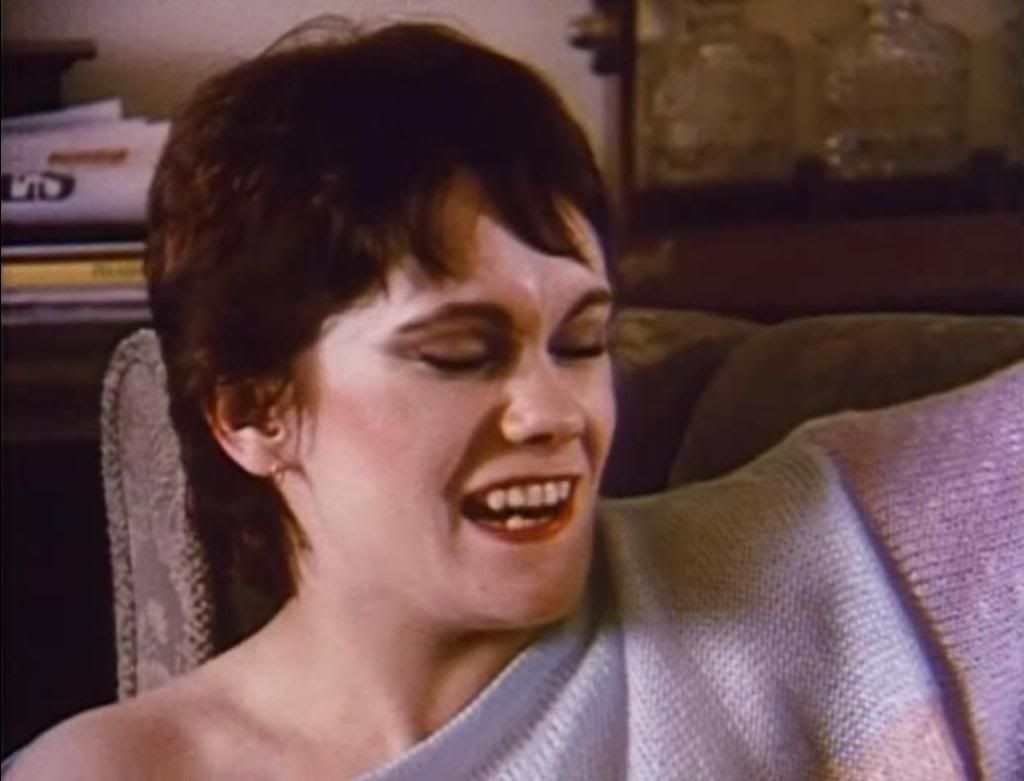
The Terence Davies Trilogy is the British filmmaker Davies' triptych of short films made between 1976 and 1983. Obviously based on autobiographical experiences, all three films deal with the life of a gay man named Robert Tucker growing up in a repressive culture — the film is set in the specific culture of Britain in the 60s or 70s or 80s, but its depictions can apply anywhere that desires and feelings are suppressed and denigrated. These films are universal and timeless in that way, despite their specificity and wealth of detail. The films simply but powerfully examine sexual and emotional repression, Catholic guilt, confusion, grief, and the simmering hatred and despair incubated by a life of fear and lies in the closet.

The first film of the trilogy, Children, collects the childhood flashbacks of Robert Tucker (Phillip Mawdsley as a boy, Robin Hooper as a young man). As a child, the fey, quiet Tucker suffers tremendously. He is taunted and beaten at school, called a "fruit" by his classmates, who chase him home as soon as the ending bell rings, and sometimes catch him. He is tormented by his teachers as well; they can't seem to resist mocking his habit of answering their abuse and punishments with a subservient "yes sir" or "thank you sir." And at home, Tucker must deal with a brutish but ailing father (Nick Stringer) who's cold and angry, falling apart due to illness but still possessing enough strength to beat his wife (Valerie Lilley) and intimidate his son.

The film, like all three of these shorts, is shot in a loose black-and-white style, rough and realistic, with the deeply personal feel of lived memories. The opening, in which Davies focuses on the faces of schoolboys in silent shots, immediately recalls the Free Cinema movement, an obvious influence here, as is the style and immediacy of neorealism in general. Davies has a feel for faces, for observation. He accumulates small details until he's assembled a coherent portrait of a young gay boy's life in a repressive Catholic school: the punishment for small offenses, the bureaucracy, the near-military discipline contrasted against the brutishness of the schoolchildren whenever the teachers aren't watching. Catholic guilt and repression loom large. A cross is prominently positioned in Tucker's room so that it seems to linger in the background of several shots, juxtaposed against his suffering and anger.

The sequences of Tucker as a boy are implicitly the flashbacks of the older character, who doesn't seem much changed by the intervening years. Just as the boy goes to see a doctor in one scene, waiting in his underwear while the other boys make fun of him, the young man also goes to see a doctor. The bureaucracy of the waiting room connects the boy and the man, as does the anxiety over his homosexual desires. The boy watches, in a pool shower, as a young, muscular man washes himself: the scene is lovingly filmed by Davies as a sensuous expression of gay desire, capturing the look of awe in the young Tucker's eyes as as he watches the man's hands caressing his own body beneath the streaming water. Later, Tucker faces a doctor who seems to think of his lack of interest in girls as an illness, a temporary affliction that will eventually pass, and Tucker only politely says "thank you" and "sir" the way he always had to his teachers as a boy. A childhood of abuse and constant browbeating has turned him into an introspective, isolated young man, obviously haunted by his past. The film's structure reflects this: the scenes of Tucker as a man are brief and fragmentary, overshadowed by the scenes from his boyhood. Other than an attenuated scene of him getting together with another man, there is no sign of anything of substance in Tucker's adult life other than his negative memories of his own past.

Davies' aesthetic is unshowy, but these seemingly offhand images of prosaic life can be misleading: there's a subtle stylization in his images. In one shot, Davies shoots through the back window of a hearse as Tucker's father's coffin is loaded into it, while beyond the car's window are Tucker and his mother in another window, looking on, made ghostly by the distance and the panes of glass, as a sneering smirk curls Tucker's lips. The next shot is even more chilling, as the boy begins to laugh bitterly, and then walks forward at the head of a procession of mourners, each of whom stare disarmingly at the camera as they pass by. At the end of the shot, when all the mourners have walked by, all that's left is the black emptiness of the doorway.

The use of music and sound in the film is haunting and minimal. A static shot of Tucker and his mother riding the bus is accompanied by a mournful flute solo until, abruptly, Tucker's mother begins to sob quietly, gasping and hiccuping, her face disconcertingly maintaining its stoic composure in between sobs. In another shot, Davies holds the adult Tucker in the same static profile, staring straight ahead while a collage of sounds and music on the soundtrack evoke childhood memories: children singing and saying prayers in unison, their high voices joined together in both plaintive folk ballads and rote recitations of prayers. The most affecting music is reserved for the final shot, a long pan back from Tucker at his bedroom window, interrupted by a brief interior profile shot in which the boy breaks down and cries, moaning, "oh dad," a stark contrast to his smirking reaction before the funeral. As the camera pulls back from the window, and from this intimate moment of grief, a girl's voice sings the mournful, eerie supernatural folk song "The Ballad of Barbara Allen."


Madonna and Child, the second film of the trilogy, picks up the story of Robert Tucker (played this time by Terry O'Sullivan) later in his life, when he's living at home with his aged mother (Sheila Raynor) and working at a dull office job. Towards the beginning of the film, Davies' camera pans slowly across the deck of a ferry, tracking methodically towards Tucker, who sits alone towards the back of the boat, obviously crying. As the camera edges in closer and closer, it eventually arrives at an uncomfortably intimate closeup that reveals every messy detail of Tucker's grief: his heavy-lidded, puffy eyes, the tears streaming down his cheeks, his quivering lips. It is a powerful encapsulation of utter despair, mirrored at the end of the film by the scene where Tucker, sitting along in his room at home, abruptly screams loudly. His mother walks in, asks if everything is okay, and when he plaintively answers in the affirmative, she nods and closes the door. In both cases, Tucker's despair is seemingly unmotivated, not tied to any concrete event or incident, coming out of nowhere — but the rest of the film makes it clear that these uncontrolled emotional outbursts are an only too appropriate response to the general aura of melancholy and isolation afflicting this lonely, tormented man.

Davies' slow pan across a silent office, with the occasional scratch of a pencil or raspy cough rubbing up against the choral music of the soundtrack, emphasizes the deadening effect of this work on Tucker. This is particularly true when, in a deadpan punchline, Davies ends the tracking shot with a closeup on a wrinkled coworker, who asks Tucker if he did anything over the weekend, to which he drily responds, "no." But he does do something on the weekends, as the very next shot shows him methodically going about his sour-faced preparations for going out. He pulls on his leather boots and jeans, and his shiny leather jacket, popping the collar up around his neck. Davies emphasizes the sounds of this routine: the rustling of cloth, the metallic scrape of a zipper, the crinkling of the jacket, the creaking of the stairs as Tucker then sneaks downstairs in the dark, trying not to wake his mother. This grown man is acting like a teenager trying to get out of the house, while his mother, in a nearby room, lies awake, listening disapprovingly, knowing or suspecting where her son is going. The shot of Tucker slowly tiptoeing down the stairs, a striking black silhouette in the dark, his collar sticking up in points like Dracula's cape, emphasizes the distance between his desired image of himself and the truth of the matter, which is that he's rather pathetic, unable even to get into the underground gay clubs he tries to visit. He's so obviously uncomfortable with his sexuality that he winds up not fitting in anywhere, in the straight world or in the underground gay world he hesitantly flirts with.

The point is driven home during a remarkable scene where Tucker goes to confession. Speaking to the priest, he rattles off an impressive list of very specific sins, accompanied by precise tallies of how many times he committed each sin during the weeks since his last confession. The sins are mostly matters of thought and attitude, venial slips like "disrespecting my parents" and "coveting my neighbor's possessions." It is obvious that Tucker maintains a constant censorious eye on his own mind, tracking his impure thoughts, keeping a mental tally sheet of his bad thoughts. The unspoken subtext of this confession, however, is sexuality, the one subject that Tucker can't seem to bear to address in these admissions of failings and thought crimes. As Tucker continues to recite his sins in voiceover, Davies pans away into the black empty space of the confessional, transitioning into a fantasy or memory of Tucker lasciviously giving a blowjob to another man, the camera drifting along until it is positioned behind the man's bare buttocks as Tucker squeezes them together. Paired with the language of penitence on the soundtrack, the image is doubly provocative. It is clear that Tucker feels guilty for his sexual behavior, and his obsessive tracking and confession of his other sins becomes a form of compensation: he's struggling with feelings of guilt, and can't bear to even acknowledge his desires or his sexual actions.


The third film of Davies' trilogy, Death and Transfiguration, opens with a remarkably affecting and simply presented sequence as Robert Tucker goes to his mother's funeral. The shot sequence is precise: a hazy urban skyline with a blurry sun breaking through the clouds, the front grille of a hearse, a car door opening, a closeup of hands clasped in a prayer-like posture, the wheel of the vehicle as it slowly starts moving, and finally a closeup of Tucker's face as he sits in the back of a car, heading towards the cemetery to bury his beloved and feared mother. It is a near-abstract representation of grief, capturing the sense of ceremony and ritual that accompanies death, the ritualized gestures of mourning, the rites that precede the trip to the grave. That this sequence ends with a sustained image of a coffin being cremated, the flames flaking away the wood and slowly engulfing the screen, suggests that the ritual is merely a civilized facade on the truth, a disguise for the simpler and crueler fact that this is an absolute ending.

This final film, perhaps the most devastating of the cycle, focuses on Tucker as an old man (played here by Wilfrid Brambell, while Terry O'Sullivan returns as the middle-aged Tucker). The trilogy is structured so that each segment is about looking backwards: in Children, Tucker was a young man remembering his boyhood, in Madonna and Child he was middle-aged and thinking back on being a younger man, and here he's an old man remembering the entirety of his life. There's a sense of circularity to this structure, as the old, sickly Tucker lounges in a hospital, cared for by nuns, remembering his boyhood as a student at a Catholic school where he feared the rigid nuns who ruled his life. He has been returned to the hands of the nuns after an entire life struggling against the confines of religion, wracked with guilt over his gay lifestyle, constrained by his mother, who he devotedly cared for and desperately mourned for after her death.

Now, what's left to him is memory. Davies' fluid editing erases the boundaries between past and present, cutting smoothly between the silent, ancient Tucker in his hospital bed and various sequences from earlier in his life. He remembers, especially, moments of tenderness and intimacy with his mother, and moments of religious instruction from his boyhood. As he approaches his own death, his thoughts are obviously on God, wondering what's next for him, thinking about his fraught relationship with religion. He's also still haunted by his mother, long after her death, consumed by thoughts of her. One of the film's most beautiful sequences is a memory from Tucker's boyhood, as he remembers seeing various adults, friends of his parents, singing in the streets, exuberant and perhaps a little drunk, winding into the house for a Christmas party. Slowly, another song wells up from amidst the revelers' cacophony on the soundtrack, an out-of-tune woman's voice singing, badly but with such passion and feeling, "Someone To Watch Over Me." This song, sung boldly and clearly, with no shame over the cracked notes, slowly replaces the sounds of the party on the soundtrack, as the young Tucker sees his mother on the street and embraces her, and the song continues as Davies cuts back to the hospital, where Tucker wheezes and moans in his sleep, his mouth hanging open, his face looking gaunt and skeletal.

This film ends with a harrowing and mysterious sequence in which Tucker at long last proceeds, gasping and wheezing, into the pure white light that consumes him in his final moments. That's the moment of transfiguration hinted at by the title of this final film, but it's a singularly open-ended transfiguration, leaving one to wonder if Tucker has been lifted up into God's arms, as he had always been told he would be, or if he passed into some other void. It's a perfect, if desolate, ending to the film, and the trilogy as a whole, because it captures the isolation and loneliness of this man who was never able to be himself. He dedicated his life to his mother, and to hiding and suppressing the truth of his gay identity and desires, and in the end he's left with a lonely, frightening death, facing the light with so many questions left unanswered, so many wishes left unfulfilled.

Who's Who


Who's Who is one of six TV films that director Mike Leigh made for the BBC television series Play For Today. It's an acerbic, biting class comedy, nastily funny in its portrayal of the class divisions between employees of different social levels at a stock firm. Leigh satirically observes the profound disconnect between the low-level workers in their middle-class lives and the upper echelons with their full social calendars. Alan (Richard Kane) is one of the lower workers, but he's obsessed with the British royal family and the upper classes. He writes letters to anyone he can think of — the royals, various celebrities, politicians, even famous doctors if they're connected to the peerage — asking for autographs and inscribed photographs, and he files the results in a cabinet where he stores these treasured artifacts. He's infected with a profound class envy, worshiping those with an upper class name or even the slightest whiff of class status. It's his way, perhaps, of coping with what seems to be otherwise a very unsatisfying life, with his staid office job and his dowdy wife April (Joolia Cappleman) who's obsessed with her copious cats. While he sits at work listening to the upper-class managers talking about their busy weekends, their dates and dinner parties, his idea of an important engagement is a TV program he wants to watch, so it's no wonder that he idolizes the upper class and gathers any scraps he can get from that arena of privilege and fame, as though his drawer full of autographed pictures could convey some of that classy aura to him by proximity. He even keeps, in a place of privilege, pinned on his wall, the letters of rejection from the highest members of the royal family: it's obvious that he's deeply impressed by the implication, in these letters from secretaries and royal functionaries, that to sign a letter for a "fan" would lower the queen or the duke or whoever. Even his rejection by the upper class is a reason to celebrate them, to venerate them even more.

Mostly, though, Alan sees those above him in a very rosy light. Speaking about one of his superiors at work, he tells his wife, "he's a very charming man, once asked me the way to the office toilet." In fact, in an earlier scene, the man obviously couldn't wait to get away from Alan, answering his nosy questions with strained politeness and then hurrying away as soon as possible, which doesn't stop Alan from presenting the whole incident to his wife as though he'd had a lovely chat with the man while walking to the train station together. Leigh clearly sees Alan as a hopelessly pathetic character, ridiculous for his aspirations, for his desire for any least contact with those above him socially. He's laughable because he ascribes some kind of sacred importance to the idea of class, buying into the heavily stratified British society with its sharp divisions between different levels.

One of the film's most painfully funny scenes is the lengthy sequence where a society woman visits Alan and April's house to buy a kitten from April. While the woman is there, a photographer named Desmond Shakespeare (Sam Kelly) is also bustling around, setting up his lights and camera equipment for a photo shoot of the cats. In the midst of this chaos, Alan sees the opportunity to present himself as a man of culture, and he hurriedly puts on a dressing gown and fancy accoutrements, then tries to engage the woman in polite conversation even as the photographer keeps scrambling around them, setting up, and April keeps telling the potential buyer about problems with litter boxes, diet, spaying and defecation, despite the obvious fact that the woman couldn't care less, that she knows that she is certainly never going to personally deal with the animal, that it will be her servants who do all that work. The woman nods and laughs with badly feigned politeness at Alan's conversation, and when she leaves he pronounces her "charming," his favored word for the representatives of the upper class, even though in fact she'd been far from charming, even though she'd actually been looking at the house, and Alan, and everything around her as though she was disgusted, and winced whenever she was offered a drink. The whole scene is absurd and funny in its dark, embarrassing way. When Alan asks the photographer, "by the way, you do know there was a famous writer called Shakespeare?" it's just another sign of Alan's desperation for any hint of contact with something beyond his pitiful life, his pitiful desires. The photographer simply deadpans, "yes, I've heard of him," and then later, when he's leaving, is stunned and exasperated by Alan's request for an autograph, disgusted, much as the society woman herself had been, by this particularly blatant and ridiculous starfucker.


To juxtapose Alan's social ambitions with the lives of those he wishes he could be, Leigh intercuts Alan's story with scenes from a dinner party held by the socially connected Nigel (Simon Chandler) and Giles (Adam Norton). The pair invite Anthony (Graham Seed), a boss at the company where Giles and Alan both work, along with two girls, Samantha (Catherine Hall) and Caroline (Felicity Dean). The dinner party provides another study in social divisions, as even within the upper class circles that these people all travel in, there are obvious hierarchies: Nigel, Giles' roommate, is more like a servant than a friend, preparing dinner for everyone and generally getting treated with polite distance. The conversation at the dinner table is shallow and pointless: these people have nothing to say except where they've been on vacation, what other socially connected people they've seen or not seen, whether they like to hunt or ride horses or ski. They talk about who they know, who they've met, where they've been — in that, they're not so different from Alan, who's similarly obsessed with namedropping.

The only point at which the conversation actually touches on something real is when these upper class snobs discuss punk. Samantha, it seems, is a punk sympathizer, at least in her shallow way: she's adopted some of the dress of the punk style, and she giggles at the provocations of the movement. She likes to shock, and in her circles probably the best way to shock is to make some gestures towards a populist movement of noisy provocateurs. She wears a jacket with a few buttons pinned to it, and when she walks in Nigel asks her, "what is it, punk? Where are the safety pins?" Everyone laughs: these people, only a few years into punk's peak period, have already grown accustomed to the movement enough to see it as just another fashion trend, a costume to be appropriated, tossed on lightly. It doesn't seem to be much more than that to Samantha. She likes that it offends people, that it shocks; it fits with her giggly, sexually suggestive persona, her garish makeup and leering smile. It never occurs to her, or to any of the other partygoers, that there might be a class component to it, that the anger and provocation of the punks were in part responses to the very class inequities chronicled in this film. The others only see it as "offensive," parroting Anthony's word for it, none of them seeming to have any clue what punk even is.

Leigh's eye for this milieu is acute as ever. He's always been a potent observer of class, of how people live their lives. His aesthetic here is unobtrusive, alternating between slightly aloof, distanced observation — as in a sequence where Leigh's camera sits at a quiet distance, watching the absurdity of these upper class buffoons trying to iron out the proper seating for a dinner party — and abrupt, in-your-face closeups like the one that pushes uncomfortably up against the shrill, desperate face of April as she tries to impress her potential buyer. This is a darkly funny film about the ugly and pathetic facts of life within a restrictive class system that cleaves people from one another, sectioning them off behind "codes" like the one that Anthony says governs his behavior. If this is control, if this is order, one thinks, then the chaos and anarchy of punk that Anthony so fears starts to look more and more attractive.

The Red Shoes


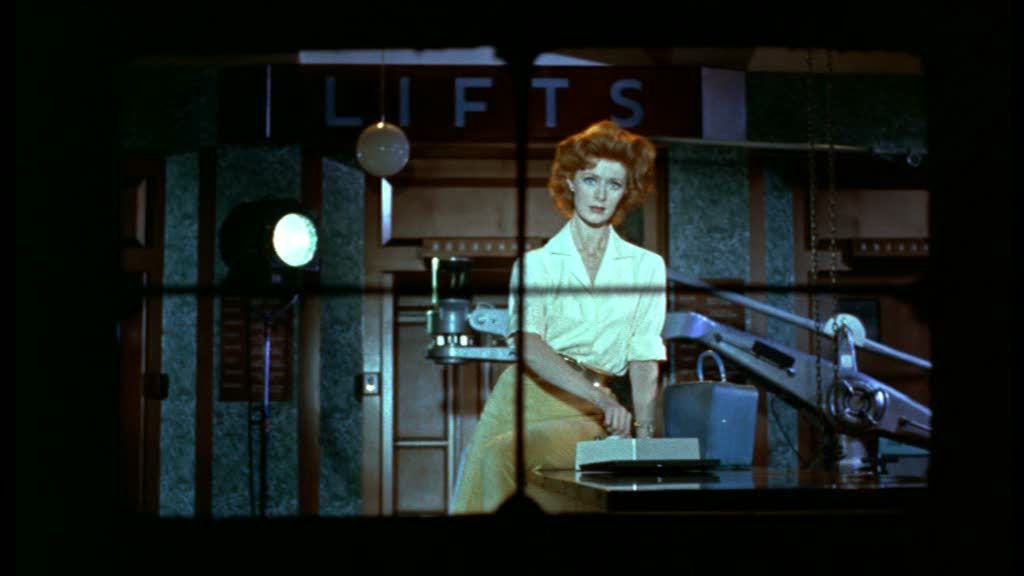
The Red Shoes is Michael Powell and Emeric Pressburger's film about a ballet company and its new star, Victoria Page (Moira Shearer), who is torn between her love of dancing and her love of the composer Julian Craster (Marius Goring). Victoria has always dreamed of being a great dancer, and with the famous ballet director Boris Lermontov (Anton Walbrook), she gets her chance, catching the notoriously picky Lermontov's attention and increasingly becoming the company's star performer. At the same time, Lermontov has hired the aspiring young composer Julian, and he too becomes a star within the company, composing original new music that impresses everyone who hears it. The only catch is that Lermontov has an obsession with dancers committing their entire lives to their art — he is furious when his previous star announces that she's getting married — and since it's inevitable that Victoria and Julian will eventually fall in love, their success seems very tenuous.

The film is about the ballet, of course, but more than that it's about the untenable position of women in a world that forces them to choose between ordinary domestic pleasures — love, marriage, family — and the ability to express themselves creatively or professionally. By the end of the film, Victoria is positioned between two men, Lermontov and Julian, neither of whom will allow her to build a balanced, happy life for herself. Both men demand that she choose one or the other. The final confrontation is structured like the showdown of a love triangle, the two men verbally dueling over the woman they both want, even though Lermontov has no sexual or romantic desire for Victoria; he wants only for her to dedicate herself entirely to dancing. In between them, Victoria can only cry, being asked to choose when it's obvious that she both loves Julian and loves dancing, and wouldn't want to give up either. (Though why she'd ever want Julian, who's made up like a wispy 30s Hollywood leading man and who's as much of an arrogant, unyielding jerk as Lermontov, is a question the film can never quite answer.) The film is positively progressive in its examination of Victoria's dilemma, even if it's only in tragic terms, with no way out for her, no solution to resolve these tensions tearing her apart.

But that's the nature of this film. It's an overwrought melodrama and it knows it — it revels in it, in fact. The performances, with the exception of Shearer's supple, subtle turn as Victoria, are uniformly over-the-top, both onstage and off. At one point, the choreographer Ljubov (Léonide Massine) dances around Lermontov while arguing with him, as though dancing a part in a ballet; a spotlight even follows Ljubov around as though he were still rehearsing. This scene, with its light comic undertones, suggests that these people live the ballet, that onstage and off they're prone to dramatics and overstatement, to grand gestures that could be seen way up in the last rows of the theater. They're always projecting, and so their histrionics work within the context of their characters. This is especially true of Lermontov, who despite his backstage role always seems to be acting, to be projecting the image of the demanding, tyrannical director that he believes he should inhabit. Walbrook's performance is such great fun because of this artificiality, this note of hysterical overacting that infuses everything Lermontov does. After he finally convinces Victoria to return to dancing towards the end of the film, when she leaves the room he shakes his arms around, clasping at the air, grandly declaring his excitement at his victory to the empty room.


Powell and Pressburger match the story's melodramatics with lush, patently artificial imagery that enhances the film's underlying themes: as is so often the case in their cinema, the film seems to take place in a surreal dreamworld of painted backdrops and lavish sets that stand in for such glamorous locales as Monte Carlo. Onstage and offstage are united in artificiality, suggesting that for these artists, under Lermontov's guidance, life and art are unified, with the latter overshadowing the former. Nowhere is this more apparent than during the sublime 15-minute sequence in which Victoria performs the ballet The Red Shoes for the first time. It is one of the finest sequences in the cinema, a beautiful and remarkably playful melding of the cinema and the theater, and an ode, not to the power of ballet but to the power of Powell and Pressburger's own chosen art.

Once the performance starts, Powell and Pressburger deliberately and playfully erase the boundaries and limitations of the theatrical stage, leaping into the realm of the cinema. When Victoria's character in the ballet sees the red shoes in a shop window, she imagines that she sees herself dancing in the window, turning pirouettes. It is an idea that's all but impossible to convey purely through dancing, on a stage: it is internal, a moment of imagination that can only be conveyed cinematically. So Powell and Pressburger superimpose an image of Victoria dancing in the window, as she stands outside, looking in and imagining this scene. Although the moment ostensibly occurs during a real theatrical performance of the ballet, before an audience, Powell and Pressburger instead stage the sequence with a cinematic sensibility that could never be translated to the stage in this way. When Victoria first dons the red shoes, she does so by leaping forward into them, and in a closeup on her feet, the shoes change, in an instant between frames, from her plain white ones to the bold red ones. It is, again, a moment that purposefully shatters the illusion of a ballet taking place on a stage — in a theatrical performance, the dancer would have to go backstage and change her shoes at this point, but Powell and Pressburger elide the costume change through the magic of editing.

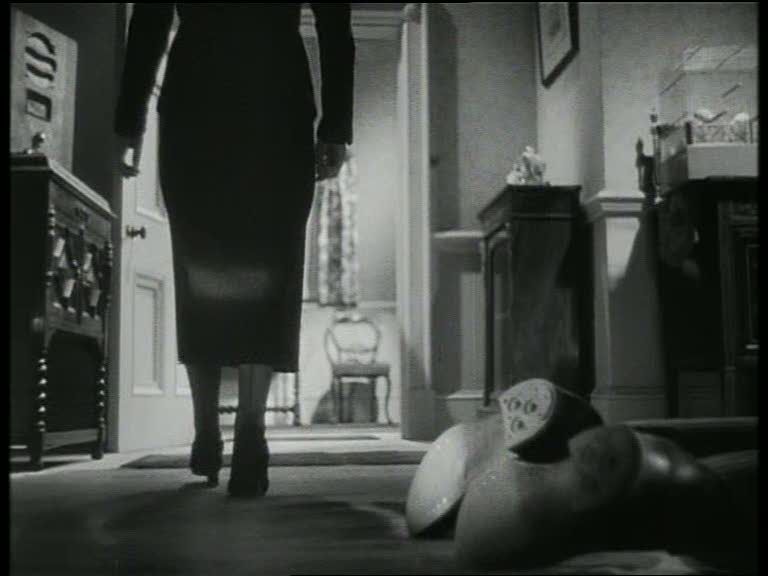
Again and again, the filmmakers are calling attention to the differences between the cinema and live theater, using every cinematic trick at their disposal to transform this ballet into a fluid, magical sequence. Victoria turns and leaps across the stage — and the wooden boards of the floor keep reminding one that this is a stage — and dances in long straight lines that would be impossible to maintain on a real stage without dancing into the backstage area. Indeed, at one point, after a lengthy sequence in which Victoria dances through a succession of narrow corridors and between buildings, Powell and Pressburger cut back to a long shot of the entire stage, which reveals Victoria emerging from the rear of the stage, where she would have just been dancing for a long time completely unseen by a theater audience. Only the camera is able to follow her back there, its graceful tracking following the fluid lines of her movement. The subsequent sequence of Victoria being taken away by the power of the red shoes relies heavily on superimposition to lend a ghostly, translucent quality to the dancer as she hops and twirls through eerie nighttime vistas and, finally, enters a free fall that's familiar from cinematic dream sequences but would, again, break the constraints of reality on a real stage. Still later, she dances with a wisp of paper that transforms briefly into a man, her own costume changing between shots, before the man again fades away into a newspaper blowing in the breeze.

Towards the end of the performance, Powell and Pressburger finally insert a high shot looking out towards the audience beyond the row of lights at the front of the stage, the first time since the very beginning of the performance that the presence of the audience or the stage borders are revealed. But at this moment the audience is replaced by a superimposition of a churning sea, and the sound of the waves blends subtly with the sound of applause, suggesting that Victoria is seeing everything through her character and the story of the ballet, seeing everything around her transformed and made real through the magic of creative expression. It is a stirring, thrilling sequence, and one feels both Victoria's joy in the dance, and the joy of the filmmakers in shaping and directing her dance. That joy, both in front of the camera and behind it, is the joy of creativity and art, and even when this film is at its most tragic and heartrending, that joy is the feeling that comes through most strongly.

Happy-Go-Lucky


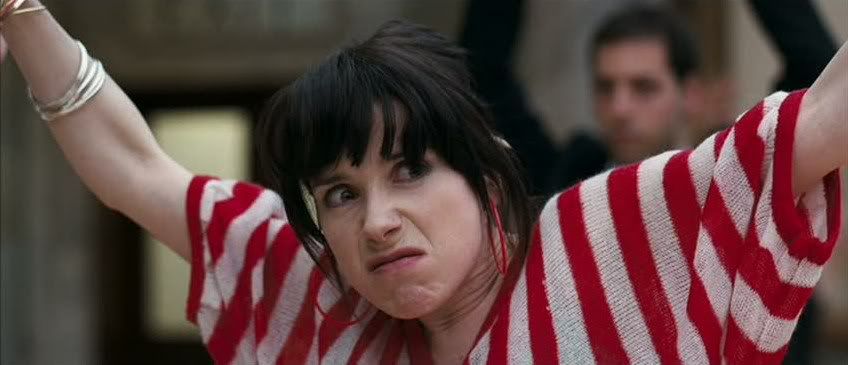
Mike Leigh's Happy-Go-Lucky is built around a peculiar and extraordinary character, the 30-year-old school teacher Poppy (Sally Hawkins), a woman who is forcefully, unbelievably enthused about life and, seemingly, everything in it. In the opening minutes of the film, she encounters a reticent book store clerk who responds to her peppy greetings with glowering silence and confusion, as though he doesn't understand why this woman is wandering through his store, asking him questions and smiling and laughing for no apparent reason. But this is just how Poppy lives her life, with an attitude of openness and cheerfulness that can seem, to the people she encounters and at times to the film's audience, like absurd naiveté or even lunacy. Poppy is a person of boundless optimism and good will, and her final question to the store clerk provides a subtle glimpse of her worldview. She asks the man if he's having a bad day, and this finally shakes him out of his stony silence, at least long enough to answer with a simple "no." The unspoken question, then, is why he seemed so rude, so closed off, so unwilling to interact. When Poppy encounters this kind of attitude, she assumes that something must be wrong, because she doesn't realize that for a lot of people — even most people — the default setting for getting through the day is not boundless cheer but resignation or, at best, neutrality. Most people are not like Poppy, greeting every day with laughter no matter what happens. When she leaves the store, she realizes that her bike has been stolen, and even that she responds to with bemused laughter rather than anger; she's a little sad only that she didn't have a chance to say goodbye.

As a character, Poppy perhaps strains credibility — and in certain scenes shatters it altogether — but that's part of the point. She's almost artificially, supernaturally happy, very unlike the poor, downtrodden, miserable characters who often populate Leigh's films about the British working class. Poppy presents an alternative to that misery, an alternative to the attitude of constant complaining, an alternative to the attitude that the world is out to get us and that the best thing to do is snarl back. When Poppy encounters the small adversities of everyday life, she muddles through as best she can and tries to make it as enjoyable as she can. At one point, she injures her back while trampolining, and winces her way to the chiropractor, although she also exclaims that her back pains make her laugh — which is not surprising, since everything makes her laugh. While she sees the doctor, her friend Zoe (Alexis Zegerman) waits outside, trying to chat up another back pain sufferer, and Leigh not too subtly points out how outrageous Poppy's attitude is. While the man in the waiting room cringes and glowers at everyone around him, and Zoe points out that back pain affects everything, including one's attitude, Poppy is giggling and smiling through her pain, joking with the doctor. Back pain doesn't alter her attitude, and neither does almost anything else. Leigh stages the scene in a strikingly intimate, even sensual way, with Poppy stretched out on the examining table in a pink bra and bright orange panties beneath black net stockings. As the big hands of the doctor probe her body, Leigh almost makes the examination seem sexual, flirtatious, but really Poppy is just doing what she always does, which is to remain open to other people and to her own pleasure even when things aren't going so great.

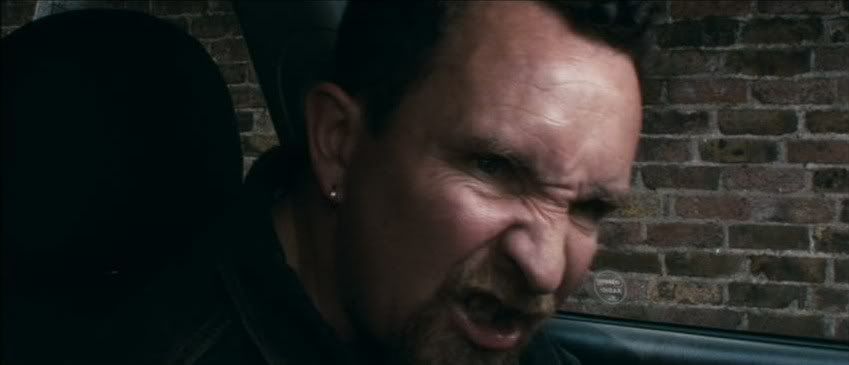
This attitude encounters its greatest challenge in the form of Scott (Eddie Marsan), Poppy's driving instructor. Scott is an obvious bundle of (barely) repressed rage and disdain for other people. He is a Christian of a particular type — he says that Satanists and the Pope amount to the same thing — and also a conspiracy theorist and a racist. The openness of Poppy and Zoe to the black chiropractor — who they find attractive and kind — is contrasted against Scott's instinctual reaction to lock the car doors when two young black men go innocently riding by on bicycles. Scott is nasty and perpetually angry, always complaining about his driving students, about the inconsideration of other drivers, and especially about Poppy's cheerful attitude. Leigh relies a lot on closeups throughout this film, probing closeups that establish an at times uncomfortable intimacy with his characters' exaggerated emotions and the way those emotions are scrawled across their faces. There could not be more distance between the ready smile and bright eyes of Poppy and the constricted, taut face of Scott, who's always snarling and spitting from between clenched teeth, his face threatening to turn red with anger, his eyes scrunched up into angry slits. The two actors are each exaggerating, each projecting their feelings in the broadest possible ways, and Leigh purposefully sets these two caricatures against one another, letting the sparks fly simply by placing them in the same car together.


Of course, it's wildly entertaining and exciting, but the surprising thing is that it winds up being more than that, more than just an over-the-top acting exercise in which two broad types clash. Because even though Poppy and Scott are each extreme incarnations of opposite personality types, there's something poignant about this meeting of the avatar of good cheer and the personification of Christian repression and rage. The tension between the two explodes during the final act, when Scott unleashes, in a torrent of startling hostility, exactly how he feels about Poppy and exactly how he sees her. It's a vision of Poppy strikingly different both from how Poppy sees herself and how the audience has likely seen her up until that point. And Poppy looks at him with a dawning sadness on her face, an expression of true despair as she realizes how badly he has misunderstood her and her intentions, how different his whole way of looking at the world is from hers. It's such a bracing moment because it gets to the heart of the film's study of Poppy, who remains so outwardly happy through everything that one is forced to wonder if it's an act, if she's really happy or if she's nursing a deeper loneliness or depression beneath the surface.

That would be the conventional understanding of such boundless cheerfulness. The usual idea is that anyone who responds to everything with a laugh or a joke is adopting a defensive posture against the world, but that refreshingly doesn't seem to be the case with Poppy. She is thirty years old and has no boyfriend for most of the film, and several times her friends delicately probe how she feels about this situation, asking if she's lonely or if she wants a baby or if she's unhappy with her life, but Poppy shrugs off such concerns. She's OK with her life, with her friends, with her job, and she doesn't feel the need to dwell on the things she doesn't have. People keep telling her to be a grown-up, but Poppy certainly has a more mature attitude than Scott, who tells her to grow up but is implicitly compared by Leigh to a schoolyard bully in Poppy's class, a troubled boy taking out his anger on his classmates. And just as Poppy tries to draw out that boy, to get to the root of his troubles, she tries to do the same thing with Scott, though his grievances have had longer to fester, his angry worldview has had time to solidify, and his troubled childhood has lasted well into his outward adulthood.

What's interesting about Happy-Go-Lucky is that, although Leigh obviously admires his heroine's pluck and joy, there are certainly times where Poppy must become aggravating even to a sympathetic audience. Her openness to everything leads her, at one point, to wander into an abandoned construction site late one night, following the crazed ranting of a bum. This is surely the scene where Leigh goes too far in portraying Poppy as a kind of holy fool, as she interacts with this obviously mentally damaged man with the same innocence and good cheer she displays with everyone else. The scene has a sense of danger running throughout it, an uncertainty about whether this man is dangerous, whether he's going to assault Poppy. Poppy isn't oblivious to the danger — she's not that stupid — but she traipses on anyway, trying to do... well, what? She offers the man some change, which he refuses, and she asks if he's cold, though she wouldn't have any obvious remedy for that if he had said yes, but mostly she just seems to be trying to connect, to talk to him, to see what he wants or needs.

At moments like this, though, Poppy seems less cheery and optimistic than suicidal, or at least willfully blithe with risk, naivé about the dangers of the world. The scene seem like a fantasy diversion from reality. In other scenes, one even sympathizes with Scott as Poppy, unable to keep a straight face for more than a minute, makes light of the dangers of driving and turns her lessons into jokes. It's hard not to agree with the otherwise unsympathetic Scott that driving is a responsibility to be taken seriously or else people will get hurt. Leigh intends for us to just keep laughing along with Poppy, to see her perpetual teasing of Scott and her casualness with driving as a joke, but in some ways he sets this up so that he can pull the rug out from under us with Scott's final enraged speech to Poppy. Because although Scott ultimately reveals himself as even more pathetic and distasteful than he'd first appeared, Leigh doesn't flinch away from the fact that Poppy's carefree, always-happy attitude led her to this place. And Poppy, of course, has reason to be happy: she has good friends, a job she loves, in the end she even finds a boyfriend. The worst thing that happens to her in the film is Scott telling her off. One wonders if her attitude could survive a change of context, or how she would cope with real tragedy, if she could cope at all. The film's final image of Poppy and Zoe rowing together on a lake — Poppy and Zoe go boating? — is a peaceful and cheerful one, but lingering questions remain, like whether Zoe hides a twinge of resentment now that her friend has a man and she doesn't, and whether Poppy would even realize such things. She's happy, but is she aware? And does it matter?

Peeping Tom


Peeping Tom was a breaking point in the career of director Michael Powell, the end of his productive association with Emeric Pressburger, who had co-directed most of Powell's previous run of films throughout the 40s and 50s. Powell went solo for Peeping Tom, and audiences of the time proved unprepared for its psychosexual darkness, its ugliness and brutality, its stark frankness about the sexual thrills of murder experienced by a shy, quiet young man working in a film studio. One would expect that such shocks would not endure, that audiences would become inured to such horrors — and, indeed, the reputations of Powell and Peeping Tom have been rehabilitated since the initial controversy. But this is not to say that the shock of the film itself has worn off. It is still an extraordinarily tense, raw film, dealing with some nasty and discomfiting emotions in a very open way, laying bare the despicable violence that lurks within the impulse to voyeurism, including or especially the voyeurism of the movie theater.

The voyeuristic murders in Peeping Tom are explicitly linked to the cinema, and Powell places his audience in the position of the voyeur, admiring the victim through the lens, thrilling on the expressions of fear and revulsion that pass across the faces of the young women about to be killed. Right from the opening scenes, in which a killer stalks a prostitute, Powell places the audience in a voyeuristic position by filming from the point of view of the killer, with the view-finding crosshairs of the camera centered on his victim as though marking her for death the moment she appears in the frame. Later, a murder takes place on a movie set, with the eager young extra Vivian (Moira Shearer) posing happily for the camera until she realizes that her photographer has a darker fate in mind for her; screen immortality coupled with physical mortality. The camera captures the images of the victims at the moment when they will be lost forever. Of course, the victim is found the next day while filming a scene, stuffed inside a trunk used as a prop by a "real" studio movie, and again the killer is on hand, filming the reactions of the actress who discovers the body, as she screams and faints, her reactions not faked for once. The director, who had earlier spent countless takes trying to get a realistic-looking fainting scene out of this same actress, looks over in frustration, exclaiming, "that silly bitch has fainted in the wrong scene." Later, this same director will cruelly force the actress to repeat the scene with only cosmetic changes, asking her to repeat the same lines that are now inextricably intertwined with murder and the discovery of a corpse. Powell's dark humor makes it apparent that he's tweaking the voyeurism of the audience, suggesting that we're all too happy to take pleasure and entertainment in horrible things as long as we know that it's fake, even when we allow an engaging movie to fool us, if only for a moment, into reacting as though it were real.

Later, the home movies of the killer Mark (Karlheinz Böhm) will be discovered by his innocent young neighbor Helen (Anna Massey), and she'll recoil in horror, crying and begging him to tell her that it's not real, that it's just pretend, just a movie. But there is no such reprieve for her; none of the security that ordinary movie audiences have when watching fantasies of murder and madness. Maybe this is why audiences were so turned off by Powell's film, which takes the potential ugliness of the cinema, its capacity for abstracting real horrors, and rubs it in the viewer's face. Mark's murderous cinema places him in a violent and sexual relationship to the women he films, the "actresses" in his homemade psychodramas. When Mark is filming Vivian, at one point he stands behind her, holding his camera close to his chest, raising one of the legs of its tripod in what can only be called a stunningly obvious phallic symbol, an erection even. But it's the camera that's getting excited on behalf of Mark. It's as though he's transferred his sexuality — he's clearly a virgin, and can barely muster the composure to speak most of the time — into the camera, made its tripod leg (capped with the knife he uses to murder his subjects) an extension of himself, just as its lens is an extension of his own vision. Through the camera, he sees everything with crosshairs layered over it, a subject to be captured and immortalized, all working towards a "perfect" film.


Powell's filmmaking is brilliant here, creating almost unbearable suspense in one scene after another. Böhm turns in such a creepy but oddly charming performance that it's never quite clear what Mark is going to do next, when he's going to give in to the darkness within him and when he's going to resist. This tension is especially acute in the early scene where Helen visits Mark's apartment for the first time, intrigued — why she's drawn to him never really makes sense, other than that she needs to be for the sake of the plot — by this awkwardly shy man upstairs. When she enters his dark room/screening room, it feels like an invasion, like she doesn't belong in such a place of evil and perversion. Powell creates an overpowering mood of dread, infusing every movement, every action, with suspense; even the way Mark glides around the shadowy room, guiding the hesitant Helen to admire his camera equipment, is incredibly eerie. But the most profound suspense comes from Helen's request to see one of Mark's movies. Powell draws out the moment, showing Mark at his cabinet, hesitating over what to show her, and it's so tense because in some way, we understand that Mark's choice of film reels will decide this woman's fate. Will he show her one of his murders? Or the film he was watching when she came in, an only slightly more innocuous documentary reel he shot of his latest victim's body being removed by the police? Or will he actually choose something innocent?

It turns out that in fact he chooses a childhood film of himself, shot by his father, and Powell again ratchets up the tension as this film begins to make sense of Mark's warped mind, at least for the audience; Helen, not understanding what she's seeing, without the knowledge of the adult Mark's actions, is only confused. Powell's genius here is to make the audience root for Helen to stop watching, not to look any deeper into this man's tormented psyche. We don't know what's coming next on this reel, but we fear for her eyes anyway, fear that she'll see something she'll wish she hadn't, fear especially that she'll something that will provoke Mark to turn his camera on her, as he does eventually, trying to film her reactions to this childhood memory. Instead, the camera keeps running, revealing the origins of Mark's psychosis in childhood traumas and the cruel experiments of his father (played, in a brief cameo in these films, by Powell himself, further confirming the film's linkage of cinema with corruption and horror). If the psychology is perhaps a little trite, seen now, it's only because Peeping Tom — along with Hitchcock's Psycho — has served as one of the template inspirations for virtually all the serial killer thrillers to come along in its wake.

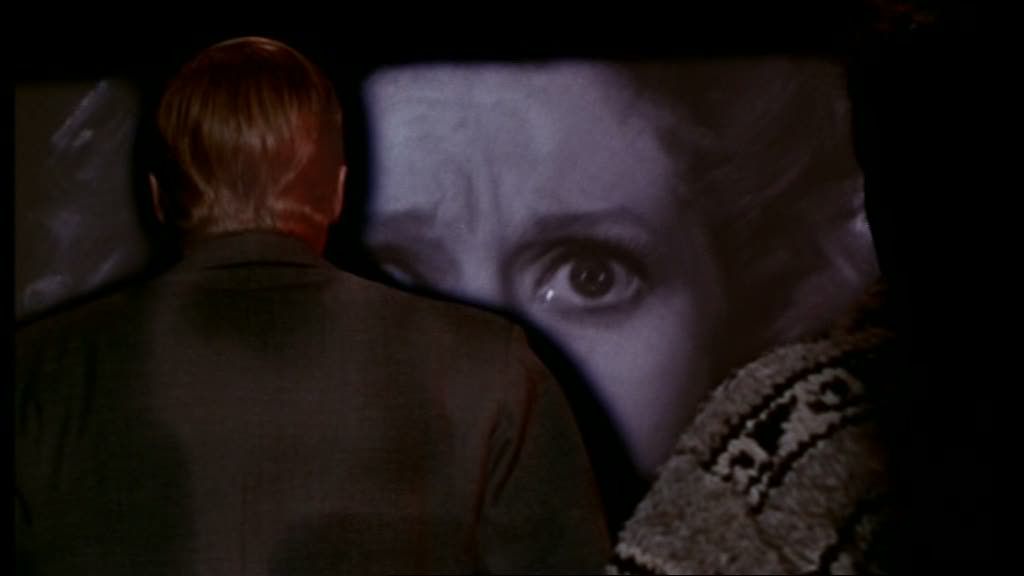
Even so, Peeping Tom retains much of its power for making audiences squirm, tapping in as it does to the psychosexual undercurrents of the cinema, the appeal of the glamorous actress posing for the cameras, the appeal of the action and horror that makes audiences react viscerally. For Mark, the cinema is a mortuary, a method of embalming. When watching one of his films, as he approaches the screen, the face of a screaming woman is stretched out across his back, and where this happens her pretty face becomes skull-like, gaunt with black eye sockets, killed within the camera's trap. This, Powell suggests, is the real horror lurking within the empty entertainment of the movies.

Sabotage


Alfred Hitchcock's Sabotage is best known for a plot device that Hitch himself regretted using, a suspense sequence that the Master of Suspense later deemed a failure in his oeuvre. Indeed, the film is dominated by this particular set piece, a lengthy scene in which a young boy carries a package across London, not knowing that there's a bomb beneath the unassuming brown paper wrapping. The boy is Stevie (Desmond Tester), the younger brother of Sylvia (Sylvia Sidney), and he was given the deadly package by his sister's Eastern European emigré husband, Verloc (Oskar Homolka). Verloc is a saboteur, working against the British war effort at the behest of shadowy employers who urge him towards increasingly horrible crimes. When his initial acts of sabotage, like disrupting London's electrical power for a few hours, are deemed "laughable" by his superiors, Verloc is instructed to deliver a bomb instead.

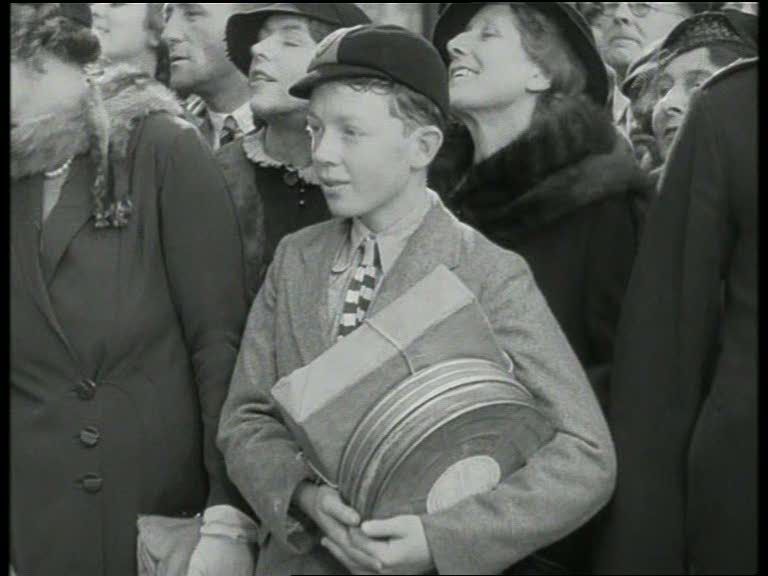
The sequence in which young Stevie carries this package across town for his sinister brother-in-law is a typically masterful Hitchcockian suspense set piece, despite Hitch's later disavowal of the scene. The tension builds steadily as Stevie is continually delayed in his journey. He was told to get his package to a cloak room by a certain time, but obviously not told why or what was inside, so he doesn't really feel the urgency of the mission. Instead, he dawdles along the way, admiring the goods at an open-air market, getting pressed into a toothpaste demonstration by an aggressive street hawker and stopping to watch a parade that prevents him from crossing a street. Throughout the sequence, Hitchcock frequently cuts back to the package that the audience knows carries a sinister cargo, and also inserts shots of clock faces to show the passage of time as the minute of the bomb's detonation ticks slowly closer. It's a harrowing scene, and by the end each stoplight, each delay that keeps the boy from his destination, only makes the pulse pounder harder and faster. As the final moment draws closer, the cutting accelerates, faster and faster, until the economical final montage: a few quick shots of the package in the boy's arms, followed by a shot of the tram he's on exploding.

This shocking denouement destroys the audience's expectation that a filmmaker would never kill off an adorable kid so callously — especially after really jerking on the audience's heartstrings by having a cute little puppy playing with the boy in his final moments. It's a startling and horrifying scene, and in fact Hitchcock was probably right to disown it despite its undeniable power; it unbalances the film, elevates its stakes to a level that it would be pretty much impossible for a light thriller to justify. In the aftermath of this scene, the film struggles to find its feet again, and never quite does. Actually, Hitchcock is never really able to conjure up much credible drama here at all. Verloc is being investigated by the Scotland Yard detective Ted Spencer (John Loder), who poses as a vegetable seller and constantly hangs around outside the cinema Verloc owns. Ted takes an interest in Sylvia, who's married to the older Verloc not out of love but because he's good to her brother and provides them with stability and security. It's a familiar 30s story, the romantic triangle of the young woman, the handsome man her own age, and the older man who she respects and feels indebted to, here given a twist by making the older husband a sinister, criminal figure.


The plot is relatively inert, since from the beginning the audience knows that Verloc is a saboteur working for a foreign power, that Ted is a detective, and that by the time the film is over Sylvia will have to realize what's going on with her seemingly harmless husband and switch her affections to the other man. With not much happening on the story level, Hitchcock gets as much as he can from the pure visual storytelling possibilities of the situation. In fact, at times the film seems to consist of little besides exchanges of charged glances and slowly tracking dramatic closeups. Hitchcock encodes the drama in alternating closeups, focusing on the eyes: Sylvia looking suspiciously at her husband, wondering what's going on with him as strange men meet with him in the cinema's back room; Verloc glaring, his heavy brows arched as he contemplates his next devious and desperate step.

This approach reaches its apex in the climactic dinner scene after Stevie has been killed in the explosion. Sylvia knows what happened and about Verloc's role in it, and as Verloc cravenly tries to act as though everything is normal, Sylvia's eyes are burning holes in him. Hitchcock accentuates the tension by patiently drawing out the moment, capturing that look of hatred and rage in Sylvia's eyes, and honing in on the details that reveal what's going through her mind. Hitchcock's camera pinpoints her fingering her wedding ring, thinking about what it now represents, and eyeing the knife she's using to serve dinner, thinking about what other uses it could be put to.

Despite the dark material, Hitchcock also still finds some space for comic relief and humorous asides. Sometimes these diversions come in the form of offhand jokes, as when a couple walks by during Verloc's rendezvous with an enemy agent at an aquarium, and Hitchcock takes the opportunity to toss in a joke about oyster sex changes. But there's also the character of the bomb-maker A.F. Chatman (William Dewhurst), who disguises his real profession behind the front of a pet shop and quarrels with his bitter daughter (Martita Hunt), implicitly insulting her right to her face. It's deliciously funny, naughty material, and Dewhurst delivers a juicy performance in a small role, clearly having fun with this nebbishy terrorist. Indeed, the performances in general — excepting perhaps Loder's thankless role as the bland Ted — are strong, from Homolka's vaguely foreign evil to Sidney's wide-eyed innocence, reminiscent of fellow Hitchcock heroine Nova Pilbeam. The film falls apart after Stevie's death, struggling to find the proper tone and ultimately finding that there is no way to salvage a lightweight thriller after such a devastating event. But even so, Hitchcock's keen eye for entertaining performances and subtle visual storytelling keeps the film interesting even when it's not wholly satisfying.

TOERIFC: If....

[This post is prompted by The Oldest Established Really Important Film Club, which will be spotlighting a different blogger-selected film every month. This month's selection is courtesy of Pat Piper from Lazy Eye Theatre. Visit his site to see his thoughts on the film and to join the main discussion.]

Lindsay Anderson's If.... is a harsh, uncompromising nightmare vision of British society as a culture unhealthily obsessed with tradition, locked into brutal, nearly fascist rituals and a blind, cowering respect for authority. Set in a British boys' college where the discipline is draconian and completely without rationale, the film examines the peculiar pressures placed on young men in a society where militaristic virtues such as loyalty, obedience, servitude and conformity are held up as the example. This school establishes a rigorous chain of command, selecting the most obedient of the older boys as "whips," who then become disciplinarians, keeping the younger boys under control. The result is that the school seems structured not so much for real education as for indoctrination and control — the only thing these boys are learning is that, in order to get by, they must learn the rules by rote, parrot back what they're told, never question orders, never think for themselves. Anderson juggles multiple storylines throughout the first half of the film, showing the way the school is run from multiple perspectives.

Jute (Sean Bury) is a new boy in the school, and he provides the newcomer's perspective in the early scenes, looking at the chaos around him with wide, terrified eyes. He is quickly taken under the wing of another boy, who impresses upon him the importance of obedience, of learning the rules quickly and being able to pass the complicated tests that will be imposed upon him. Jute is the film's icon of innocence, a usually silent and cherubic witness to the horrors around him, confused and disheartened by what he sees, unwilling to be shaped into the cold, brutal thing that this place seems design to churn out. There are other boys drifting around the film's edges, too, mostly stock types like a scrawny loser who's constantly being beaten up, a fat kid, and a quiet intellectual who generally buries himself in his telescope or his studies. But the film quickly centers itself around the school's trio of rebellious outcasts, the three friends who refuse to conform, who refuse to bow politely before the pointless discipline and cruelty of this place. Mick (Malcolm McDowell) is the de facto leader of the trio, with Johnny (David Wood) as his best friend and co-conspirator, and Wallace (Richard Warwick) as their somewhat slow-witted, dopey buddy. These three boys have the only reasonable reaction to the absurd regulations of power-hungry whips like Rowntree (Robert Swann) and Denson (Hugh Thomas).

Anderson presents this college as a nasty, suffocating place, piling on one infuriating incident after another until it seems obvious that something has to break, that no one could sustain this much tension and pressure. There is more than a hint of the absurd here, too. The whips are fey and masochistic, fingering their canes as though they'd really love to use them at any moment. They shout at the students to stop talking even before anyone has talked, as though always anticipating some minor infraction over which they can exercise their power. They survey their fellow students in the lower levels like military drill inspectors, advising them to cut their hair, making sure they're docile and ready for bed at the proper time, and capriciously confiscating any trivial item they deem unnecessary. The teachers are no better. The headmaster (Peter Jeffrey) is a pompous elitist who seems to fancy himself an education reformer, adapting to new times, when in fact his school is run like a barbaric Middle Ages prison. He leads the whips around the grounds at one point, boldly orating about the necessity to encourage creativity in young minds, to enlighten the next generation, to prepare them for life. His words are hypocritical, of course, considering his audience — the brutish thugs whose job it is to beat and suppress the younger students — and his spiel about education is especially empty when contrasted against the scenes in actual classrooms.

The teachers, for the most part, barely engage with their students. A professor of mathematics marches around the room intoning abstract phrases about geometry, lessons that can have no real meaning without demonstrations and diagrams, and yet he randomly stops every so often to ask a student if he understands. Then, even if the poor boy says yes, he slaps him in the head, or molests him in some way, at one point worming his hand inside a boy's shirt to caress his chest. Anderson's style is exaggerated and absurd, presenting these shocking, over-the-top images side by side with more naturalistic and conventional presentations of college life, the brutality and oppression of students guided by pointless rules. The result is metaphorical more than realistic: Anderson views education as a process of molesting and deadening the minds of the young, so he presents the education system in his film as literally abusing and violating the children it's supposed to be teaching. Only one teacher here even tries to engage his students, talking about the power of fascism and asking the students if they believe that fascism arises because of one powerful, evil leader, or because of a whole society of docile, casually evil people. As if to prove his point, the students simply stare back at him, uncomprehending.


This question is a central theme of the film, particularly in its final acts. The film slowly slips more and more into an absurd, surrealistic dreamworld in its second half, particularly after Mick and Johnny go out on a trip to town. The two boys steal a motorcycle, riding through the lush, open green fields of the countryside, laughing as the speed blurs their faces; it's a potent image of freedom in a film where these boys are hemmed in on all sides by oppression and a denial of free will. At an empty offroad café, the two boys meet a young girl (Christine Noonan), a waitress who will turn out to be a pivotal and mysterious presence, gently nudging the film into the spiraling surrealism of its denouement. At first, her confrontation with Mick and Johnny is utterly prosaic and nearly silent, as the boys snarlingly order coffee and Mick tries to grab her for a kiss, getting violently slapped for his efforts. But then the tenor of the scene abruptly changes, as the girl begins seducing Mick; they act like tigers, snarling and clawing at one another, rolling around on the floor tearing at their clothes, until suddenly their clothes disappear altogether and the girl is biting Mick's arm. The whole interlude is over as suddenly and inexplicably as it began: a lurid and transitory dream vision of animalistic sexual release. It's a true down-the-rabbit-hole moment, signaling the film's increasing departure from reality into a netherworld of dreams and nightmares.

The girl, who periodically reappears without explanation as an icon of freedom and sensuality for the three rebel boys, leads them into the final act of the film, in which the school is taken over by militaristic fervor. Generals and bishops visit, along with distinguished men and women dressed up for some pomp and circumstance, while the students, now dressed as soldiers, march around in formation, chanting and playing tightly controlled war games with paintball guns and firecrackers. This, Anderson suggests, is what this kind of oppressive conformity is grooming people for: to be soldier-automatons, ready to die for God and country, always willing to obey, never questioning orders. Only Mick, Johnny and Wallace really stand out, refusing to go along with this absurdity: while they lounge around in exhaustion, bored with this ritualistic violence, other students teach each other the "scream of hatred" that's yelled out when charging one's enemies. Then, just as these war games are starting to die down, the three boys begin shooting real bullets at the administrators and teachers, finally shooting and then bayoneting a priest in a general's garb. Absurdly, the boys are given a slap on the wrist for this offense, and asked to apologize to the dead man's corpse, which is kept in a wooden drawer in the headmaster's office and sits up to shake their hands before lying back down, playing dead. Obviously, the film has departed from reality by this point, increasingly existing in a fragmented fantasy in which these boys are finally able to strike back at their oppressors, using the headmaster's much-vaunted creativity and imagination to fashion an alternative world, one in which they're actually free.

The paradox, of course, is that having been themselves created by an atmosphere of cruelty and violence, the only freedom they can imagine is the freedom to wage war. The film's final scenes are a horrific vision of anarchy and destruction in which the rebels and the authorities (the latter represented, cartoonishly, by stereotyped authority figures like generals and bishops, as well as a knight in armor) go to war, everyone handling submachine guns as though they were born to. This anarchic finale suggests burning everything down to start anew, but Anderson's vision is more nuanced than Mick's punk rage. There's a moment earlier in the film that suggests a more utopian possibility for change, when Wallace's graceful exercises on a high bar halt a gym class, as the younger students, including the gay Phillips (Rupert Webster), stare at him in awe and admiration. The scene is staged in languid slow motion, as the younger students watch the fluid movements of the older boy as he spins around the bar, his body curling up and unfurling like a jackknife. There's a sense of wonder in this scene, a sense of real connection, that presents an alternative to the violence, hatred and disconnection that's everywhere else in this film.

This scene, like many others dotted throughout the film, including the café scene, is shot in black and white, which Anderson randomly intersperses with the color footage, creating disjunctions that call attention to the film's essential unreality. This approach separates Anderson's If.... from its obvious black and white influences, Zero For Conduct and The 400 Blows, the seminal French films of youthful rebellion and authoritarian oppression. Anderson nods to those films, but tweaks their verité aesthetics by often setting his most disjunctive and surrealist scenes in black and white, reversing the usual conventions about black and white stock versus color. Elsewhere, during a church service that's shot in black and white, Mick looks up briefly and sees a stained glass window in dazzling, brilliant color, a sudden vision of spirituality and clarity to offset the numbing banality of this college. This is a startling, utterly original film, a potent and unrestrained critique of a society seemingly teetering on the brink of fascism. Anderson is spitting in the face of the establishment, crafting a film as rebellious and revolutionary as his proto-punk protagonists.

War Requiem


Derek Jarman's War Requiem is a potent, poetic visualization of composer Benjamin Britten's grandiose anti-war composition of the same name. Britten's epic choral music, written in 1962 and recorded with Britten as conductor in 1963, incorporates Latin texts along with the poetry of Wilfred Owen, a British soldier who served during World War I and was killed in the final week of the war. Owen's posthumously published poetry captured the experience of war with a combination of romanticism and unvarnished realism, and Jarman's film is similarly conceived. The film is entirely dialogue-free, relying on the juxtaposition of Britten's music, Owen's poetry and Jarman's ripe imagery. During the prologue, Laurence Olivier appears, in his final role before his death, as an old soldier, also in his last days, reminiscing about his long-ago wartime experiences with his nurse (Jarman regular Tilda Swinton). On the soundtrack, Olivier reads one of Owen's poems. The remainder of the film is set to the entirety of Britten's War Requiem with no other sound, which was a requirement imposed upon the film by the holders of the recording. Nevertheless, Jarman makes brilliant use of this music, setting Britten's sweeping orchestrations and vocals against a collage of images, archival war footage and semi-narrative vignettes.

Tilda Swinton reappears in the body of the film as a wartime nurse, and much of the action cuts between her tending to patients and various scenes with Wilfred Owen (Nathaniel Parker) and other frontline soldiers played by Sean Bean and Owen Teale. Jarman's dialogue-free storytelling is lyrical and haunting, capturing the feel of war, its horror and misery, both for those in the middle of it and for those waiting elsewhere for news of their loved ones. These soldiers are dirt-smeared, caked in mud and blood, lying in piles to sleep, huddled together; there's a certain homoeroticism in Jarman's depictions of soldierly comradeship, inspired by the homoerotic subtexts in the poems of the possibly gay Owen. These men, suffering together, take comfort only in each other's presences, and in the periodic letters they receive from home. In Jarman's vision, there is no meaning to war, no advances or victories or even concrete battles: he shows only the aftermath, the men bleeding and dying, the muddy survivors lounging around in their bunkers, blank-eyed and exhausted, or the wounded, shell-shocked men who fill up the beds of the hospitals.

Interspersed with these scenes are memories of pre-war happiness, shot by Jarman in his characteristic grainy, hazy super-8 to contrast against the crisp formal quality of the wartime scenes. For these men, their memories are thus rendered ephemeral and indistinct against the hyper-real present of the war, and yet the past seems even sweeter for its gauzy imprecision. These memories are often simple, just glimpses of domestic tranquility, like a soldier helping his mother fold laundry. In other scenes, children play at war, making a game of it, not understanding that one day they will see its horrors for real. In one of the film's most haunting sequences, a group of children hold a warrior's funeral for a beaten-up old stuffed teddy bear: they place the bear in a red-lined coffin with solemnity and pomp, then lay it on a pyre of burning leaves, crying as they say goodbye to their beloved toy. It is a child's memory of a ritual that would later be enacted as an adult, with friends lost and buried instead of toys.


The film also incorporates a great deal of religious imagery, making a metaphor of Abraham's sacrifice of Isaac. Jarman imagines Abraham (Nigel Terry) killing his son (Parker again) to the applause of corpulent businessmen in theatrical makeup, smoking fat cigars — the angel's last-minute change of plans goes unheeded in this version of the story. The film inventively recontextualizes the Biblical tale as a metaphor for war, as fathers send their sons off to war, to be killed on the basis of vague orders from above, all for the benefit of the wealthy classes, who profiteer as the blood of the young flows through the trenches. Later, the soldiers evoke another Biblical sacrificial figure, donning crowns of thorns as they carry the dead and wounded through an apocalyptic wasteland of burnt-out fields and rubble.

Jarman's imagery, without telling any particular story, nevertheless manages to capture the one larger story of war: the companionship of the men at the front, the letters home, the friends who die and are mourned. His dialogue-free storytelling and vague characters suggest that all wars have only this one story: young men suffering and dying and losing the people they care about. In the film's final half-hour, Jarman largely switches from depictions of individual soldiers to a more generalized image of war itself. Using archival footage of various conflicts, stitched together into an increasingly frantic, frenetic montage as the pace of Britten's music accelerates, Jarman moves smoothly from the suffering and death of the individual soldier to the horrors of war as a whole. He splices together images of soldiers dying all over the world, representing different nations, different races and ethnicities, different conflicts. But they're all dying or dead, all of them ripped apart, bleeding bright red, their brains exposed within their split-open scalps, as the cannons fire, different guns, new developments in warfare, all of them intended to cause more and more fiery death. This montage reaches its seeming climax with an image of the atom bomb exploding, an apex of horror, but then the collage of dead soldiers merely resumes, as though to confirm that the dropping of the bomb was not a horror to end all horrors, but merely one more especially devastating entry in the 20th Century's massive death toll.

Another of the film's most poignant sequences is more personal, a lengthy closeup on Tilda Swinton during a particularly elegiac movement of Britten's piece. The shot opens with Swinton braiding her long red hair, her eyes staring blankly off into the distance. As Jarman holds the shot, his camera gently bobbing, reframing Swinton's distinctive face, she begins swaying with the music, closing her eyes and mouthing the lyrics. It's the only moment in the film in which the images and the music are explicitly synced in this way, and it drives home the agony of those waiting at home for news of a soldier, as Swinton soulfully dances in place with the music, its melancholy tones moving her body, her graceful limbs arcing in balletic sweeps over her head as she's overcome with grief and the bittersweet smile of nostalgia. These complex emotions, the emotions of war and its aftermath, are at the heart of Jarman's intense, affecting film.

Films I Love #34: The Angelic Conversation (Derek Jarman, 1985)


Derek Jarman's The Angelic Conversation is the purest and greatest of the filmmaker's experimental works, a lyrical, abstracted visualization of the love sonnets of William Shakespeare. Shakespeare's poems, long thought to have been addressed to an anonymous young man, are read aloud on the soundtrack by Judi Dench, accompanied by the expressive ambient industrial music of Jarman's collaborators in Coil, who intersperse their chiming electronic tones with sloshing water sounds and other field recordings. This music — my own introduction to the film, since as a Coil fan I owned the soundtrack long before I ever saw the film itself — is haunting and ethereal, a perfect complement to Dench's mannered readings and the ghostly beauty of Jarman's images. The film constantly suggests the outline of a story, but it is nevertheless largely non-narrative, simply following several young men meandering through desolate, rocky terrain or performing arcane rituals with fire and reflective metals. Jarman shot the footage on 8mm film stock and then blew it up to 35mm, giving everything a fuzzy, grainy, blown-out quality, with extreme contrasts between muddy shadows and blinding flashes of light and color.

The imagery is some of Jarman's most sensual and layered, gorgeous images in which nothing much is happening beyond the play of light on skin, the jittery slow motion that animates these figures, the mutations of a flickering flame played out in closeup frame by frame. The film is an ode to the sensuality and dark beauty of love, and particularly, unsurprisingly, of gay love. Torches flare and pulse in dark caves. Men walk through scorched, foggy landscapes carrying heavy burdens on their backs like Christ. Strange rituals are performed by men whose skin is turned a pale gray by Jarman's video processing; allusions to mythology and spirituality are encoded in these bizarre, stagey interludes. Violent wrestling and struggle slowly softens into caresses and embraces, hatred becoming love. This is a stunning, deeply affecting film, a masterful translation of Shakespeare's evocative sonnets into a series of abstract vignettes whose mystery and suppleness matches the evocative lyricism of the Bard's verse.