Showing posts with label Film of the Month Club. Show all posts

Sink Or Swim


[This is cross-posted with the Film of the Month Club, where I have selected this film as November's topic of discussion. Comments are turned off here so that all the conversation can take place over there.]

The title of Su Friedrich's autobiographical essay-film Sink Or Swim comes from the implied moral of one of the stories she tells about her relationship with her father, a robotically unemotional, distant, authoritarian figure for whom she holds very ambivalent feelings well into adulthood. In the story, she tells her father that she wants to learn how to swim, so he takes her to the deep end of the local pool, sits her down to explain the mechanics of swimming, and then simply throws her into the water to figure it out for herself. The lesson is obvious: learn to swim, or sink like a stone. This is a shocking story, a horrifying account of a father whose behavior towards his children at times verges on (or even crosses the line into) outright child abuse. And yet Friedrich presents the tale, as she does everything in the film, with a cool, even tone. The film is sporadically narrated by a young girl (Jessica Meyerson) whose childish, hesitant reading of the voiceover text gives the film the aura of a nostalgic ode to childhood, an impression that works against the sometimes horrific nature of the material being remembered. Friedrich deliberately distances herself from these intensely personal stories, searching for universality in her own life. The film is more than anything else an attempt to process and explore the ways in which childhood experiences shape a person's thoughts, attitudes, and outlook later in life.

The film is rigorously divided into twenty-six uneven parts, each of them corresponding to a letter of the alphabet, which proceed in descending order through the titles of the segments: "Zygote," "Y Chromosome," "X Chromosome," "Witness," and so on. This is the logic of childhood, attempting to arrange complicated events into nursery rhyme containers, a conceit that shows up in the soundtrack as well when the narrator murmurs sing-songy children's tunes or recites schoolyard poetry. The structure is complex and subtle, with texts and subtexts running in parallel through the visuals, the narration, and the one-word titles, which appear as onscreen text announcing each new section. The relationship between these three elements is complicated, sometimes coming together to enforce one another and enhance the overall point, while at other times the separate elements are telling different stories.

Early on, in a section titled "Utopia," the voiceover relates how Friedrich (always referred to as simply "the girl" from the film's third-person viewpoint) and her sister were not allowed sugar or TV as children, and how they got to indulge each of those luxuries once a week at a neighbor's apartment. There, the girls would get ice cream sundaes, sit in the dark and marvel at a televised circus. Friedrich accompanies this story, naturally enough, with circus images, but there is an undertone of forbidden sexuality in the images that is not present in the young girl's narration: a pair of circus performers, two shapely girls with horse tails and bare bottoms cavorting around; closeups on acrobats and strongmen whose form-fitting outfits emphasize their muscular bodies. This suggestion is carried over into the next section, "Temptation," which transitions naturally from the toned, athletic bodies of the circus performers to a closeup on the bikini-clad torso of a woman bodybuilder, while the voiceover describes the Greek myth of Atalanta and Hippomenes. The relationship between the images, titles, and voiceover in these two sections suggests an unspoken narrative beneath the text: the development of lesbian desire interwoven with a childhood fascination for mythology (those powerful, statuesque goddesses) and the carnivalesque. In this way, Friedrich explores the ways in which the child flows into the adult, without venturing into simplistic cause-and-effect chains. Rather, the film's unique structure allows her to view her life as a continuum, to see traces of various threads in her life as they develop through her personal obsessions and interests over time.


Among these, the most important thread is obviously her relationship with her father — and from that, the notion of fatherhood and parenthood as a generic concept. Friedrich explores this subject in many ways. Throughout the film, the voiceover returns periodically to stories about her childhood, usually illustrated with images that are only obliquely related to the story being told. The thrust of the film is to make its highly specific narrative more universal, to move away from this specific girl with her distant, somewhat abusive father (who ultimately leaves the family when Friedrich is around 11 years old). She is not talking about herself; she is talking about "the girl" and "the girl's father." And her images are often just as generic, just as timeless. She pairs the swimming anecdote with peaceful images of a community pool and the kids swimming in it. There is nothing to suggest the deadpan horror of the story itself. Later, after her father leaves, she describes her mother's erratic behavior, dispassionately recounting a scene where her mother placed Friedrich and her sister on a windowsill, high above the ground, and threatened their father, down below, that they'd all jump to their deaths. The father, true to his nature, simply stares at them, shakes his head, and walks away. This harrowing, unbelievable story (appropriately contained in a section called "Insanity") is accompanied by prosaic images of a hospital, suggesting the mental breakdown of Friedrich's mother following the divorce. When the story reaches its climax, the camera pauses, looking out a window, an unpopulated view substituting for the emotionally fraught content of the story.

This distanced, objective approach reaches its logical endpoint in the section entitled "Ghosts," which consists entirely of a static shot, manipulated to be a negative image, of a typewriter as Friedrich writes a letter to her father. Since the image is a negative, her words show up white on black paper, accompanied only by the sound of the typewriter. This is the most direct section of the film, in many ways: the only one in which Friedrich uses the "I" and discards the third-person disguise of the narration, and also the only one in which there is some direct sound. Throughout the rest of the film, the soundtrack is almost clinically clean and polished; whenever the voiceover pauses, which is frequently, there is complete silence. There's an aesthetic purity to this approach, and Friedrich only rarely compromises the soundtrack's dichotomy between minimal speech and absolute silence: in the "Kinship" section, she accompanies images of travel and a lesbian shower scene with a Germanic opera piece that her mother loved, and in "Ghosts" the typewriter clicks and clatters above a backdrop of tape recorder hiss, an intrusion of noise into the film's austerity. The text in "Ghosts," typed rather than spoken, is more directly autobiographical than the voiceovers, shedding the artifice of "the girl" to speak directly about how Friedrich's mother reacted to the divorce. It is the film's most personal and unmediated segment, but it is also aesthetically remote, forcing the audience to actively read this story as the words appear one by one, rather than simply listening as they had to the others. Even while briefly stepping closer to the material of her story, Friedrich makes sure that she does not eliminate the artifice that constrains her autobiography into a form where she can explore and examine it at will.

Throughout the rest of Sink Or Swim, Friedrich deals with her father's legacy in a more indirect, objective manner. One segment approaches him by discussing a book he wrote, which posited that the goddesses Aphrodite and Demeter, representing romantic love and motherhood, were once aspects of a single feminine diety, who was split in two because of men's discomfort with the dual nature of women. Friedrich cleverly illustrates this essay by alternating between pieces of art that could represent the two goddesses and their distinct aspects: for Demeter, Christian iconography showing the Madonna and child, and for Aphrodite, Japanese erotic prints. Friedrich subtly accentuates the surprising similarities between the two forms of art, bolstering her father's argument by transitioning from an image of the baby Jesus suckling at his mother's nipple to a much filthier image of a man nestling in his lover's breasts. In another scene, she attempts to understand her father in anthropological terms, filling the screen with a family diagram that traces her father's progress from Wife #1 to Wife #2 to Wife #3, but obviously explains little. Meanwhile, the sequence "Homework" is completely silent and consists only of images from 50s family sitcoms, showing a scrubbed, smiley vision of family happiness through a haze of static and video distortion. Friedrich lets these images sit without commentary, the media fantasies of fatherhood and family violently disconnected from her own experiences. The film fits all of these varied approaches and aesthetic techniques comfortably into its formal structure, as Friedrich uses all the means available to her to better understand and express the feelings and ideas brought up by thinking about her father.
November Film of the Month: Sink Or Swim (Su Friedrich, 1990)

Head on over to the Film of the Month Club, where I've been asked to select November's pick for people to watch and discuss. This whole month, we'll be discussing Su Friedrich's Sink Or Swim, a deeply personal and formally imaginative autobiographical essay made by Su Friedrich in 1990. It's a rumination on her childhood, and especially her relationship with her father. You can get the full details at the Club's site. I'll be cross-posting my writings about this film at both blogs all month long, starting later this week.

Chaotic Bodies: The Firemen's Ball Beauty Pageant (part 2)


At the Film of the Month Club, I have now posted part 2 of my visual essay about the beauty pageant sequence of The Firemen's Ball, the first part of which is here.

Continue reading part 2 at the Film of the Month Club

Chaotic Bodies: The Firemen's Ball Beauty Pageant (part 1)


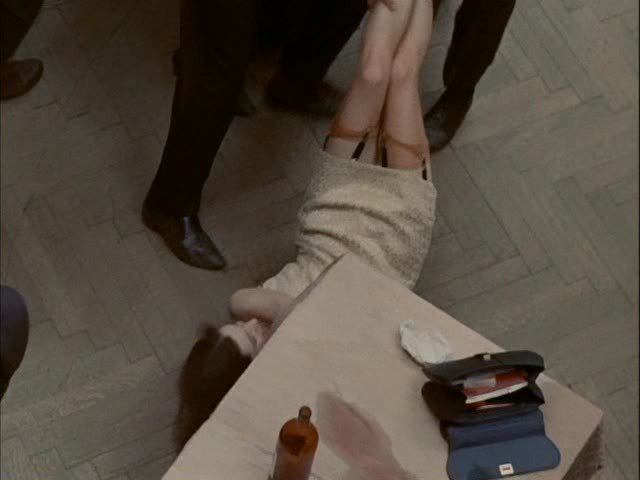
In The Firemen's Ball, Miloš Forman makes extensive use of a very crowded mise en scène in order to make his points about the absurdity and chaos of collective action in socialist societies. His frames are frequently packed with people, often moving rapidly and creating chaotic compositions that reveal isolated body parts and motion-blurred imagery. And yet, although Forman is attempting to capture the sense of chaos, his compositions still have a certain formal logic to them that defies their snatched-on-the-fly quality. This is especially true in the film's sublime beauty pageant sequence, a hilarious set-up in which the contestants all flee while the men in the audience attempt to capture them and, eventually, begin dragging entirely unrelated women on stage as well. This scene is particularly well structured despite its chaotic appearance, and Forman's formal and thematic concerns show through even in the most seemingly tossed-off visuals from this sequence.

Continue reading at the Film of the Month Club

The Firemen's Ball

[This is cross-posted at the Film of the Month Club, where this film is July's title, selected for discussion by Marilyn of Ferdy On Films. I am posting this general review both here and at the Club blog, and I will also be writing some more specifically focused posts on the film throughout this month, especially for the Club.]


Made just before he left Czechoslovakia for the US, The Firemen's Ball was director Miloš Forman's first color film, his final film in his native country, and also the reason he had to leave his country in order to continue making films. It's easy to see why. The film is, quite obviously to both modern audiences and, apparently, Czech censors, a thinly veiled critique of the Czech Communist Party and, more audaciously, of the very idea of collective action that underpins socialism. This is a deadpan, hilarious satire, documenting a single night at a small-town party organized by the local fire brigade, honoring their retiring chairman on his eighty-sixth birthday (they missed honoring him on the more meaningful eighty-fifth, a year earlier, in the first of many fumbles committed by this incompetent assemblage). From the very beginning, even before the credits, Forman sets the scene for the idiocy to come, as the firemen accuse each other of stealing the prizes from the night's lottery fund, and set fire to the banner that was to hang above the hall during the ball. The fact that they're unable to even operate the equipment to put out this small-scale blaze is both the first comment on the extent of their incompetence and a bit of foreshadowing for the film's surprisingly poignant climax.

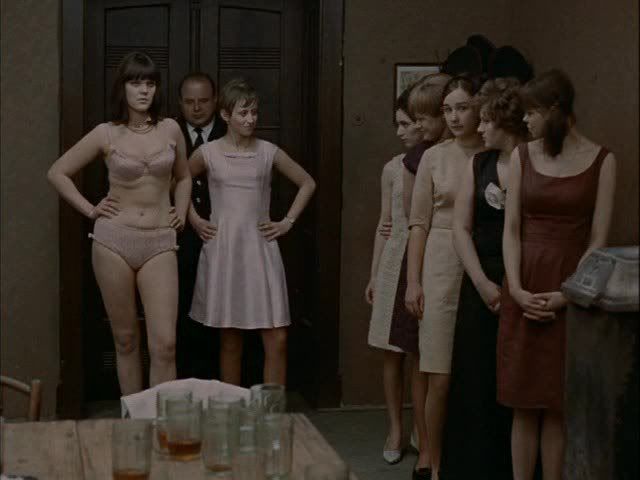
Of course, things only get worse from here. These are men who can manage to screw up the process of selecting beauty contest participants in what seems to be a ballroom positively crammed with attractive young women. Their chosen finalists are either aggressively plain or exaggeratedly awkward, like the girl who pads her bra to such an extent that her dress seems to be held away from her body on tent posts. Forman simply lets absurd scenarios like this play out in natural ways, sticking with this anonymous and ridiculous committee as they bungle their way through every aspect of the party's planning. Over the course of the evening, the table piled high with lottery gifts is slowly emptied by multiple (and unseen) thieveries, young couples copulate under tables, the chairman seems senile and lost, and keeps executing a slow, stately walk towards the stage at completely inappropriate moments, and the beauty contest itself falls apart, in one of the film's most hysterical scenes, when the contestants all get cold feet and begin fleeing.

Forman stages all this in an atmosphere of rapidly escalating chaos, as the party spirals completely out of control. His camera is intimate, casual, and perfectly attuned to the spirit of anarchic insanity running throughout this room. Indeed, Forman often seems to be taking gleeful pleasure in the lunacy going on everywhere. His mise en scène encompasses, essentially, two different visions of collectivity: the ordered committee action of the party organizers, and the wild, unfettered anarchy of the party itself. For Forman, both of these possible outcomes are equally absurd, and both are clearly tied to aspects of Communist society — just as the fire brigade stand in for the Communist Politburo, the partygoers are the proletariat, trapped within an absurd situation with absurd leaders, and forced by these circumstances to act in dishonest and despicable ways. This is a system that privileges dishonesty. Confronted with the fact that all the lottery prizes have been stolen, the fire committee decides that the people who didn't steal will just have to think of it as if there was a lottery and they didn't win. After all, everyone bought tickets; those who stole the prizes were simply the winners. When one of the committee members has an unusual attack of guilt and is caught attempting to return a stolen prize, his comrades are angry at him, not for stealing (that's expected), but for trying to return the prize, thus damaging the reputation of the fire brigade.


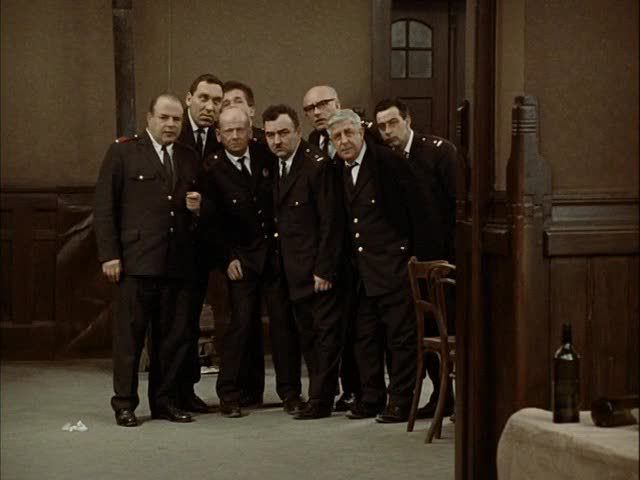
Forman's framing of the fire brigade inevitably enforces the point that they are nominally in charge but crippled by their indecisiveness, incompetence, and corruption. The group is almost always photographed together, seldom with the members isolated from one another for any length of time — the exception is when the one member has his moment of repentance. Most of them are not even given names. They are anonymous figureheads, an idealized group that acts together with no trace of individuality. Or so goes the Communist theory, Forman seems to be saying wryly. In practice, his head-on depictions of these men, massed into groups, projects an image exactly the opposite of the unity and collective action that is the ideal of socialist politics. As they cluster into tight formations, staring tentatively and fearfully at the camera, they look lost, like scared individuals trying to hide within the safety of a larger group. Forman's perspective, his deadpan camera angles and his objective distance from the assembled old men, gives them a pathetic quality that's heightened, not lessened, by their collectivity. It's this subversive questioning of collective action that is most radical in Forman's film, and is probably what the Czech censors responded to the most ferociously, even if it only registered with them subconsciously.

Not that "the people" make out any better here. The leadership may be idiotic, but the people they're leading are stubborn, unwilling to be led, and forthrightly dishonest. If Forman's vision of committee leadership is marked by its static angles and clustered compositions, his party scenes have a wildness and spontaneity that presents the reverse of this rigidly absurd group leadership. These scenes are chaotic accumulations of bodies whirling and flying past, often broken down so that only body parts can be seen. Individual shots focus on the legs of the dancers, or their arms and torsos in the midst of a frenetic riot, or their amassed heads in a sea as they listen to a speaker on stage. Best of all is the complete breakdown of order that accompanies the beauty contest, as the contestants run away and the crowd quickly degenerates into chaos, with crowds of guys attempting to corner the women and drag them on stage, throwing girls over their shoulders, even roping in girls who hadn't been in the contest to begin with. It's a masterpiece of completely unrestrained society, "the people" breaking loose of their inept masters and having fun watching the destruction of their social order. But Forman's editing in this scene is also surprisingly crisp, his images maintaining the perfect economy of his more structured compositions even when the stampeding revelers seem to be disrupting any semblance of order. Forman's portrait of disorder is perfectly conceived, achieved with a natural sense for visual rhythms and purely visual humor.

The Firemen's Ball is a delightful film, but also a film with a very serious heart beating beneath its surface humor. As the film's climax reveals, the incompetence of the fire brigade, which seems so comical in the context of a disastrous party, can also have serious consequences when applied to real world matters. When these bumblers are placed in charge of not a beauty contest but of public safety, the true extent of their bumbling, and its horrifying results, becomes readily apparent. This is why the sequence of the old man's house burning, placed where it is within the film, is so heartrending. As Forman cuts precisely back and forth between shots of the consuming, brilliant fire and the emotional faces of the observing crowd, the hopeless non-efforts of the firemen to extinguish this blaze are not funny, but incredibly depressing. The same could be said of the later scene where the committee members even bungle the presentation of an award to their former chairman, who is now dying of cancer. This old man's quiet dignity and patience in the face of the evening's many disasters make a mockery of the committee's ham-fisted attempts to honor him. A decent man in a corrupt system, he is entirely out of place here, and he becomes a victim as a result. This is a hilarious film, but its humor is cut with bitter satire, with a deep disgust for the absurdities of the political system of Czechoslovakia at the time.