Showing posts with label Coen Brothers. Show all posts

Blood Simple


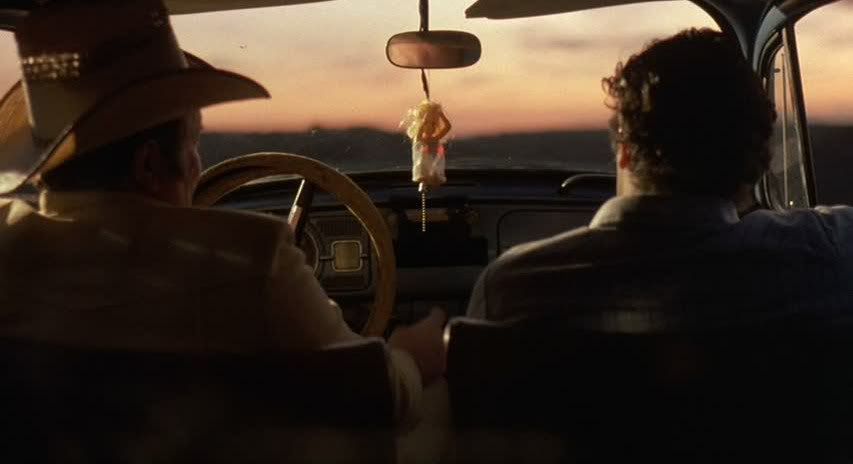
Blood Simple was the first feature of Joel and Ethan Coen, and it's a natural debut for the brothers, a darkly comic/tragic neo-noir that wallows in the greed, pettiness and stupidity of people driven by love and revenge to do terrible things to one another. In the film's opening minutes, Ray (John Getz) is driving Abby (Frances McDormand) away from her nasty, brutish husband Marty (Dan Hedaya), the owner of the bar where Ray works. Ray and Abby's love affair will trigger all of the film's grisly events, in one way or another, and the opening scene is already loaded with menace and the promise of coming tragedy. As Ray and Abby talk in the car, driving at night along a dark highway, they're bathed in pale midnight blue tones, the camera lingering in the backseat of the car, barely catching glimpses of their faces, so that their voices seem disembodied in the darkness. Abby is running away, not sure of where she's going, just sure she doesn't want to be with Marty anymore, and Ray, in his stolid way, simply keeps repeating that he "ain't no marriage counselor," but that he really likes Abby. It's obvious where this is heading, but Ray and Abby keep earnestly, nervously beating around the bush, delaying the inevitable moment when they'll fall into bed together. And the eerie mood of this scene, juxtaposed against the tenderness and vulnerability of the soon-to-be lovers, says all one needs to know about where this story will go once their affair begins.

At least, the broad strokes are apparent from the beginning. But no one could quite predict just how horribly off course this story of revenge and jealousy will go by its end, or just how many weird twists will crop up before the last drops of blood have been shed. When Marty finds out about his wife's infidelity from the slimy, smirking private investigator Visser (M. Emmet Walsh), he hires Visser to kill the lovers for ten thousand dollars. What ensues is a whole string of bloody events, most of them centered around tragic misunderstandings and acts of staggering stupidity. These people — all of them, with the possible exception of the wide-eyed, innocent Abby — are an unfortunate combination of utter incompetence and bloodyminded nastiness, and they go about slaughtering, assaulting and robbing from one another in the most ludicrous ways.

At the base of the film is the notion that people are programmed to think the worst of those around them, and that while this impulse is often proven true, again and again, sometimes it is tragically false. Ray is turned against Abby with ease, doubts planted in his soft head by the hateful words of Marty, who naturally has nothing but bile and spite for his unfaithful wife. What started as a love affair is then plagued by doubts and suspicions, by nasty words and bouts of jealousy founded on phantom fears. The unfortunate Abby barely enjoys a day of her new love before she's subjected to fights and suspicions that suggest that this new relationship is already heading down a path similar to the one that led her to the end with Marty. Abby is, however, one of those rare decent people who sometimes meander haplessly through the Coen brothers' cold, cynical universe. She is a premonition of the decency in McDormand's Marge Gunderson in Fargo, a truly good person despite some flaws, full of energy and vigor, eager to talk and to share her feelings. It's not her fault, one senses, that her wide-eyed ingenuousness inspires distrust and, eventually, hatred in the men she ties herself to. And it's not her fault that these foolish, inept men sloppily plot to kill and destroy one another with her at the center of their plots.
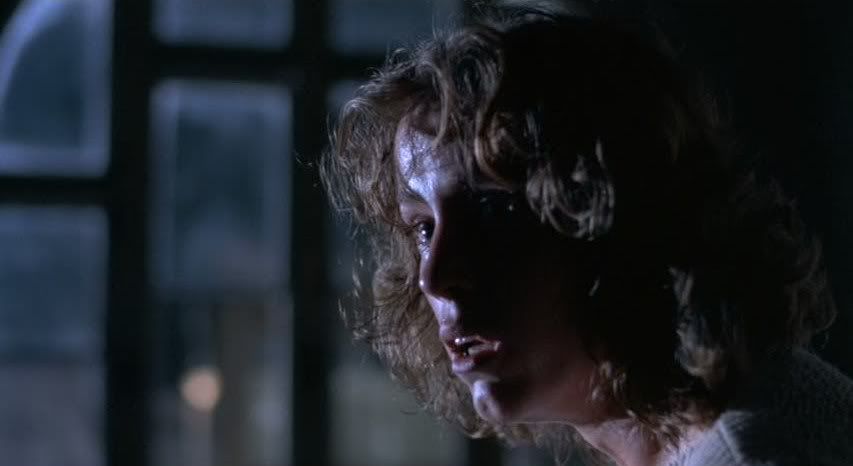

Often, the Coen brothers have been accused of laughing at their characters, holding themselves above the stupid actions of these people, looking condescendingly down on their creations as they stumble about. It's sometimes true, though that cynical attitude is softened, if only slightly, by a countervailing sense that the filmmakers are sympathetic to these characters as well, that they feel bad for these people as they destroy themselves through their base emotions and desires. In this, the Coens' first film, their worldview is perhaps especially clear, and it's obvious that if the filmmakers are laughing at their creations, the laughter is always tinged with a sad awareness of the futility of all this violence. The film opens with voiceover narration by Visser, announcing the film's themes and indeed the themes that would continue to animate the brothers' films throughout their subsequent career:

"The world is full of complainers. And the fact is, nothin' comes with a guarantee. Now I don't care if you're the Pope of Rome, President of the United States or Man of the Year; something can all go wrong. Now go on ahead, y'know, complain, tell your problems to your neighbor, ask for help, and watch him fly. Now, in Russia, they got it mapped out so that everyone pulls for everyone else. That's the theory, anyway. But what I know about is Texas, and down here... you're on your own."

That just about sums up the bleak worldview of the Coen brothers: their characters exist in an amoral universe, derived from film noir's bleak settings, in which everyone is out for his or her self, and one can't rely on help or sympathy from anyone else. Not even from the filmmakers, who watch these characters fumble around from an omniscient, detached viewpoint that suggests a God who's equally amused and disappointed by the follies of these people in their shortsightedness and petty emotions. The murders in the film are purposefully staged so that it's obvious that the characters think they're being clever, that they've planned everything out and have thought of everything. At the same time, the Coens take pains to reveal the opposite: the slip-ups, the stupid mistakes, the missing information. They highlight details like Visser's lighter, or blood spots on a car seat, or a hand touching a surface, sure to leave behind incriminating fingerprints. Again and again, they revisit the bar where the film's first murder takes place, and each time they do, with different characters, things have been changed around and each character tries to understand what has happened, to fill in the gaps in their knowledge. To some extent, the film's tragedy is caused by this lack of understanding, and by the willingness of these misguided fools to leap to conclusions and act rashly anyway.
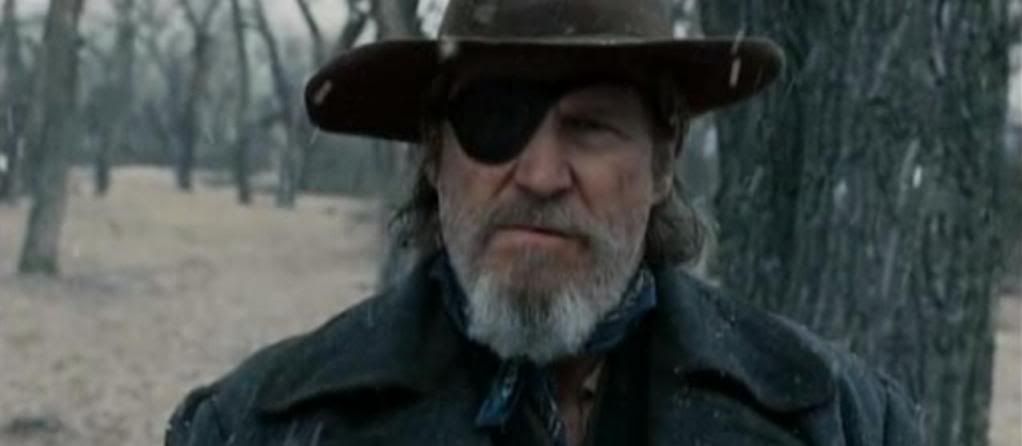
The Conversations #23: True Grit


The latest installment of The Conversations has now been posted at The House Next Door. This time around, Jason Bellamy and I discuss the Coen brothers' new adaptation of Charles Portis' True Grit, and compare their take on the material to Henry Hathaway's iconic John Wayne-starring version of the same story. We talk violence, revenge, Wayne, Westerns, the place of this film in the Coens' oeuvre, and much more. Join us at the House and be sure to comment to continue the conversation.

Continue reading at The House Next Door

A Serious Man


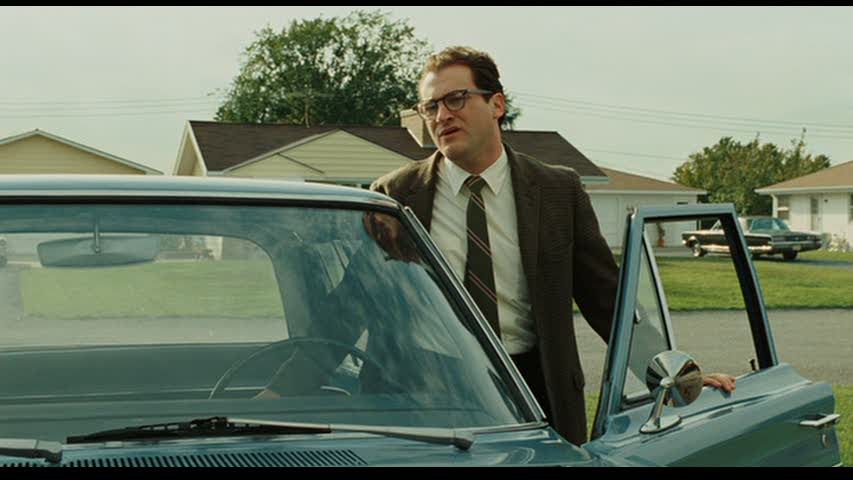
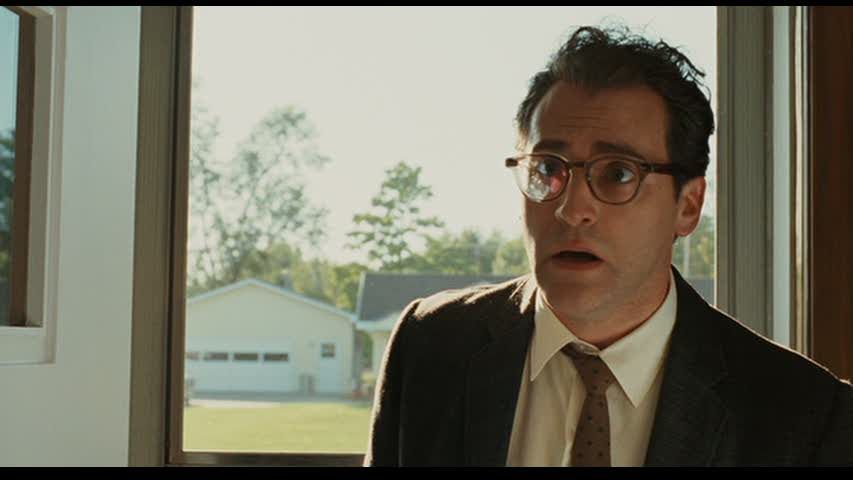
The Coen brothers' latest film, A Serious Man, is one of the duo's most challenging and confounding works — challenging in the sense that it continually defies interpretation, and perhaps even suggests that interpretation, the search for answers, is somewhat beside the point. The central character here is Larry Gopnik (Michael Stuhlbarg), a physics professor whose life is beginning to fall apart around him. His wife Judith (Sari Lennick) abruptly announces that she wants a divorce, that she's going to marry their friend Sy Ableman (Fred Melamed) instead, and that maybe Larry should move out. So he does. Larry's also hounded by his brother Arthur (Richard Kind), an obviously damaged man whose medical problems keep him in the bathroom for hours at a time, and who's devising a complicated mathematical system that he winds up using to win at gambling. At school, Larry's confronted by students who just don't understand his complicated mathematical "proofs" for physics concepts, and one student, Clive (David Kang), protests his failure and possibly offers up a bribe, though he both denies and confirms it when Larry confronts him.

Larry is a hapless man, a Job figure whose trials are fairly mundane: a mooching brother, an unfaithful wife, stress over the school's impending ruling on whether he gets tenure or not, petty conflicts with neighbors, bickering kids. He doesn't understand why he's being so tormented, why he has this increasing sense that life isn't something he lives so much as something that's happening to him. He gets wrapped up in the quest for answers, both about the big questions and the little things, but everyone keeps telling him not to try so hard. When he complains to his wife that their neighbor has been mowing part of their lawn, she spits back, with obvious annoyance, "does it matter?" Everyone keeps telling Larry: his concerns don't matter, he should relax, take things as they come, stop worrying so much.

Naturally, Larry turns to religion in order to understand his plight, moving up through the hierarchy of rabbis at his temple. The young Rabbi Scott (Simon Helberg) has little to offer besides meaningless platitudes, and he noticeably stammers to a halt when Larry reveals the full extent of the trials facing him. The inexperienced rabbi's enthusiasm melts when confronted with someone who really has problems bigger than a petty marital spat. The ancient Rabbi Marshak (Alan Mandell), on the other hand, won't even see people anymore; he simply sits silently in his study, surrounded by clutter and knick-knacks (the accumulated weight of history and tradition?) and, according to his secretary, is busy thinking. This leaves only Rabbi Nachtner (George Wyner) for Larry to get any advice from, and it initially seems like Nachtner is going to deliver. In one of the film's best and funniest sequences, he launches into an elaborate and mystical anecdote about a dentist who discovers a message, in Hebrew letters, on the insides of the teeth of a goy patient. The dentist is understandably shaken and is desperate to find answers, to know who put the letters there and why. The dentist thinks that maybe God is trying to tell him something, and for weeks he can't sleep, can't eat, can't stop thinking about what this all might mean.

This all builds up to a crescendo as the dentist comes to visit Nachtner, asking for advice much as Larry is. Larry is on the edge of his seat, eager for answers, and the brilliance of the sequence is that the audience has been placed in the same position as Larry: mystified, enthralled, eager to understand, to hear what wisdom Nachtner has to offer. So the dentist comes to visit the rabbi and... that's it. Nachtner stops, takes a sip of tea, and seems to think the story is over. And when Larry pushes him for more, Nachtner shrugs, says that he told the dentist not to worry about it, that no one understands anything, and that the dentist eventually forgot all about the strange incident and went back to living his life as though nothing had happened. This is supremely unsatisfying, but then that seems to be what the Coens are suggesting: life is unsatisfying, at least if you're looking for definitive answers and tidy resolutions, which are in short supply. Moreover, religion is unsatisfying, only fulfilling its role as a security blanket for those willing to take its vague assurances and pat answers at face value. That's not enough for Larry, who wants to know the truth, who wants to understand why things happen, why he feels so cursed.


This impulse is of course at the heart of Larry's profession; as a physics professor, he seeks to understand the universe, to code the workings of everything into complex mathematical problems that supposedly prove one thing or another. Throughout the film, Larry sees only the details, never the big picture, and the Coens highlight this by showing him crouched at his blackboard, scribbling equations in chalk. His explanations to his befuddled class are laughable: "This is this, so we can do that," he says as he scrawls letters and numbers and square root symbols across the board. As though that explains anything. These closeups of Larry at work eventually give way, at a pivotal moment, to a pullback into a wide shot, revealing Larry at the front of a classroom, dwarfed by a tremendous board on which every inch is packed with equations, which Larry explains are an illustration of Heisenberg's uncertainty principle: a whole blackboard dedicated to equations all meant to prove that we can never really know anything for sure. Larry is so desperate for answers, so convinced that there must be a logical explanation for it all, some way to figure things out in nice, clean math, that he doesn't see just how meaningless all these abstract equations are. For him, the math has replaced the real things it's supposed to be accounting for: he tells Clive, his failing student, that the real-world examples he gives in class are just illustrations, that the math is the thing. He's got it backwards, it seems, forgetting that in science all the math and numbers are meant to support and explain some observable real-world phenomenon.

Perhaps that's why the paradox of Schrödinger's cat is so central to Larry's thinking; it's the perfect illustration of how little we know, how uncertain everything about the world is. And Larry is confronted with a kind of Schrödinger's bribe when a mysterious envelope of money shows up on his desk, and Clive both implies and denies that he left it there as a bribe to get a good grade. As Clive's father tells Larry later in the film, he should simply "embrace the mystery," not try to untangle who left the money there or why, should accept that it's possible for the money to have simultaneously been left there and not left there, just as Schrödinger's cat is both dead and not dead. The Coens are perhaps subtly suggesting that religion, like other attempts to make sense of a world that doesn't make sense, is a fruitless pursuit. It's also perhaps an attempt to grapple with Judaism, with the historical perspective of Jews who believe themselves to be simultaneously "chosen" and cursed, an oppressed and tormented people beset by troubles. As one woman tells Larry, as Jews they don't suffer alone, they have history and tradition and the whole massed Jewish people to help them come to terms with their troubles — but Larry's experience suggests exactly the opposite, that the example of history has nothing to offer him. Rabbi Marshak, the oldest Jewish authority figure in the film, is surrounded by accumulated detritus, evidence of his age and experience, but he literally won't speak to anyone, won't share his knowledge with others — and when he finally does speak, towards the end of the film, it's only to quote Jefferson Airplane and enumerate the band's members, words of wisdom that resonate with Larry's stoned young son Danny (Aaron Wolff) but probably wouldn't have meant anything to Larry himself.

All of this is leading towards an apocalyptic denouement that doesn't explain anything, that never makes sense of Larry's dilemma or his religious, metaphysical and philosophical inquiries. That's the point: nothing makes sense, no one knows what it all means. If the film is somewhat unsatisfying, somewhat incomplete, as a result, hey, that's what life is like, too. The Coens are perhaps being too oblique here, even for filmmakers who notoriously refuse tidy explanations, and their film's ending is a deliberate anti-climax, a final non-sequitur in a film that relied throughout on countless such deadpan, absurdist non-sequiturs. It's an ending, and a film, designed to leave audiences thoroughly nonplussed and perhaps unsettled as well. And that's even without trying to divine the meaning of the introductory scene, in which a Jewish couple is confronted by an old man who they believe to be a dybbuk, an evil spirit.

Larry's confusion and uncertainty are also our own. This would be especially frustrating if the film wasn't so well-made, so compelling in the way it explores Larry's 60s suburban universe. All the wide-open space, the houses with carefully manicured lawns, no fences separating one tract from another. The clouds billowing in the sky, turned dark and threatening by the final moments of the film. And the faces, oh those faces: the Coens have always had a real feel for capturing personalities through deadpan closeups, and A Serious Man is possibly the peak of this approach. From the wrinkled, hound-dog visage of the teacher who confiscates Danny's pocket radio in the opening scenes, to the smug yuppie smirk of Sy Ableman, to the stoned, reddened eyes of Danny and his profanity-spouting friends, to the leathery fake tan and bitchy nonchalance of Larry's next-door neighbor, the Coens continually capture faces in interesting ways, probing these characters through their expressions. The film is clever and darkly funny, and its finale is another of those irresolvable Schrödinger paradoxes: it provokes audiences into trying to decipher the meaning of it all, even while its ultimate message seems to be that nothing is decipherable, that it's all a big cosmic joke of some sort, perhaps perpetrated by a god with the kind of bizarre sense of humor that makes him carve meaningless but cryptic messages inside the teeth of a goy.

Burn After Reading


Burn After Reading is a kind of silly, twisted follow-up to the Coen brothers' last film, the relentlessly grim Western fable No Country For Old Men. Despite the tonal differences, both films place ordinary (if somewhat dim-witted) folks into a position where they are suddenly poised to have a lot of money, a situation that brings considerable violence into their previously routine lives. But the relationship between the two films is more than just a simplistic dichotomy between light and dark, comedy and tragedy, silly and serious; in their own ways, both films are tragedies, although tragedies of very different types. In No Country, violence enters the lives of the characters through a force of evil, the remorseless assassin Anton Chigurh (Javier Bardem), a truly terrifying individual whose murderous rampage nevertheless adheres to his own warped moral code. There are no such evil characters in Burn After Reading, in which the violence arises neither from evil men nor moral failures, but from a combination of profound stupidity, rampant paranoia, and institutional cluelessness and indifference to consequences.

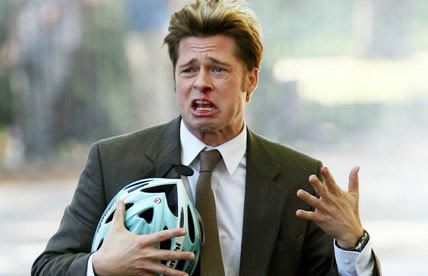
In other words, it's a movie about America's intelligence system. The rambling plot wanders, sometimes aimlessly, around a loose set of castoffs from the CIA and the State Department, and the people they intersect with when a disc possibly containing secret intelligence information winds up in the hands of the effervescent gym employees Linda (Frances McDormand) and Chad (Brad Pitt). The setup promises hilarity, and to some extent it delivers, but the Coens keep the humor mostly low-key and subtle, rooted in the nuances of the actors' performances — it's all about the bubbly, earnest, but totally blockheaded stubbornness of Linda, or the head-bobbing, gum-snapping, relentlessly upbeat Chad, two dead-on caricatures of middle American feel-good nothingness. The film mocks them for their unabashed greed and silliness, but it reserves its harshest caricature for Osborne Cox (John Malkovich), an uptight, snobbish former CIA man who is ousted from the agency and whose misplaced bank statements trigger the film's plot. Cox is an insufferable prig who says he's spent his entire life fighting against "stupid people," and who takes obvious pleasure in correcting his inferiors for their every tiny mistake, and especially their grammatical foibles. Malkovich turns in a great performance, channeling every ounce of his own innate arrogance and smugness into this character's every phrase; his mannered enunciation of the very word "memoirs" indicates the esteem with which he feels his life story should be greeted.

The plot also pulls in the Treasury Department agent Harry Pfarrer (George Clooney), a quirky paranoiac with a voracious sexual appetite. Pfarrer is sleeping with Cox's ice queen wife Katie (Tilda Swinton), but he's also romancing a variety of women who he meets for random encounters through Internet dating services, which is how he also winds up with Linda. The Coens weave the narrative patiently from out of this complicated web of relationships, letting the threads of blackmail, spying, sudden violence, and deceit interact with the parallel narratives involving the characters' various disintegrating marriages, serial unfaithfulness, and bald-faced lies. The personal and the public wind up blending together in interesting ways, reflecting the complete moral confusion of these people who can't seem to figure out what they're doing, what they want, or how to get it.


All of this confusion is, of course, being closely observed by the various intelligence agencies, who are keeping a close eye on everyone involved: they know almost immediately that Cox may have lost some confidential information, they know it may be handed on to the Russians, they know that several federal agents are involved in this mess, that there's rampant infidelity involved ("they all seem to be screwing each other"), and that the body count is slowly rising. But they don't care. J.K. Simmons plays an unnamed senior intelligence officer who receives periodic reports on the progress of this "clusterfuck," while his agents watch closely but never intercede, letting the mess escalate out of control and never getting a real handle on what's going on. "Come back with a report when it, uh... when it makes sense," he tells an underling at one point. Later, he reacts with horror when someone suggests collaborating with the FBI on this case, sputtering, "No, no. God no!" Simmons' deadpan performance delineates a fairly minor character in a film populated by larger-than-life caricatures, but his clueless CIA man nevertheless embodies the film's real satirical point and its primary target.

In this film, the stupidity of individuals — who cheat, steal, manipulate, and even kill to get their own petty desires — is only surpassed by the institutional stupidity of the government, which is near omniscient but so indifferent to life and everything else that it can't be roused to action by even the most horrifying events. The Coens depict the corridors of power from the ground level, opening each scene at the CIA headquarters with a series of quick shots of feet walking through unvarying hallways lined with unmarked doors. This detached perspective emphasizes the anonymity of the walker, who goes to deliver reports that ultimately have no effect — the CIA never steps in until after it's way too late. Simmons' disinterested manner is only penetrated once, late in the film, when he sighs with disappointment after learning that Cox has survived a gunshot wound and merely lapsed into a coma instead of dying; the Agency is peeved only when they're inconvenienced. Otherwise, Simmons seems blithely unconcerned about the whole affair, seemingly dismissing it all when he learns Cox's security level — implying that some supposed "secrets" aren't really worth bothering about, after all. This callous indifference to security and individual lives alike comes together in the pointed satire of the final scene, in which the Coens abruptly cut away from the climax of the mayhem and give the final word to Simmons and his assistant at the CIA. This duo ruminates on what they've learned from this mess, finally deciding that it's close to nothing, and ending with a vain promise to "never do it again" — a schoolboy oath so insincere and perfunctory that the two agents barely even pretend to mean it. It amounts to a disinterested shrug, a disavowal of responsibility and an implicit acknowledgment that the same thing could happen again tomorrow (and probably will) and again nobody would care.

11/17: No Country For Old Men


The signal moment in the Coen brothers' excellent No Country For Old Men comes about halfway through, and it's a seemingly minor scene with precious little to do with the main plotline. Sheriff Bell (Tommy Lee Jones) is recounting a story he's read in the newspaper, about a homicidal couple who had been torturing, robbing, and killing old people, and he laments how it took one of the victims running from the house screaming and wearing a dog collar before anyone took notice. "I guess digging graves in the yard wasn't enough," he says, and it inevitably elicits a wry chuckle. It also gets a laugh out of the deputy who Bell's telling the story too, and the Coens abruptly cut to the deputy's "hyuck," before cutting back just as quickly to a disapproving Bell. The effect is electrifying. The scene both provokes a reaction and then proceeds to explore the nature of that reaction, all in a few rapid cuts, forcing the audience to question its own assumptions and the implications of its jaded laughter at such images of violence and human ugliness.

This kind of moral questioning is at the heart of the Coens' film, as it was in the Cormac McCarthy novel which the film is adapted from. In adapting McCarthy's novel, the Coens have remained remarkably faithful both to the substance of the plot and to the feel of the material, the folksy rhythm of McCarthy's border town dialogue and the philosophical inquiry into violence and evil. But this scene indicates at least one way in which the Coens have gone beyond the book's scope, making its moral inquiry a kind of interactive experience in which the audience must follow along with Bell (the moral center in both film and novel) in tracing the ontology of evil. Many people, when they heard that the Coens would be tackling McCarthy's arch-moralist novel, feared that the brothers would inject the film with too much of their trademark ironic humor, dulling the impact of the story and its intentions. But quite to the contrary, in most cases the Coens have actually dulled the novel's humor, stifled it in favor of a deadpan realism that accentuates rather than lifts the horror. In one scene early on, there's another exchange between Bell and his deputy. "This is quite a mess," the deputy says. Bell's response ("If it ain't, it'll do until the mess gets here") was, in the novel, exactly the kind of ironical humor that one would most easily associate with the Coens, and this is the kind of moment that would seem to gel most easily with their own aesthetic. And yet the directors choose to deliberately defuse the humor by emphasizing the dead bodies strewn around the desert, and keeping the body of a dead dog pointedly in shot throughout the scene, glimpsed just to the right of Bell in the background, even framed between the legs of a horse at one point.

In addition to de-emphasizing McCarthy's morbid humor, the Coens have also played up the gore that always figures in McCarthy's work. Their images of violence have a quality of stasis, as though the camera is lingering in order to examine the gore in detail, an effect that admirably captures the extended nature of McCarthy's head-on descriptions of violence. The unstoppable hitman Chigurh (Javier Bardem, incredibly sinister) turns violence into a process, reducible to its steps and casual in its application. His offhand robbery of a drug store, achieved by setting fire to a car outside as a distraction, is followed by a lengthy scene in which he removes a bullet from his leg, shown in all its gory detail. Both scenes are presented as though Chigurh is simply going through the motions, following a set of instructions that he's memorized through repetition. Chigurh's mission is to locate Llewelyn Moss (Josh Brolin), who's stolen $2 million from a botched drug transaction he stumbled across in the desert one afternoon. The killer's path is strewn with corpses, as he stoically tracks his prey with little regard for anyone who winds up in his way. He is an incarnation of evil, an evil intimately associated with the modern age but, as the philosophical coda makes clear, not unique to it. Bell's mistake, throughout the film, is to take the (conservative) moral stance that the modern age is degraded and its evil more widespread than in the past. But McCarthy's novel has more historical sense than that, and the Coens bring over a précis of the moral examination that occurs in the final quarter of the book, following the abrupt death of its former protagonist Moss.

This moment, one of the most startling in the book because of its radical disposal, without ceremony, of the hero, has been beautifully preserved by the Coens, as has the sudden switch of perspectives from Moss to Bell. The final 20 minutes of the film are dedicated to Moss' struggle to come to grips with the evil represented by Chigurh. This is a struggle that the audience must engage in as well, and the Coens' film allows plenty of room for such moral questioning. In adapting McCarthy's novel, their faithfulness to the text, despite many necessary changes, involves above all a faithfulness to the book's moral character, its insistence on not just taking murder as a fact of life the way Chigurh does.