Showing posts with label Westerns. Show all posts

High Plains Drifter


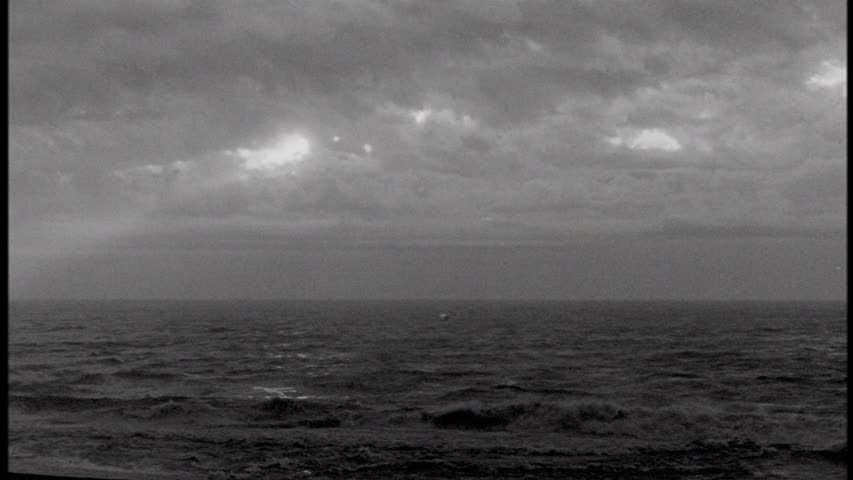
Clint Eastwood's High Plains Drifter is a rotten, ugly, disgusting movie, a descent into Hell in every way. It is a disturbing moral vacuum of a movie, a vision of complete societal breakdown that wallows in non-stop muck and grime for most of its running time. It doesn't start that way, though, as the opening sequence introduces Eastwood's unnamed drifter in a way that quite consciously recalls the spaghetti Westerns he made with Sergio Leone in the 60s, the films that established Eastwood as a Western icon. The opening is slow and methodical, as the drifter — he's credited as "the stranger," and remains one throughout the movie — rides over lush green countryside into the town of Lago, entering the town through a cemetery, the gravestones of which are highlighted in the foreground of the shot as the horse stomps between them, a staggeringly obvious premonition of what's to come. The setting itself is unique, a seaside town (shot in California) that surreally looks like a ramshackle Western way-station on the edge of a beach. The music sets the tone, too, an eerie whining drone that evokes Ennio Morricone's Leone soundtracks with more of a sinister edge; one isn't sure if a flying saucer is going to land or if a lot of people are simply about to die or, perhaps, if a ghost is riding into town.

Once the stranger enters the town, Eastwood puts the emphasis on the repetitive sounds of the town, as everyone simply stares silently as the rider passes by. There's no dialogue, only the rhythmic chuff, chuff, chuff of the horse's hooves kicking up dust on the dry road and then, when the stranger dismounts, the clang of his spurs and the hollow reverberation of his boots on the wooden planks of the saloon's front steps. After this evocative opening, which so thoroughly sets the scene and suggests that this film is a self-conscious response to Eastwood's spaghetti Western background, the film's story kicks into action and it becomes clear that, if this is a response to the spaghetti Western, it's strictly in negative terms. It's as though Eastwood set out not only to deconstruct his screen persona, but to drag it through the mud and totally destroy it, to tear it into shreds.

This stranger is recruited by the people of Lago to defend against a trio of outlaws who are returning to exact vengeance on the townspeople for sending them to jail, a familiar setup derived from multiple Western antecedents. Throughout the film, flashbacks and contrived dialogue scenes fill in the details of the town's past, suggesting that it's an utterly corrupt place with some very dark secrets. Eastwood's stranger appears to nudge this vile place a few steps closer to the abyss, acting as a kind of moral arbiter and judge of these disgusting, cowardly people, even though this stranger is equally monstrous. In particular, the film's attitude about rape is absolutely unforgivable and horrifying, as several scenes suggest that not just one but two women are forced into sex with Eastwood's character and wind up enjoying the rape and even in some ways actively pursuing the drifter. It's played, more or less, for laughs, as when one of the women returns to, quite understandably, take a few shots at the drifter for what he did. The stranger asks why it took her so long to get upset, to which the stranger's midget sidekick (Billy Curtis) replies that maybe she was just upset that he hadn't come back for more, which is a pretty appalling laugh line by any measure. Eastwood's character is portrayed as such a smirking badass that these women, though initially resistant, come to enjoy his attentions even when he forces himself on them. It's despicable, and makes it especially hard to take too seriously the film's moralist judgment of the other characters for their various hypocrisies and sins.

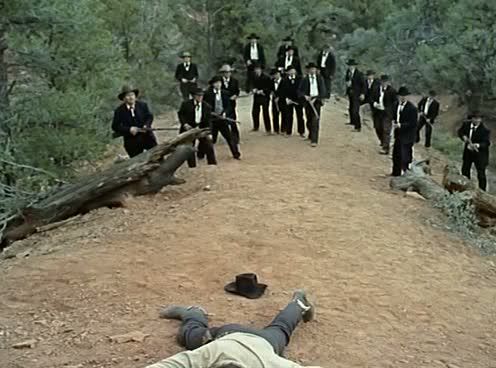
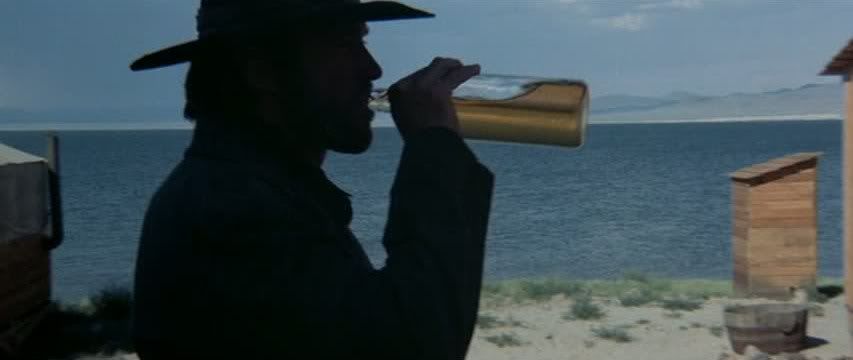
Indeed, by the end of the film the whole town has descended, quite literally, into Hell. Eastwood's drifter, using his position of power as their only defender to take control, reorganizes the town, orders all the buildings painted red, and paints over the town's name on the sign outside town with the inscription, "Hell." Yeah, it's not a very subtle movie. There's a kind of awful impact to many of the film's images, particularly when Eastwood exploits the slightly surreal setting of this beachside Western town. In one scene early on, Eastwood strides through the town and the camera tracks along with him, the bright blue of the sea shining through the glass whiskey bottle that the stranger is taking swigs from. Later, the town becomes truly hellish, with all those red buildings and flames everywhere, with the stranger himself as a kind of devil pronouncing his verdict on nearly everyone in the town. It's almost beautiful in its horrible way, especially when Eastwood's familiar silhouette is framed in black against the bright orange flames.

The film betrays a sadistic, nasty-minded sensibility, assaulting the audience with horrific images like a lengthy flashback (repeated several times) of a man being whipped to death in the center of the town. Each time the scene recurs, it goes on for an uncomfortable amount of time, with an emphasis on the sound of the whips thumping into flesh, while streaks of bright red movie blood run across the dying man's face and torso. The townspeople all look on, passively allowing this horror to happen, and Eastwood's aesthetic forces the audience into a similar passivity, forced to endure the sounds of the whips drawing blood for what seems like an endless span of time. Eastwood wants to rub the audience's faces in the violence, like a cinematic punishment, but he repeats the whipping sequence so many times, and lets it run for so long, that it goes beyond grating into simply boring.

Eastwood's character, though a sociopathic monster and a rapist, is the film's moral center, which says a lot about what a morally bankrupt movie this is. He's meant to be the voice of conscience who rides into town and exacts vengeance on these people who once stood by and watched while a man was killed. The revenge theme provides a justification for everything that happens subsequently, especially since the finale draws an explicit link between the unnamed drifter and the dead man, even suggesting, as the stranger fades away into a hazy mirage in the desert, that he's the reincarnation of the noble murdered man. The film keeps implying that, while what the stranger does is despicable, in some ways these people deserve what they get, that they were asking for it. That's precisely the film's attitude about rape, for sure, and what the stranger does to the town as a whole is akin to rape as well, the violation of the community as an entity. The stranger comes into town and rapes, not only the women, but the town as a whole, and the film suggests that maybe this is alright. The filmmaking frames most of the stranger's behavior as a big joke, with Eastwood's self-satisfied smirk as the rimshot following the punchline. Eastwood encourages the audience to laugh along with the stranger as he humiliates, punishes and torments the townspeople in revenge for their own horrible deeds.

Johnny Guitar


Nicholas Ray's Johnny Guitar is a fantastic, lurid Western, a drama of sexual repression and desire played out with bullets and lynchings, the struggle for power between two rival women exploding into a bloody, bleakly beautiful morality tale. The film's central struggle is the battle of feminine strength between Vienna (Joan Crawford) and Emma (Mercedes McCambridge), two driven women with diametrically opposed personalities. Vienna takes what she wants, and through her strength, her determination — and, it's implied, her willingness to use her sexuality as a tool when she needs to — she's put together a saloon that's isolated right now, in the middle of nowhere, but that will soon be at an important hub on the expanding railroad that's scheduled to run right through Vienna's territory. She's made her own way in the world, and now all she needs to do is sit in her lonely saloon and wait for the railroad to come, bringing with it the people who will make her rich. Emma is also a woman with power and money, but it's not her own; her family owns a bank and has power in the nearby town, which means that the men of her family have gotten Emma what money and prestige she has. More crucially, Emma differs from Vienna in her sexual confidence and security; Emma wants the quasi-outlaw known as the Dancing Kid (Scott Brady), though she'd never admit it, and Vienna has the Kid but doesn't really want him. Emma's jealousy, and the sexual repression that causes her to deny her obviously overwhelming desires, creates the fierce rivalry between the two women, a rivalry that will eventually be stirred up into a conflagration, both literal and metaphorical, that threatens to turn everyone in its path to ash.

Into this tense situation rides the drifter Johnny Guitar (Sterling Hayden), who at first seems like a detached stranger. Johnny Guitar rides into town, and into the movie that bears his name, not as an actor in this drama but as a witness: he sees, much like the audience, the railroad company setting off dynamite, and he sees, from a distance, a stagecoach getting robbed, and then he rides up to the lonely saloon in the middle of nowhere, isolated in a swirling dust storm. He's a witness, an audience, watching from a comfortable distance, just as the film's audience watches over his shoulder. When he then enters the story, it's as though he's breaking out of his passivity, abandoning the position of the observer to engage with the action and to try to change its course — reflecting the fantasy of engaging so deeply with a film or a work of fiction that one becomes a part of its world. It's fitting that Johnny's entry into the drama at the saloon is his interruption of a shot glass in its rolling path towards the edge of the bar. He steps into the frame, with a tea cup held daintily aloft, and catches the glass just as it drops off the bar, irrevocably changing what had seemed inevitable, introducing an unexpected element into the proceedings. He's no longer the audience, passively looking on with a drink in his hand; now he shuttles between the two sides of the confrontation in the saloon, tweaking them both, acting as the wild card who's entered the story from outside it. Later, during a bank robbery, Johnny will revert to his audience role: "looks like I got a front row seat for the show," he quips to the robbers, lounging against his cart, his hands in his pockets. He's a study in passivity versus action, and for long portions of the movie he disappears altogether, incidental to the real emotional and aesthetic core of this movie.


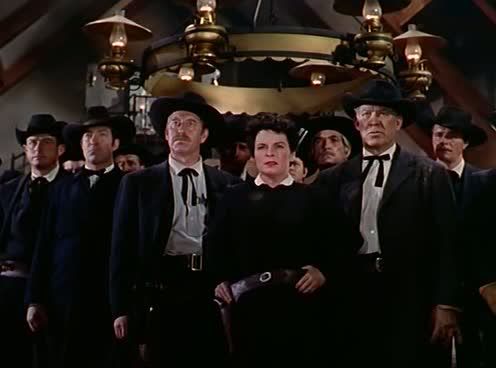
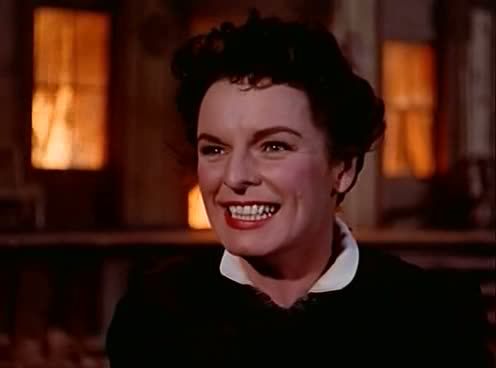
Vienna, on the other hand, is pure action, and though the film bears Johnny's name, it's really Vienna's movie — and Emma's. As Vienna finds herself caught up in the Dancing Kid's ill-advised plan to belatedly live up to his unearned reputation as an outlaw and robber, Emma stirs up the entire town into a fearsome but aimless lynch mob that's ostensibly searching for the bank robbers but is in fact, under Emma's direction, being aimed like a weapon towards the bitter woman's sexual rival. The entire mob, still dressed in black from a funeral, swarm on their horses through the bleak surroundings, spurred on by the black-cloaked Emma, who's like an avenging harpy with her teeth bared, snarling and insinuating, goading the men into terrible action, her face flushed with rage and vindictiveness. And when she gets her way she can't help but grin, the grin of the damned, an evil but joyous grin, girlishly skipping as she spurs on her followers towards death and destruction. Ray makes her a monster, a demon in black, her mourning shawl dropped from her head at the very beginning of the chase, the purpose — or the justification — for all this chaos almost immediately forgotten and replaced with a feverish sexual hysteria.

It's a mad film, but its intense emotions are carefully controlled within a very rigid and powerful aesthetic framework. These oversized emotions, these bold feelings and words freighted with meaning, are straining against the boundaries of the Academy ratio frame, against the very form of the film which seeks, in vain, to hem them in. This tension is embodied in the jarring leaps between natural splendor and studio artificiality, necessitated at least in part by star Joan Crawford, a solidly artificial actress who refused to be filmed in closeup in nature. That might be a crippling limitation for a Western, except that Ray makes it into a weird virtue, adding to the impression that Vienna is always in control while Emma spirals into deranged hysteria. Vienna's saloon is cool and clean, almost clinical, its color scheme a uniform reddish brown, its large, high-ceilinged rooms almost always empty. When Vienna is filmed in closeups, they're glossy, beautiful images, the light shining almost entirely on her face so that her head glows like a spotlight in the dark void around her, the shadows falling so closely around her face that at times, when she moves even slightly, the lower or upper portion of her face melts into the shadowy surroundings.

Moreover, Vienna — or Crawford — carefully coordinates her costume changes to augment her surroundings. It's even made a material part of the film, as she's forced to change out of her bright white dress during a night-time flight from the posse, who are more sensibly dressed in their funereal blacks to blend into the darkness. With the change, Vienna opts for dark blue pants to blend into the Hollywood night, and a red blouse that initially seems as ill-advised as the white dress until one sees Vienna positioned amidst the similarly reddish studio rocks of the surrounding countryside. In the wild, she'd stick out absurdly; in the garish studio West where she's most comfortable, she's a chameleon.


Obviously, color and costume are very important to this film, from Vienna's color-coded outfits to the black suits of the mourners who comprise the posse. The posse is constantly arranged into densely packed compositions in which they crowd the frame, forming threatening triangles aimed at Vienna, often with Emma at the point. Towards the end of the film, with the threat dissipated, that triangle will reverse, at last pointing away from Vienna, grouped around the dead and the survivors, providing a corridor for Vienna's exit. The awful geometry of sexual repression had closed in on her, but by the end of the film the geometry reconfigures to provide a way out. All of the artifice, the blatantly fake sets that Ray makes no attempt to integrate convincingly with the naturalistic outdoor scenes, contribute to the impression that Vienna, with her melodramatic persona, her expressive eyebrows and bright red lips, is a kind of mythic figure, with Emma as her opposite number. The two seem to be locked in a bigger-than-life combat, like two goddesses who have come to Earth and penetrated the usually masculine realm of the Western as the grounds for their confrontation. Indeed, during the grand finale, the men make a big point of calling off their own battles: all the men stop shooting to allow the two women to have their final showdown and shootout, an almost unheard-of gender reversal of the usual Western climax.

Indeed, this Western is actually a melodrama in genre drag, especially since Vienna keeps switching back and forth between long, flowing, feminine gowns and more manly gunslinger clothes. Her counterpart, Emma, on the other hand, remains in her funeral black for the bulk of the film, and in contrast to Vienna's carefully lit studio closeups, Emma is captured in increasingly frazzled states of derangement and disarray. As Vienna maintains her self-possession even in her moments of the most melodramatic emotional excess, Emma snarls and spits like an animal, her hair growing disheveled around her head, her teeth constantly exposed in a smile that looks like a grimace.

McCambridge, like Crawford, delivers an intense and raw performance in a film that's full of them, surrounded by other memorable performances from actors like Ward Bond, Ernest Borgnine and John Carradine, all of whom turn in appropriately gritty and meaty performances, and all of whom get their moment to shine. Carradine's Tom, who works in Vienna's saloon and mostly goes unnoticed by everyone, gets a surprisingly moving final scene that abruptly brings him into sharp focus. Ironically, only Hayden, as the title character, is stiff and uncharismatic, not quite getting into the melodramatic spirit of things. It hardly matters, though, because this is a Western where the women are, for a change, at the center of it all. What makes the film great is that Ray, while indulging the excesses and the weird humor of this story at times, also takes it very seriously, infusing every frame of the film with the potent sexual and gender subtexts that drive it to ever greater heights of emotional intensity and aesthetic overload.

Rio Lobo

This is a contribution to the Late Films Blogathon being hosted by David Cairns at Shadowplay.

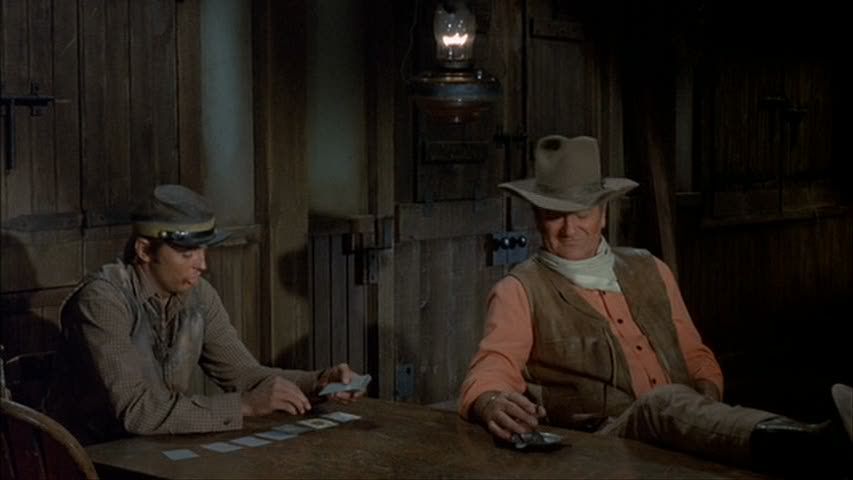
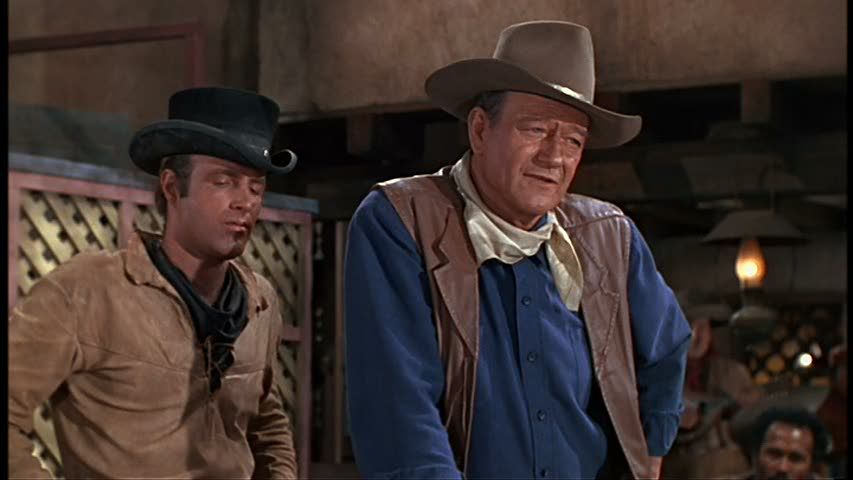
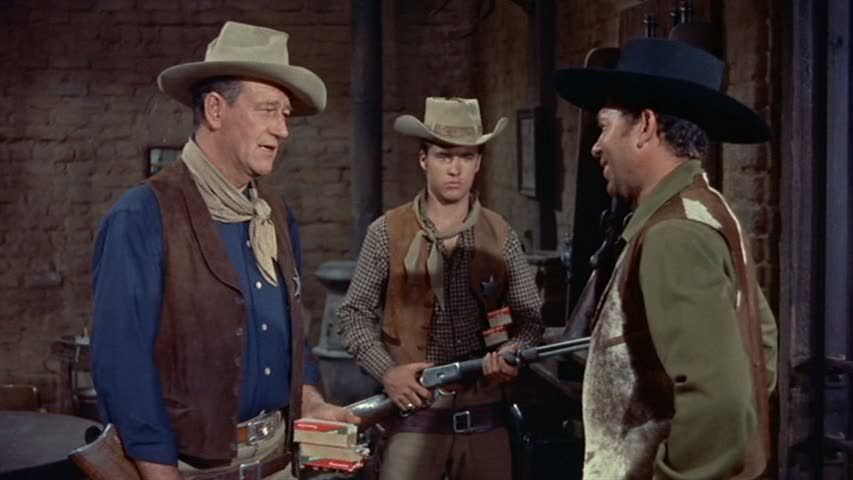
Howard Hawks' final film, Rio Lobo, is an awkward, limping, but still often poignant and entertaining goodbye from the great director. It is the concluding chapter of his loose, self-plagiarizing trilogy of John Wayne Westerns, another film cast from the mold that produced the classics Rio Bravo and El Dorado. Like its predecessors, Rio Lobo centers on Wayne as a tough but good-natured man of principle, in this case the Union officer Cord McNally. McNally is looking for justice following an incident at the end of the Civil War when a Union traitor allowed a gold convoy to be hijacked by Confederate troops, with one of McNally's best friends dying in the attack. With the war over, McNally enters into an unlikely alliance with two former Confederates, the Mexican-French Cordona (Jorge Rivero, an exceptionally unlikely Confederate officer) and Tuscarora (Robert Mitchum's son Christopher, singularly lacking in his father's screen presence). This trio, eventually joined by the lovely drifter Shasta (Jennifer O'Neill) and Tuscarora's crotchety, cross-eyed old father Phillips (Jack Elam), set out to find McNally's justice while also resolving a battle over land rights in the town of Rio Lobo.

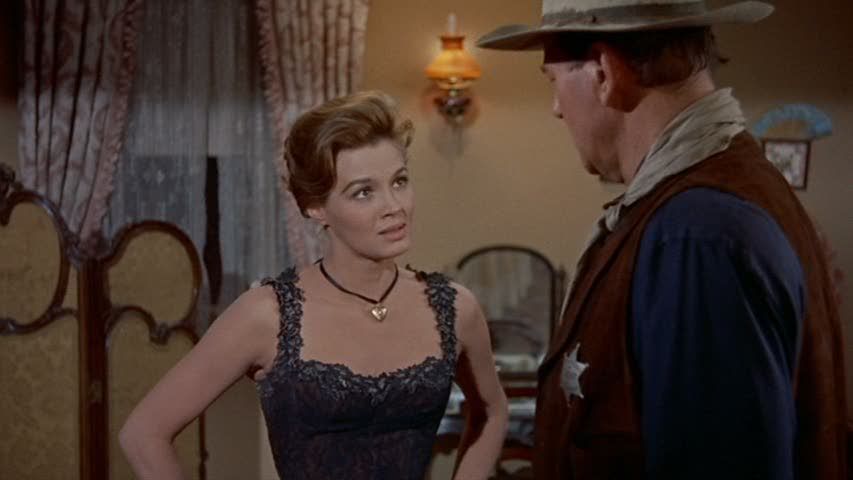
The film has all the ingredients of a classic Hawks adventure, taking a disarmingly offhand approach as the heroes rush headlong into danger. The script has the signature laidback feel of late Hawks, spiced with some mild banter and goofy humor, but something feels off about it all. A big problem is the casting, which is almost top-to-bottom awful. Hawks' other two late Wayne Westerns had been packed with supporting turns from Robert Mitchum, James Caan, Arthur Hunnicutt, Walter Brennan and Angie Dickinson, and their ease and charm with the quick-witted scripts were crucial to the films. For Rio Lobo, Hawks pulled together a cast nearly as inexperienced and undistinguished as the young troupe he'd gathered for his equally clumsy racing picture Red Line 7000. Only experienced character actor Jack Elam is really fun to watch, in a campy, over-the-top role; the rest of the cast is simply lackluster. The usual Hawks charm occasionally shows through anyway, which is to say that one gets what he's going for, even if the actors can rarely pull it off. O'Neill has a certain appealingly matter-of-fact attitude that makes her laughing banter go down easy, but she has no depth, no feeling, and Hawks did her no favors by casting her in basically the same role, of the proud woman with a checkered past, that had previously been played with far more wit and pathos by Angie Dickinson.

But O'Neill at least makes an impression. Most of the rest of the cast is utterly unappealing. Hawks' great hangout Westerns had relied on a minimum of gunplay and a maximum of relaxed wordplay, and for that he'd needed actors who could be comfortable in their skins, and with one another, who could be captivating while simply lounging back in a chair and verbally sparring. He comes up empty here, and seems to know it. Even Wayne, who was near the end of his own career and ailing, seems ill-at-ease, and in any event his laconic manner can't compensate for the non-entities he's surrounded with. The actors can't shoulder all the blame, though, because the script is nearly as haphazard as the performances. There are some fun lines — asked why Cordona had taken Shasta's clothes off after she'd fainted, he replies that he and McNally flipped for it, and he won — but otherwise there's a whole lot of clunky exposition and banal dialogue. There's too much purely functional chatter, the kind of placeholder fluff that one suspects the Hawks of a few years earlier would've improvised or rewritten on the spot, but perhaps he didn't have the energy anymore.


In that respect the film is kind of sad, as though it bears the marks of Hawks' age, his inability to marshal all his tremendous talents the way he once had with such verve and wit. He'd live another seven years, but he wouldn't make another film. In many ways, the film is about saying goodbye, is about what it's like to be the man of action growing old. If one reads between the lines, Rio Lobo begins to seem like Wayne and Hawks, two old men at the ends of their careers, wondering what old age could possibly mean for men like them, men who had in many ways defined themselves by youth and virility and vigor. To see Wayne, old and sickly and bulkier than ever, struggling to mount a horse, is to know that Rio Lobo is a kind of farewell to the cowboy who'd grown old onscreen — it's a long way back from here to the young, surprisingly skinny gunslinger defining his iconic image in John Ford's 1939 Stagecoach.

One sees the difference in Wayne's relationship to the women, too. Wayne had never been the most comfortable actor in romantic situations, and Hawks had always gleefully taken advantage of that discomfort, making it the chink in the tough guy's armor, pushing him into situations where beautiful younger women could upstage him with their frankness and their beauty. In Rio Lobo, though, the duo finally acknowledge Wayne's unlikelihood as a romantic hero; he's now the aging father, uninterested in women and uninteresting to them. When Shasta throws in with McNally's group, Cordona immediately latches onto her, aggressively pursuing her, but she spends the night cuddled up next to McNally — not because she wants him, but because he's "comfortable," because he's not a sexual threat the way the fiery, passionate Cordona is. McNally laughs it off but the way he keeps bringing it up subtly underscores how much it stung, how much he took it as an insult. The tough guy, the gunslinger, the cowboy, has become sexually irrelevant, to the extent that this beautiful young woman doesn't even consider him in terms of sexuality. She thinks nothing of spending the night curled up next to him under a blanket because she obviously considers him sexless, safe, and one feels how much that must hurt McNally — and by extension, Wayne and especially Hawks, who always prized his ability to win the attention of far younger women.


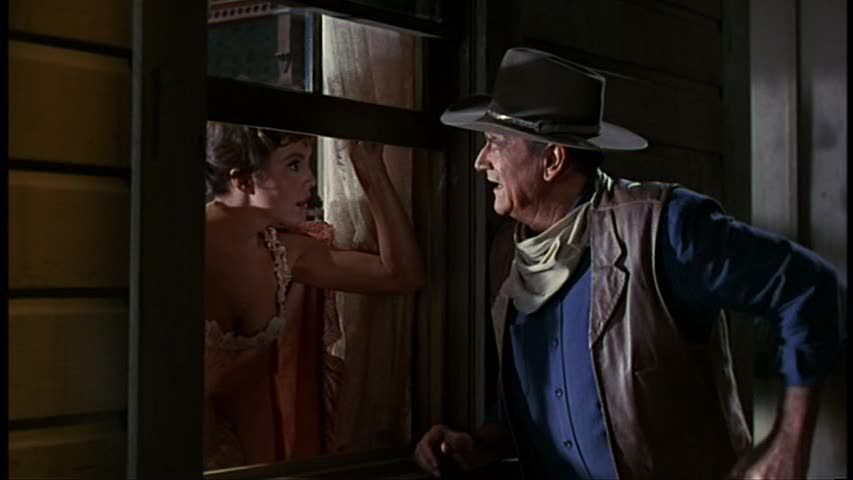
Hawks' insecurity with this theme leads him, perhaps, to counterbalance it with a scene where Cordona, fleeing from the bad guys, stumbles into a young woman's house, where the topless Amelita (Sherry Lansing) waits, barely covering herself with her hands. The scene reads as racy and flirtatious — and it might've come across as funnier if the actors weren't so bland — but it's an obviously gratuitous display of T&A, a particularly blatant bit of pointless, seedy pandering. The moment is redeemed only slightly by the film's climax, in which Amelita, thirsty for revenge, proves her mettle as a tough Hawksian woman.
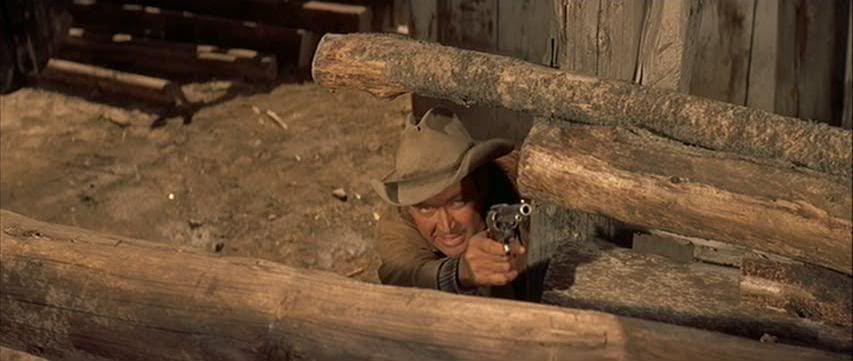
Still, this is a Hawks film, and if the casting and scripting aren't up to his normal standards, there are still pleasures to be had here. Perhaps to make up for the lack of compensating joys in the characterization, the film is much heavier on action than either Rio Bravo or El Dorado, and the action is well-staged and viscerally exciting. During the lengthy opening sequence, Confederate bandits rob a Union train using a string of contrivances — a nest of hornets, torches, grease, ropes strung across the tracks — that are ludicrously convoluted but play out great on screen. The robbery leads directly into a cleverly staged pursuit from the Union troops, with the troops splitting up at each fork, so that eventually McNally is riding through the center of a shallow stream all by himself, seeking out his prey. Later, the trio of McNally, Cordona and Phillips lead an assault on the ranch of their enemy Ketchum (Victor French), and Hawks' tense staging of their stealth dispatching of the ranch's bodyguards is impeccable.

But he has the most fun with the grand finale, after the ranch shootout. At one point, when McNally calls a huddle and tells his allies that they're going to hole up in a jail, it's a kind of metafictional wink: he might as well have turned to his friends and said, "hey, did you ever see Rio Bravo or El Dorado?" The actual jail hangout sequence is pretty short, but Hawks quickly follows it up with a re-enactment of the prisoner exchange and shootout with which he ended Rio Bravo. This time, though, it's the bad guys who think to throw dynamite into McNally's position, along with other subtle variations that show Hawks having fun recycling old plots and old situations. The film is frequently clunky and awkward, but it's also often charming, exciting and, in its examination of the aging Western archetype — and the aging filmmaker behind the camera — surprisingly poignant.
For a Few Dollars More

[This review has been cross-posted at Decisions At Sundown, a blog started by Jon Lanthier and dedicated exclusively to the Western genre. I cross-post all of my Western reviews with this blog, where I am one of several contributors.]

For a Few Dollars More is the second film in Sergio Leone's "Man with No Name" trilogy, his spaghetti Western cycle starring Clint Eastwood. In each of these films — the trilogy is bookended by Fistful of Dollars and The Good, the Bad and the Ugly — Eastwood doesn't actually play an unnamed character, but three different more-or-less anonymous drifters, mercenaries and bounty hunters. He might have a name (in this film it's Manco) but he doesn't seem to have a past or a sense of place. He simply wanders through forbidding desert landscapes in his distinctive poncho and cowboy hat, with a cigarette clenched between his gritted teeth. He's fast on the draw, laconic, and has a strong sense of morality and right. He is, in other words, the archetype of the Western hero, and the power of Leone's films comes from the way he riffs on these familiar tropes, mythologizing and stylizing the Western gunfighter into a truly outsized figure. He takes a cultural icon that had already permeated popular mythology, and amplifies it into something operatic.

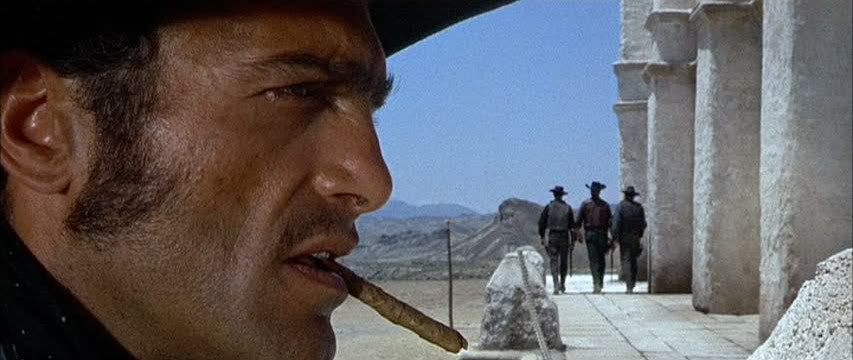
A large portion of the credit for this achievement must of course be shared with Leone's collaborators, notably Eastwood and composer Ennio Morricone, who provided the famous music for all three films and many of Leone's other works. Morricone's music defines the spaghetti Western: his distinctive twangy compositions, collaging together traditional Western motifs with sweeping orchestral strings, dramatic vocals, and goofy sound effects, are instantly recognizable and synonymous with Leone's cinema. And Eastwood, of course, was in the early stages of defining the tough guy persona that would become his career trademark. He carries over the same props and costume from film to film, always smoking the same cigarettes and wearing the same poncho. It's an unconventional garment for a gunslinger, and one that gives Eastwood a kind of grandeur to his movements. When he knows he's going to need his gun, he simply tosses the poncho up across his shoulder, exposing the holster at his hip. Leone seems especially attuned to details like this. The way a man wears his gun, the way he smokes a cigarette, the way he draws and fires, says everything about him. In this film, he emphasizes the way the vicious outlaw El Indio (Gian Maria Volonté) smokes in a strange way, the cigarette held between his middle and ring fingers, his whole hand placed across his mouth to smoke as though he was trying to mute himself. Eastwood, meanwhile, lights his smokes with the match elegantly cupped inside his hand, so that he seems to be lighting the cigarette, unseen, on his palm. When Eastwood describes the way another bounty hunter wears his gun, an old man instantly knows who he's talking about, because such things are signifiers of identity in this world.

This attention to detail extends to the three-part introduction, following Leone's favored method for introducing and contrasting his central characters; it's a technique he'd use again for The Good, the Bad and the Ugly, where even the title indicates Leone's preference for dealing with his characters as sets of opposing traits. The opening two sequences follow first the bounty hunter Mortimer (Lee Van Cleef) and then Manco as they each track and kill a target for pay. The differences in their methods, in the flourishes of their technique, highlight the differences between the characters; for Leone, style is character. Mortimer is calm and steady, slow-moving and graceful. He follows a fleeing bandit without getting ruffled by the man's evasions and attacks, and finally unfurls a blanket full of rifles so he can calmly unseat the man from his horse from a great distance. Then, as the criminal wildly fires his pistol, hitting only the dirt at Mortimer's feet, the bounty hunter carefully assembles his own pistol, with a rifle stock attachment so he can steady his aim on his shoulder. He takes his time, sets up his shot, and dispatches the outlaw with a single shot right between the eyes. Manco, in contrast, is more spontaneous and also has a component of moral engagement in his hunting. He finds his target and then engages the man in an impromptu card game, a game of chance that, though his target never suspects it, has the man's life as its stakes. Manco wins and tells the man that he's lost his life, and in the resulting fight he uses his lightning-fast draw to dispatch both his target and three other outlaws. As he's leaving town, he then takes the opportunity to castigate and expose the corrupt local sheriff.

The impression is that, while Mortimer is a cool professional just doing a job, Manco is a raw moral force, relying on his inherent superiority — both morally and in terms of skill — to get him through everything. To some extent, the remainder of the film will complicate this relationship and stand it on its head. In the end, Mortimer has more of a personal, vengeful stake in the hunting of the bank robber El Indio, who is revealed in flashbacks to have raped Mortimer's sister and led to her eventual death. Both Mortimer and El Indio carry watches with pictures of this woman inside, making them mirror images, each haunted by what happened to her — Mortimer because she was his beloved relative, El Indio because, as Leone eventually reveals, the woman killed herself rather than letting him take her, an insult which devastates the proud bandit.


El Indio is the third point of this triangle, and the third man introduced in the opening sequences. He is shown being broken out of jail by his gang, killing his cellmate and heading off to a hideout that's set up and presented like a church. At one point, Indio steps up into an elevated area that's an analogue for the lectern, and gives his men a speech about their next job; Leone inserts a shot of the space's high, V-shaped rafters, which cause the outlaws' words to reverberate magnificently. This religious satire is a consistent undercurrent in the film. The first shot after the opening credits is a closeup of a gold-embossed Bible being read by an unseen man on a train, who everyone assumes is a reverend. But as soon as he lowers the book, revealing the chiseled, hardened face of Lee Van Cleef, his eyes squinting coolly, there's no doubt that he is not a man of God. It's a subtle joke about appearances and surfaces: Mortimer may be reading the Bible, but one look at him is enough to suggest that he is actually a killer, a hard man who's seen much bloodshed in his life, that he couldn't be any holy man. Appearances mean everything here, which is why Leone focuses so intently on the iconography of the Western, the gestures and accoutrements.

In fact, at times the film seems to be nothing but gestures. The plot is simple: a dangerous bandit has escaped from prison, with a massive reward offered for his capture, dead or alive, and two bounty hunters set off after him, sometimes competing and sometimes agreeing to work together as partners. Within this minimal framework, Leone riffs on the mechanics of the shootout, the showdown, the stylized rituals by which rugged Western men test their mettle against one another. When Manco and Mortimer first meet, they engage in a playful duel, with an undercurrent of danger, by shooting at one another's hats. It's a process of sizing up the other man, testing his nerves, testing his skill. If they were not assumed to be equals, there would be an element of humiliation in it when Manco shoots Mortimer's hat off his head and then shoots it away whenever the older man stoops to pick it up. But Mortimer maintains his even-keeled demeanor and then shows up his adversary with his own showy gunplay, and Leone cuts away to them sharing a drink together, professionals with a healthy competitive respect developing between them. The other major gunfights in the film are staged as showdowns where Leone cuts precisely between closeups, watching the men's eyes and faces, watching their hands poised above their gun butts, watching them prepare, internally, for the violence to come. The actual bloodshed is swift and over in a moment. It's the build-up, the accumulating tension, always set to Morricone's grand music, that Leone is concerned with.

This tension builds throughout this sprawling, patiently paced film, which packs in a lot of action — including an explosive bank robbery — but never seems to be moving at a truly frenetic pace. Instead, Leone seems to be steadily building up towards the grand climax, the showdown between Mortimer and Indio, with Manco standing by as a kind of referee to make sure the fight goes smoothly. This is another rehearsal for the threeway shootout that caps The Good, the Bad and the Ugly, another of Leone's moral climaxes.

El Dorado

[This review has been cross-posted at Decisions At Sundown, a blog started by Jon Lanthier and dedicated exclusively to the Western genre. I cross-post all of my Western reviews with this blog, where I am one of several contributors.]

El Dorado is a sneaky kind of movie, in terms of narrative. It starts out like it's got purpose, a strong forward drive the likes of which hadn't been seen anywhere near Howard Hawks' increasingly languid cinema in years. It sets up, quickly and economically, a rivalry over water rights between kindly farmer Kevin MacDonald (R.G. Armstrong) and the nasty Bart Jason (Edward Asner). Stuck in the middle of this conflict are two old friends, the town sheriff J.P. Harrah (Robert Mitchum) and his older mentor Cole Thornton (John Wayne), who came into town as a hired gun for Jason until he realized what was going on. The film's opening section establishes a tense situation, a classic Western pressure cooker, and when Cole accidentally kills one of MacDonald's sons and then himself gets shot in revenge by the clan's feisty daughter Joey (Michele Carey), things look to be really heating up. Hawks, of course, takes the opportunity to insert the first of the film's radical ellipses, shifting away from the action and leaping forward, in a few quick scenes, several months into the future, with Cole now safely away from the town of El Dorado. It's almost a panicked reaction, as though Hawks was afraid he was getting to the climax too fast. The rest of the film pretty much meanders, slowly but surely, back towards the tension of those opening scenes.

A funny thing happens along the way, too, as not only does Hawks take his time getting back to the center of the action, but he begins morphing the film into a virtual remake of his previous John Wayne Western, Rio Bravo. This predecessor is already hinted at in the film's opening minutes, with a shot of Cole walking along a street that runs diagonally across the frame, a composition that recurred throughout Rio Bravo as Wayne's John T. Chance patrolled his town. By inserting the shot here, into the opening's series of establishing shots, Hawks hints at his eagerness to revisit his earlier success. The joke goes that Hawks liked Rio Bravo so much he made it twice more, with El Dorado and its successor Rio Lobo, and at times it virtually is a joke. One can sense Hawks and Wayne and company chuckling at getting away with remaking their own picture just seven years later, and the way the plot begins to fall in line with its ancestor is decidedly tongue-in-cheek. The result is another light, low-key charmer of a Western from Hawks, an amalgam of everything that made his previous efforts in the genre so much fun; there's even a visual reference to the cattle drive from Red River, this time with a herd of horses filling the screen. Once Cole makes his way back to El Dorado, the film's mirroring of Rio Bravo becomes more and more complete, as various pieces fall into place. It seems that during one of the narrative ellipses, Mitchum's J.P. got his story crossed up with Rio Bravo's Dean Martin character: a no-good girl whirled into town, seduced him and broke his heart, leaving him a useless drunkard and the town laughingstock.

Naturally, this leaves him singularly unable to deal with the MacDonald/Jason rivalry, which is just now reaching a head as Jason hires the ace gunman Nelse McLeod (Christopher George). Mitchum is arguably a perfect choice for the drunk sheriff, the formerly noble and strong-willed lawman brought low by a bad woman. With his sleepy eyes and hunched posture, he stumbles around, grasping his stomach, slumped over, slamming into things. His performance is both more harrowing than Martin's, and also somehow more broadly comic, even cartoony, channeling the same pop-eyed lunacy he brought to his homicidal preacher in Night of the Hunter. At one point, when Cole hits him over the head with a metal pan, J.P. freezes stiffly, his eyes wide, looking like one of Bugs Bunny's frazzled opponents. There's nothing here as iconic as Martin's scrambling for a coin thrown into a spittoon, but Mitchum's performance is complex and multilayered, heartrending and hilarious in roughly equal measures.


The film is packed with such bravura performances, which is good because even more than Rio Bravo itself this is a true hangout movie, a movie about dialogue, about the easygoing exchange of barbed witticisms. Filling out the cast of Rio Bravo analogues are Bull (Arthur Hunnicutt in the Walter Brennan cranky old man role), Mississippi (James Caan standing in for Ricky Nelson's cocky young fighter) and Maudie (Charlene Holt replacing Angie Dickinson). The cast may be different, but the dynamics are startlingly familiar, so the pleasures here are in seeing how Hawks and company weave variations on the formula they'd established. Certainly, Mississippi gets a great introduction, stepping into a bar and announcing to an older gunfighter that he's after revenge for his dead friend. It turns out, he's a knife-fighter rather than a gunfighter, a Wild West anomaly, further set apart by his goofy hat and his general naïveté. He provides much of the film's comic relief, along with Hunnicutt's Bull, who often communicates through his trumpet. As for Holt, she had previously been great in small roles for Hawks' middling Man's Favorite Sport? and Red Line 7000, an electrifying and sexy presence on the fringes of those films, and here she finally gets a good showcase in an actual peak Hawks production. Her banter with Wayne is typically awkward, marked by the stop/start rhythms that reveal the aging tough guy's discomfort with romance and emotional expression. It's a virtual repeat of the hesitant Wayne/Dickinson chemistry, though Holt doesn't get quite as much to do, beyond memorably reprising Dickinson's va-va-voom lingerie modeling scenes.

These kinds of mirrors recur throughout the film, and part of the fun is waiting to see when Hawks (with screenwriter Leigh Brackett) is going to stick to the script, and when he's going to shake things up. Again and again, he riffs subtle variations on Rio Bravo's key scenes, like the one where Cole and J.P. track a killer to a saloon full of hostile gunmen. Here, instead of hiding in the rafters and revealing himself with blood dripping into a beer glass, the killer is behind a piano and reveals his presence through the nervous piano player's wrong notes. Elsewhere, Hawks stages a great gunfight at a church, where the bullets pinging off the bells not only provide a deafening soundtrack to the scene, but contribute to the strategy of the battle. The film is packed with great moments like this, scenes where Hawks' careful, deliberate staging turns every cut, every movement, into something graceful and purposeful, whether he's shooting an action climax or a simple dialogue exchange. The dialogue is fantastic too, especially since the amazing ensemble cast does such justice to that characteristic Hawks looseness, and to Brackett's witty writing. The recurring gags, like J.P.'s absentmindedness about just who Mississippi is, are as good as Rio Bravo's best running gags (and Walter Brennan's crankiness about always being told to stay in the back of the jail is given a nod here in the form of a similar brief scene with Hunnicutt).

The crackling dialogue also asserts itself in the film's emphasis on storytelling over action; the characters spend a lot of time talking, telling tales, rather than doing anything. Mississippi's vengeful showdown is paced by his languidly meted out story about his dead friend and his mission of catching up with the men who killed him. Then McLeod tells Cole a story about a drunk sheriff and a no-good woman, not realizing that 1) he's talking about Cole's friend; and 2) he's retelling the story behind Rio Bravo. One of the funniest of these stories is a brief interlude with a Swedish gunsmith, who tells the tragicomic tale of the nearly blind gunman who previously owned Mississippi's shotgun. Later, Maudie tells J.P. about her long friendship with Cole, and her great debt to him, and we realize that she's another Rio Bravo echo, beyond her faint resemblance to Angie Dickinson and her sexually suggestive wit (best showcased in some hilarious dialogue about a "bouncing" bed). Like Dickinson's Feathers, Maudie is also a gambling widow; she's just further along in her relationship with Wayne's character when we meet her. Indeed, her character's familiarity allows Hawks the freedom to omit key scenes, like the late reconciliation between her and Cole, which takes place offscreen, relying on the memory of Rio Bravo's Wayne/Dickinson showdown over the girl's skimpy performing outfit.

Ultimately, what's great about El Dorado is how Hawks and his cast take what should have been an utter throwaway project, a shameless retread of a relatively recent film, and turn it into something special of its own. It's a roughshod film, casually skipping over long periods of time with inexplicable edits — and sloppy editing is also responsible for the one sight gag that just plain doesn't work, a lamely executed stunt that's supposed to show James Caan leaping under a charging horse's hooves. Somehow, though, these elliptical narrative shenanigans only add to the film's indelible charm. This is especially apparent in the ending, when after the final showdown Hawks jumps ahead a small amount of time to show J.P. and Cole patrolling the town together, both injured, both limping with crutches, bickering and laughing. It's a wonderful moment, these two crotchety gunmen propped up on crutches, patrolling the town: it's absurd, strangely touching, and funny all at once, just like the film as a whole.

Films I Love #46: Dead Man (Jim Jarmusch, 1995)


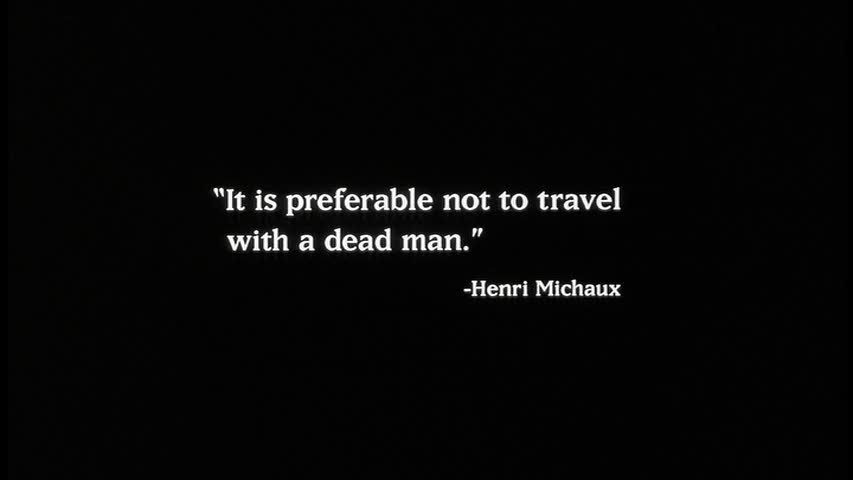
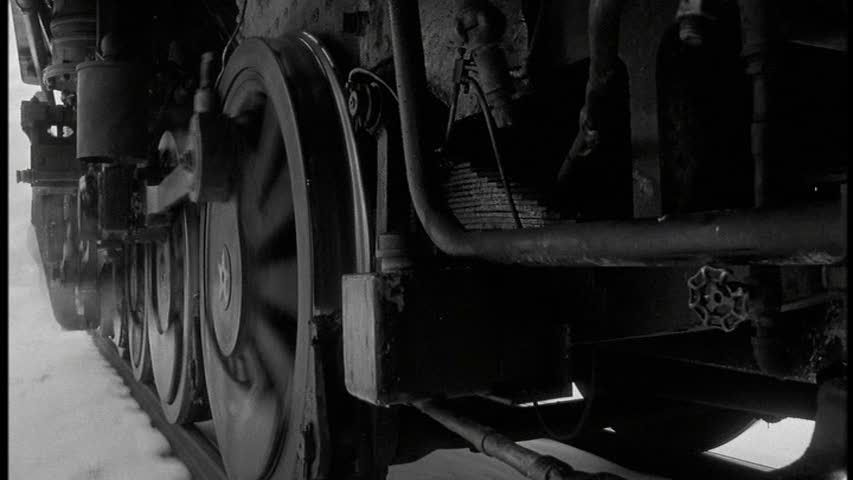
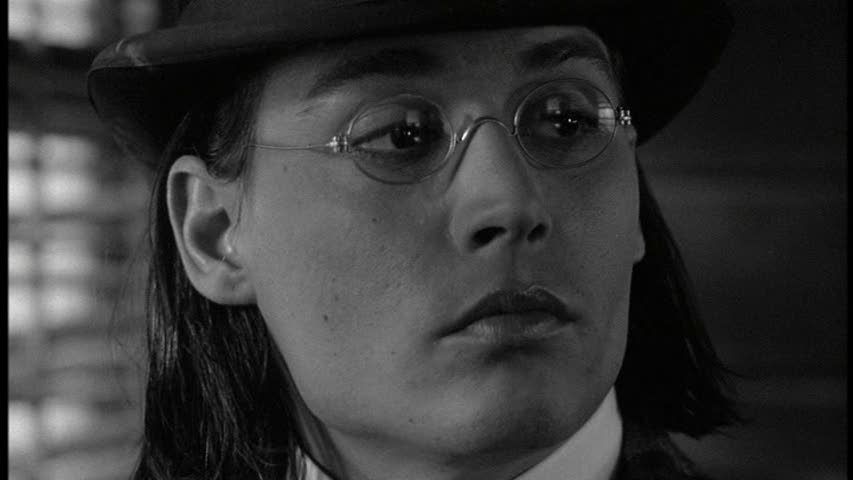
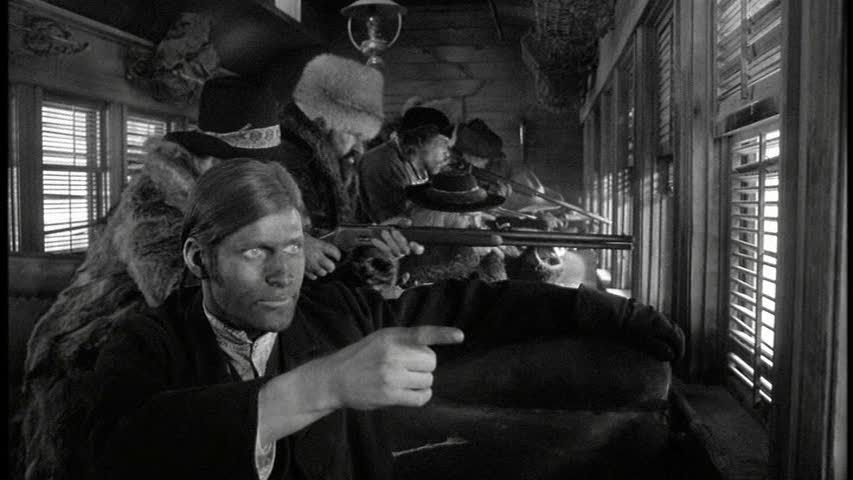
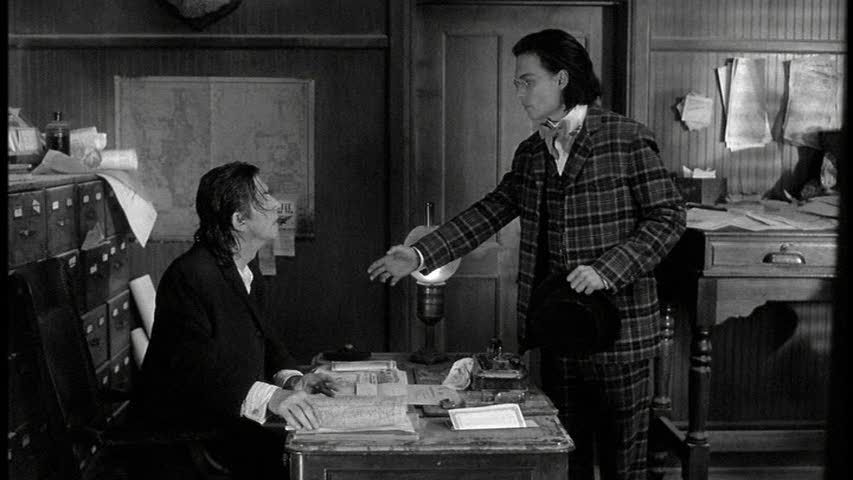
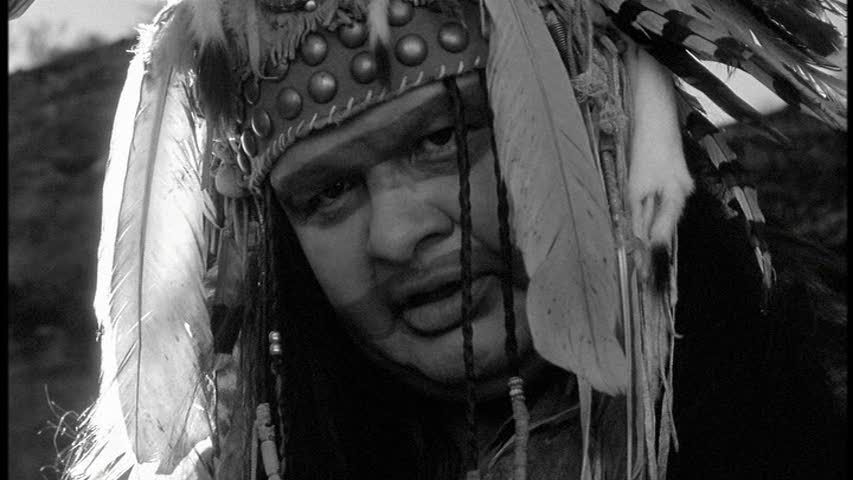
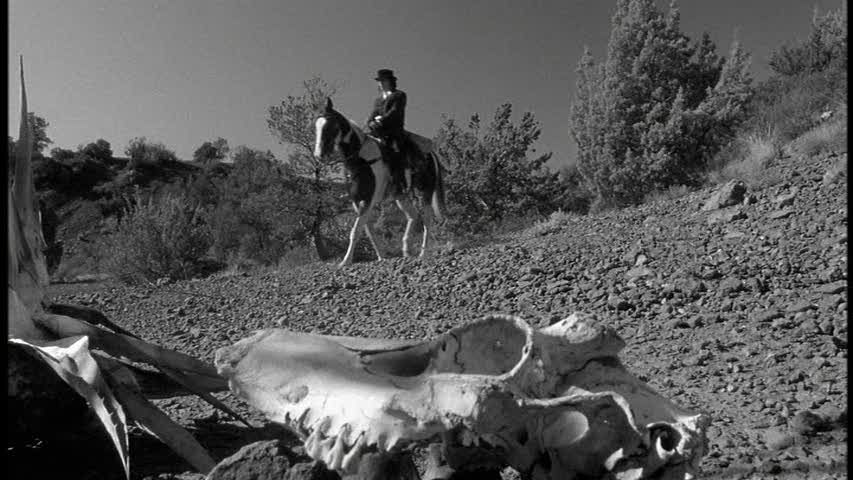
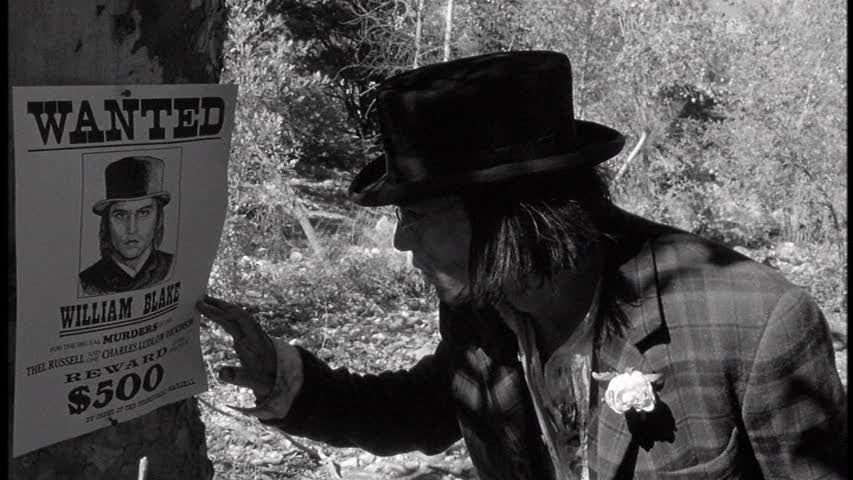
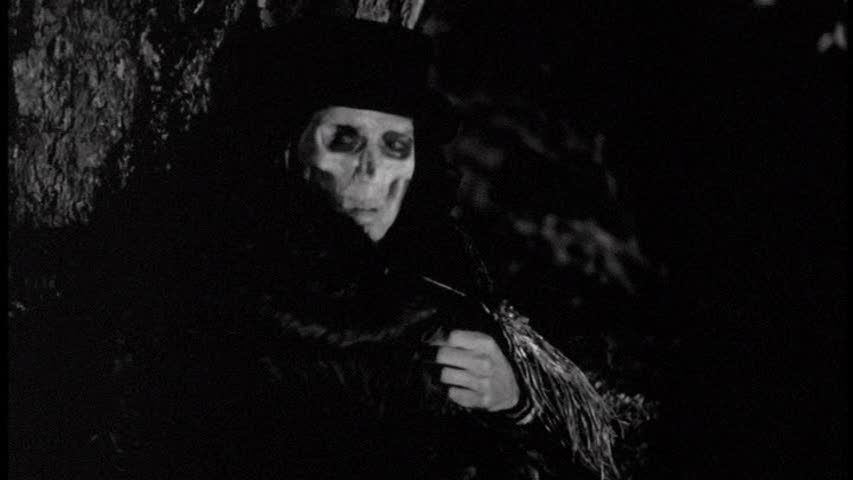
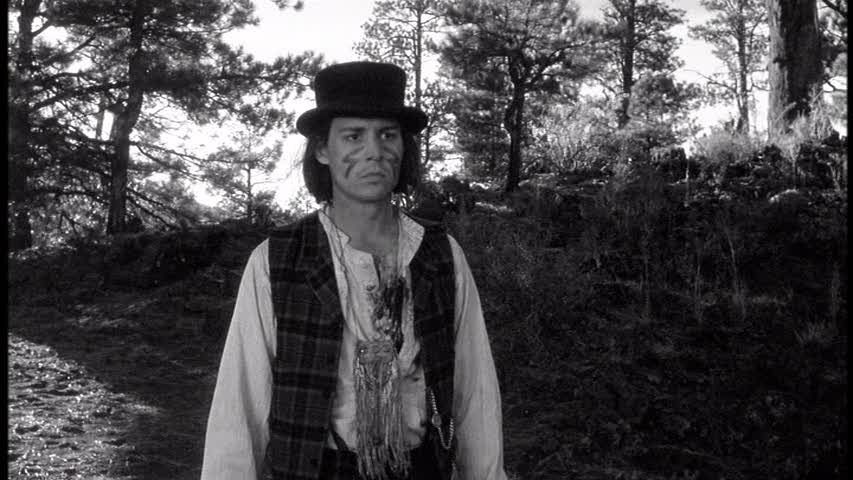
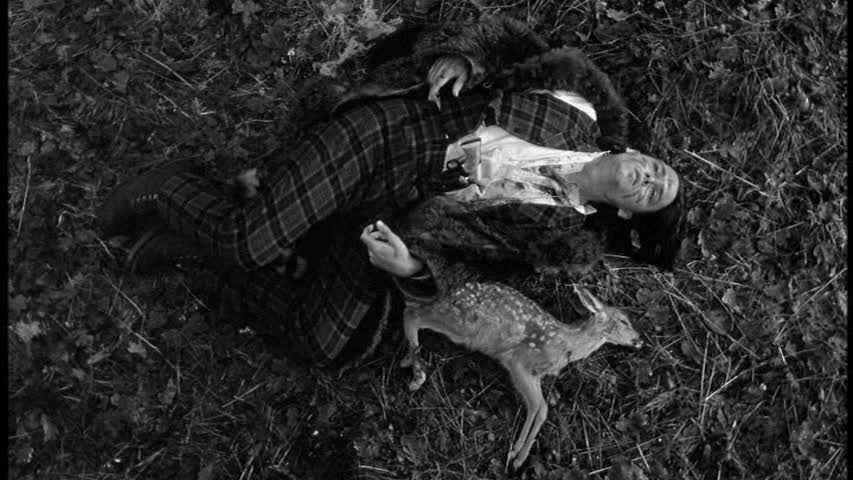
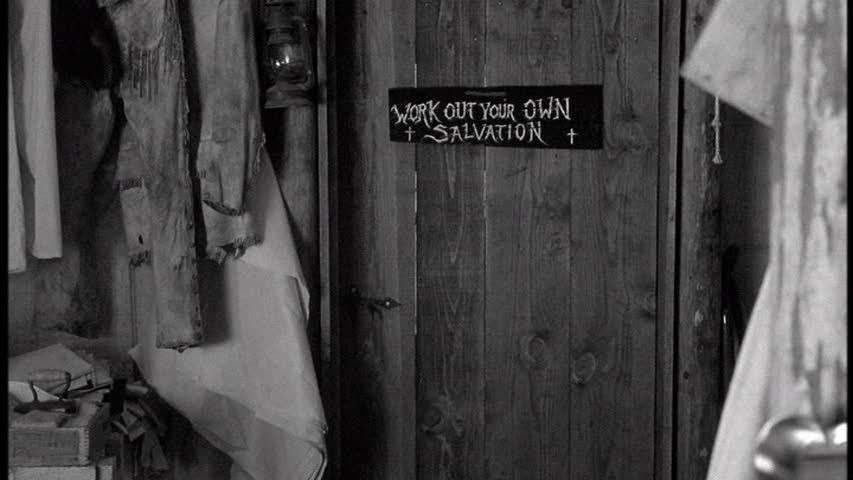
Dead Man is Jim Jarmusch's feverish American nightmare, a poetic vision of the American West — and the movie Western — as an endless plain of absurdist violence and senseless destruction. In the film's opening scenes, the accountant William Blake (Johnny Depp) rides on a train bound West following the death of his parents, towards the promise of a new job. But a coal-smeared train worker (Crispin Glover, in one of many memorable cameos dotted throughout the film) prophetically warns him not to trust in anything, not to expect sense or justice from the West. After all, he points out, as behind him the men on the train hoot and holler, shooting at buffalo through the windows, this is a land where millions of animals have been killed for no apparent reason. It's this idea that carries through the rest of the film, the idea of the American West as a surrealist frontier, where buffalo skulls line the walls, where friendliness is greeted with gunfire, where even sensual pleasure is deadly. Blake arrives in the West to find he doesn't have the job he was promised, but his true downfall comes after a gunfight in which he's wounded, fleeing with a bullet in his chest and an unjust dual murder charge chasing him.

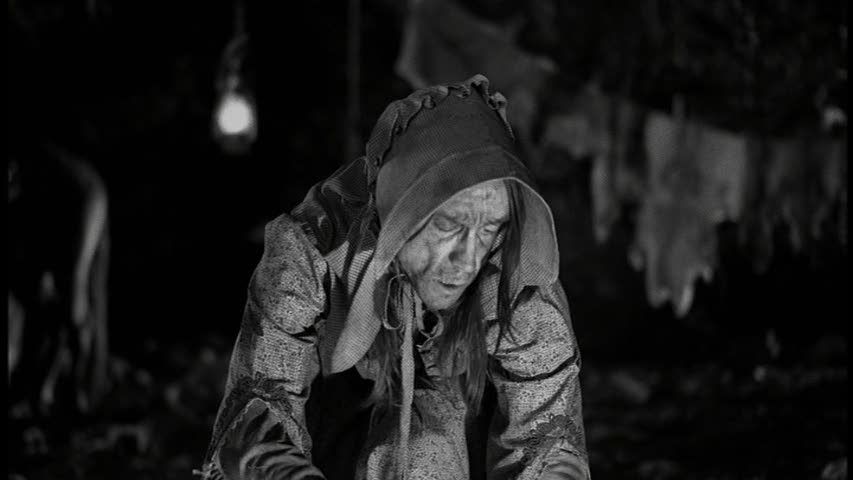
Wounded and weak, Blake is discovered by the Native American Nobody (Gary Farmer), who believes that his new ward is actually the poet William Blake. Together, they embark on a metaphysical journey towards Blake's eventual death, a spiritual adventure that Nobody approaches as if the other man is already dead, which maybe he is. In any event, Blake and Nobody's journey causes them to cross paths with Iggy Pop as a cross-dressing outlaw, an aging Robert Mitchum as a shotgun-toting factory owner who always appears in front of his own self-portrait, and Lance Henriksen, Michael Wincott and Eugene Byrd as a trio of ornery bounty hunters. The film's bursts of violence are darkly comic and ridiculous, with Depp's Blake evincing a serene detachment while his enemies are dispatched through Rube Goldberg-like bullet trajectories. The film is a fable of the West, a deconstruction of the scrubbed-clean Hollywood Westerns of old: Jarmusch makes his film about the exploitation of the Native Americans, the casual brutality and violence, the greed and power lust that drove men into the West, grasping at everything they could find. Jarmusch's poetic dream-story suggests an alternative to the cowboys vs. Indians mythology; this is the West in all its raw, nightmarish intensity, a West awash in blood and grit.

Rio Bravo

[This review has been cross-posted at Decisions At Sundown, a blog started by Jon Lanthier and dedicated exclusively to the Western genre. From now on I will be cross-posting all of my Western reviews with this blog, where I am one of several contributors.]

Howard Hawks' Rio Bravo is the pinnacle of the director's late style, in which he increasingly stripped his films down into ambling, nearly plotless examinations of his signature themes and the interactions of his characters. Hawks' cinema was always more about relationships than stories: relationships between male friends, between men and women getting to know one another, between professionals working on dangerous jobs together. Rio Bravo is about all these things, and as in much of Hawks' other late work, all the extraneous stuff, like the narrative, is pared away to focus more directly on these relationships as they develop and change. The plot itself is utter simplicity. Small-town sheriff John T. Chance (John Wayne) arrests Joe Burdette (Claude Akins), the brother of the notorious outlaw Nathan Burdette (John Russell). Chance holds Joe in the town's tiny jail, while Nathan schemes to break his brother out. The film was famously inspired by Hawks' well-known hatred of Fred Zinnemann's High Noon, in which Gary Cooper's small-town sheriff must plead with the unwilling townspeople to help him face off against an outlaw who's coming for revenge. The macho Hawks obviously despised this show of weakness, and conceived of Chance as standing virtually alone against the encroaching outlaws, aided only by a motley assortment of true friends: the drunken former deputy Dude (Dean Martin), the old cripple Stumpy (Walter Brennan), and eventually the quick-shooting young Colorado (Ricky Nelson).

From this slight material, an archetypal white hat/black hat story, Hawks developed one of the great works of cinema. His patient pacing allows plenty of time for the character arcs to develop naturally. Dude was once a proud, tough man, brought low by a woman and reduced to a pathetic drunkard, memorably introduced in the opening scenes stooping to pick up a coin that a man throws into a spittoon for him. Throughout the film, he struggles with his alcoholism, trying to regain control of himself, to reassert his dignity and intelligence and bravery, as well as his formidability with a gun. Chance is, in comparison, a bedrock of stoic self-confidence and moral rigor, though Hawks emphasizes that he's merely human too by including all of the fumbling, awkward love scenes with Angie Dickinson's ambiguous bad gal Feathers. These scenes play off of Wayne's own obvious discomfort in romantic scenes, infusing a layer of metafiction into each of them: is Chance thrown off balance by Feathers, or Wayne by Dickinson? Seemingly the only thing that can ruffle Wayne's drawling onscreen persona, pushing him out of his comfort zone, is the presence of a pretty girl, a fact Hawks would take advantage of again in Hatari!, to equally amusing effect.

There's a lot more going on in this film, too, even as virtually nothing actually happens. The film simply rambles along, the connective tissue between set pieces often consisting of lengthy scenes where the characters just sit around and shoot the breeze. Much of the film takes place in the tight, constricted space of the jail, where Hawks is comfortable filming tight, constricted compositions crammed with people. The joy of the filmmaking is palpable in every frame; there are few Hollywood movies that are so relaxed, so carefree. Watching Rio Bravo feels like spending a few hours on the set with Wayne, Brennan, Martin and Nelson, hanging out, cracking jokes, sparring sometimes in jest and sometimes in earnest, shifting between the two so smoothly that it's hard to tell when the characters' jokes bleed over into genuine hurt. The film is packed with incident, but somehow it never seems to add up to a real forward-moving plot, perhaps because the whole film is based around stasis: it's a waiting game. That's what gives it its unique charm.

The easygoing pace also allows Hawks the time to examine his themes and characters in depth, with subtle touches rather than broad gestures. There's surprising nuance and emotion in set pieces like the one where Stumpy nearly blows off Dude's head when the latter enters the jail unexpectedly. On its face, its a comic bit of action, a near-miss that the men can laugh about because it wasn't a hit. But it also lays bare some of the deeper emotions at the core of the story. Stumpy doesn't recognize Dude to begin with because the former drunk has cleaned up and gotten sober, has taken a bath and donned some new clothes, replacing his old threadbare, filthy rags. He looks like a real man again, and Stumpy, accustomed to seeing him as a ragged beggar, doesn't even realize it's him. It mirrors the earlier scene where the rancher Pat Wheeler (Ward Bond) doesn't recognize Dude because he'd never seen him sober before. Underneath the violent humor of the incident, there's this poignant undercurrent, as Dude is reminded yet again of how far he'd fallen, while Stumpy, behind his ornery chatter, is horrified by what he almost did to his friend.


Hawks treats these complex emotions seriously, but he never allows them to truly overwhelm the film's surface charm, its low-key wit and humor. After all, this is a film in which, at a pivotal moment, the characters decide to take a break and have a good old singalong, showcasing the star voices of Nelson and Martin. It's a wonderful moment, a perfect indication of the film's total commitment to its anti-narrative languor: when the tension is at its peak, the final showdown approaching, the characters break out into not just one but two folksy songs in a row, as though they had all the time in the world. Dude is lying on a cot with his hat shading his eyes, Colorado plays the guitar, and Stumpy hollers and plays the harmonica, all while Chance looks on, smiling benevolently, too stiff to join the fun but not to enjoy it. Indeed, one would have to be pretty stiff not to enjoy this film, which encourages the audience to revel in the sparkle of the dialogue and the ways in which the charming personalities of these likable actors blend seamlessly into their characters. Hawks, though he appreciated fresh faces too, was always adept at using star personalities in interesting ways, zeroing in on the essence of an actor and channeling that into his or her onscreen persona.

Here, the confined space of the jail allows Hawks to play these personalities off of one another, ricocheting Brennan's manic grouchiness off of Martin's slouching, half-speed delivery, while Nelson's boyish confidence resonates as a nascent version of Wayne's mature persona, his unflappable manliness. The film juggles these different personalities admirably, and the film's tone shifts smoothly between comic patter, hesitant romance, slow-building suspense, and action. Indeed, despite the laidback pace, Rio Bravo boasts some exceptional action sequences, not only the justifiably famous final shootout, in which Chance and his allies finally defeat the bad guys with dynamite, but also an earlier scene in which Chance and Dude track an assassin to a saloon filled with Burdette's men. This scene is formally precise, rigid in its geometry and use of the bar's space. It's through angles that Chance and Dude control the room, lining up the men at gunpoint in a straight line on one side of the room. The way Hawks frames this scene emphasizes how the two heroes remain on opposite sides of the room, both angled towards the disarmed bad guys, forming a triangle with the bar at its base and its point balancing on the line of criminals. The scene's denouement, in which Dude discovers the hiding assassin by noticing the man's blood dripping down into a glass of beer from above in the rafters, is similarly precise in its formal mastery.

For all these reasons and many more, Rio Bravo is one of Hawks' most sublime achievements: it's more like an old friend than a film, a familiar place to visit and revisit over and over again, always enjoying the company and the ragged charm of its storytelling.

The Treasure of the Sierra Madre


[This review has been cross-posted at Decisions At Sundown, a blog started by Jon Lanthier and dedicated exclusively to the Western genre. From now on I will be cross-posting all of my Western reviews with this blog, where I am one of several contributors.]

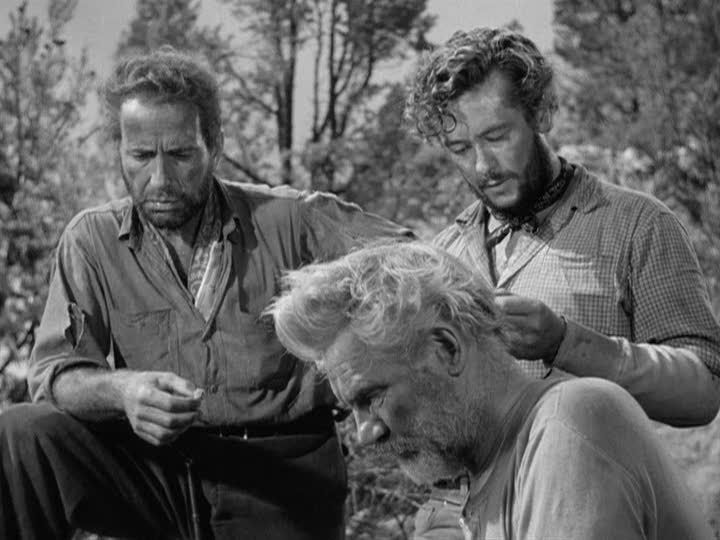
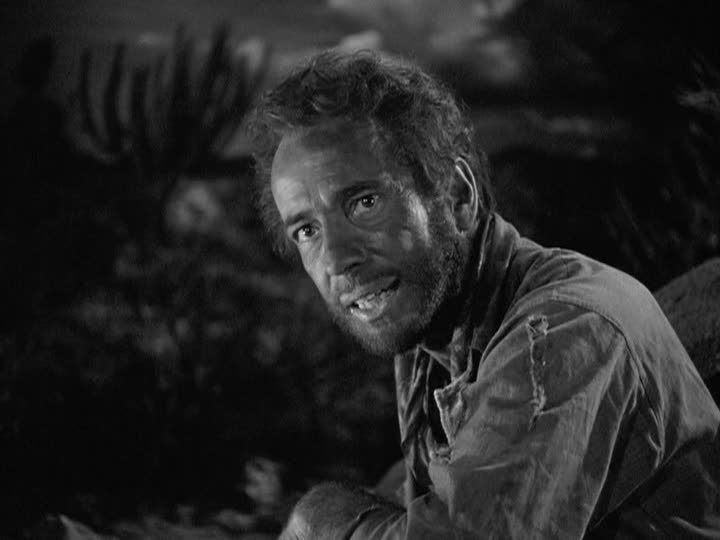
The Treasure of the Sierra Madre is John Huston's epic exploration of American greed, paranoia and violence, of the ways in which material wealth can corrupt the soul. It's a dark, relentless parable, setting up its central tensions very early on and then simply letting its characters slowly build up pressure until they inevitably boil over. Dobbs (Humphrey Bogart) is an American drifter in Mexico, scraping by without any dignity by begging for coins from American tourists. A running gag throughout the first segment of the film is Dobbs' habit of asking for change from the same American man in a clean white suit (played by Huston himself in a cameo). He asks the man for change three times, each time in the same way, each time receiving a coin, but finally the man blows up at him and asks to be left alone. It's both a moment of humor and a demonstration of just how pathetic and beaten-down Dobbs is; he hadn't realized that he was continually begging from the same man because he never looked people in the eye when asking for money, looking only at their hands and the money itself. Dobbs is a slave to money, debasing himself for it, obsessed with getting more of it. He soon meets a fellow American bumming about, the equally poor but slightly less desperate Curtin (Tim Holt), and the two of them decide to hook up with a wizened old prospector named Howard (the director's father Walter Huston) to look for gold.

This trio heads off into the mountains together to search for gold, but it's obvious from the beginning that there's too much tension between them for this to end well. Huston masterfully foreshadows the explosions to come, in tightly packed frames where the characters seem jammed together, pressed against one another, their fates intertwined as they share the same cinematic space. In one early shot, Dobbs and Curtin shake hands, agreeing to become partners, and Huston frames Howard in the background, looking on sadly at the hands joining in the foreground. It's obvious that he already knows: this union will be only temporary and fragile, will shatter as easily as two hands drawing away from one another after a handshake. (Or as easily as the film's illusion of verisimilitude is shattered whenever Huston awkwardly stages a fistfight.)

Throughout the film, Huston's images have this kind of clarity and insight into his characters. His deep-focus compositions are strikingly beautiful, but more than that they have texture, they have weight to them. The scratchy beards of the prospectors look as sharp and spiky as the spines of cacti in the rocky area around their camp. The dirt and exhaustion of their labor is palpable; they move with the feel of men who have actually just spent all day in the sun hauling rocks and swinging pickaxes. Huston immerses his audience in this world, and thus he allows the quarrels between the men to develop organically from their frustrations and daily toils. Dobbs' innate greed and ornery nature, already evident in the early scenes of him as a beggar in a Mexican town, becomes even more dangerous once he's at the gold mine.

In one of the film's most telling early scenes, immediately after Dobbs had begged enough money to get himself some food, he is approached by a young Mexican boy (played by a very young Robert Blake, of all people) asking for money for a lottery ticket. Dobbs simply snarls at the kid and tries to chase him away, even throwing a glass of water at his face. Dobbs has no sympathy for those like himself, no understanding of the parallels between his own situation as a beggar and that of this boy — once he gets some money, he doesn't care about anybody else. It's as though he's forgotten that only an hour earlier he'd been approaching strangers as well, begging for money without even a lottery ticket to offer in return. Later, when he's dreaming of what he'll do when he's rich with all his gold, he describes a rich man's day of indulgences: a Turkish bath, ordering fancy food at a restaurant, and treating the staff with contempt. Dobbs seems to see money as an excuse to act superior to others, to become what he hates when he's poor.


There's a not-so-subtle socialist undercurrent to the film in scenes like this, and at times it's startling just how much Marxist critique Huston was able to smuggle into the film. At one point, Howard all but quotes from Karl Marx, applying the labor theory of value to the search for gold, theorizing that gold is valued so highly because its price factors in all the labor that went into searching for it, not just of those who actually found it but of all those men who didn't find it as well. More pointedly, Dobbs is oblivious to his own class status, and he's such a miserable figure because he never recognizes any companionship with those who struggle, like him, for every coin that falls into their hands. Instead, Dobbs — like Curtin and Howard to a lesser degree — embraces the race for wealth, the all-encompassing greed that dictates that there is never enough. Instead of truly uniting himself with his partners, developing a trusting, mutually beneficial relationship, he sabotages everything with his paranoia and every-man-for-himself ethos.

Dobbs is, essentially, the ugliest incarnation of a popular American icon, the rugged frontier iconoclast, striking out on his own to make his fortune. Huston completely undermines this figure, suggesting that his determination is far from admirable, and Bogart plays Dobbs with ratty, nervous energy: he's both hunched-over and wrapped up into himself. He's cruel and vicious, a hard contrast against the compassionate, righteous Curtin and the vivacious, doggedly cheerful Howard. As Howard, Walter Huston continually steals the show, infusing his character with a touch of the eccentric old codger charm of a Walter Brennan role, as well as a quiet dignity and decency that shows through especially in the scene where he tries to read the last letter a dead man had received from his wife, and keeps stumbling over the words but determinedly pressing on. He's at his best, though, in the film's final moments, when he reacts to tragedy and defeat with hearty, heaving gales of laughter, his body shaking, his mouth wide open, letting out gasps and howls of convulsive laughter. It's the only possible reaction to the unfairness and absurdity of what's happened, the way all his struggles and labor have led, ultimately, to nothing, at least in material terms.

For Dobbs, of course, such laughter would never be possible. He's too obsessed with money to ever laugh so genuinely over its loss. He's trapped by money, and trapped by the things it drives him to do. In one of the film's most memorable shots, Dobbs lies down for a guilty, sleepless night beside the campfire, and Huston has the flames lick up across the frame, obscuring Dobbs' face from view, swallowing him up. Dobbs is sentencing himself to Hell, to a self-imposed Hell of greed and perpetually unfulfilled desires. He can never have enough, and so he's devoured and cast aside, with no one to protect him and no one to mourn his loss.

Night Passage


[This review has been cross-posted at Decisions At Sundown, a blog started by Jon Lanthier and dedicated exclusively to the Western genre. From now on I will be cross-posting all of my Western reviews with this blog, a valuable resource for the Western genre.]

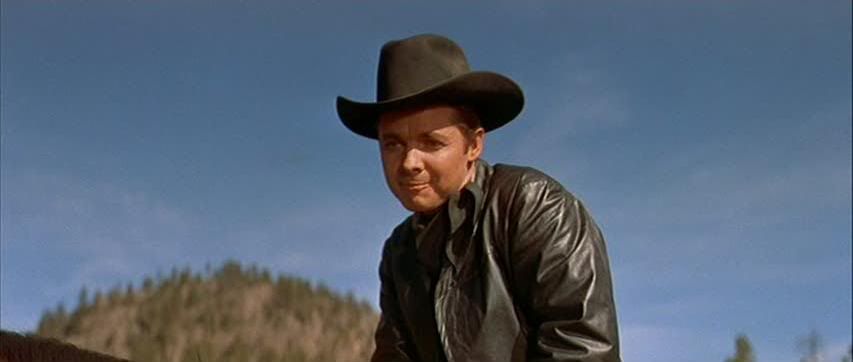
Night Passage is best known as the film that ended the fruitful period of collaboration between director Anthony Mann and star James Stewart. The pair had made eight films together, and this was to have been the ninth, until Mann walked off the picture, citing the poor script and costar Audie Murphy. The finished film, directed instead by James Neilson, proves Mann right, and one can only regret that the Mann/Stewart friendship was ended by such a slight film — Stewart never worked with Mann again. The film itself is melodramatic and convoluted, surrounding a relatively straightforward story with all sorts of distractions and ornamentation, populating it with an oddball cast of bit players who keep wandering into the story for no apparent reason. It gives the film a weird, faux-folksy vibe, a very stagey, artificial idea of frontier life. The core of the film is a story of redemption, about the former railroad troubleshooter Grant McLaine (Stewart), who was fired from his job, suspected of working with train robbers after he allowed the outlaw the Utica Kid (Murphy) to escape. Now, Grant still hangs around the train camps, playing his accordion for money, until a string of payroll robberies cause the train management to ask him back.

This story is the film's center, and one can imagine it being made with Mann's characteristic toughness and single-mindedness, with a driven Stewart willing to do anything to redeem his shattered reputation. One can also imagine it, with twenty minutes cut out, as a stripped-down low-budget B Western. Instead, it's bloated and torturously overwritten, with so many characters crowding around the fringes of the film that it never really acquires a forward momentum. There's Grant's former girl Verna (Elaine Stewart), now married to the train company boss Kimball (Jay C. Flippen) because she'd believed Grant was a crook. There's the local restaurant girl Charlie (Dianne Foster), patiently waiting for the Utica Kid to go straight so she can marry him. There's crooked railroad man Renner (Herbert Anderson), struggling cross-country on a mule, trying to reach the robber gang to give them information. There's a kid named Joey (Brandon de Wilde) who was formerly a lookout for the gang but ran away and started hanging around Grant instead. There's an ornery old frontier woman named Ma Vittles (Olive Carey), who seems to wander into the frame whenever things are starting to get slack, to provide a bit of eccentric humor. There's a big group of tough Irish railroad workers waiting for their pay and getting antsy, brawling and dancing and running after the prostitutes kept around the camp for them. And of course there's the wild outlaw leader Whitey (Dan Duryea doing his best whiny, cackling impersonation of Richard Widmark in Kiss of Death) and his gang, among them, of course the Utica Kid.

This is a big cast for a short little Western actioner, and director Neilson can never quite manage to balance the film's many different tones against each other. The ragged comedy relief of Ma Vittles and the railroad workers, including a bickering married couple, sits uncomfortably against the darker undercurrents of Grant's beaten-down depression. And then there's the musical numbers, with Stewart lip-syncing along with a couple of accordion tunes. There's even a dramatic showdown with the Utica Kid — who turns out to be his brother — where he wins over the Kid by playing a song their father always used to play on the accordion. Neilson captures the moment by focusing on the Kid's foot as it starts tapping along with the rhythms of the music. It's silly and kind of goofy, as is the sight of Stewart lugging his accordion around with him everywhere he goes, including into battle.


The film does have a few virtues, mainly in the grandeur of its Technicolor compositions of the open range, a virtue it shares with even the worst of the period's Hollywood Westerns. Its action sequences are also satisfying, particularly the robbers' assault on the payroll train, with the Utica Kid watching it all from a high cliff, as below the other men break off into groups, each accomplishing their tasks with mechanical efficiency. Later, the multiple shootouts of the climax are inventively staged, with real urgency. The first is a confrontation in a darkened saloon after Grant smashes out all the lights and hides behind the bar, shooting through the darkness at the robbers while he makes his escape beneath the floorboards. Then, after a chase through a (suddenly sunny) valley, shot from a distance to emphasize the wide blue sky, Grant and the robbers settle in for an extended siege at an abandoned mining camp, where Grant picks off the gang one by one. Neilson obviously knows how to stage action, and these scenes are as tense and well-crafted as the rest of the film is aimless and talky.

Night Passage is obviously a second-rate Western, a meandering mess of a film that only really comes together when the trite dialogue (including Grant's corny speeches about good and evil and "the soul") is replaced by gunfire.

3 Godfathers


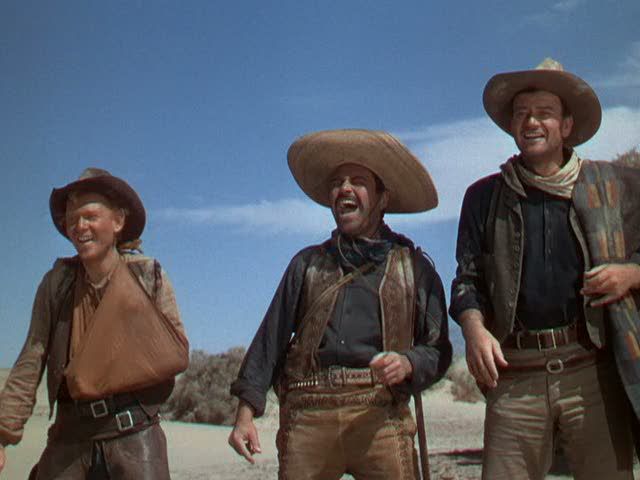
Three outlaws ride into the town of Welcome, Arizona on a clear, calm day, planning to rob the local bank. They're not particularly hard men. They're cattle rustlers, used to making money off a few stray cows here and there. This will be their first bank robbery, maybe, their first attempt at something bigger and badder. Not being hard men, they exchange pleasantries and share coffee with a man they meet on the outskirts of town, a man named Buck Sweet (Ward Bond), who turns out to be the local sheriff, the man who will dog these outlaws relentlessly for the next few days of their lives — for some of them, the last days of their lives. John Ford's minimalist Western 3 Godfathers begins with this easygoing introduction, with three friendly, good-natured men passing the time before a robbery with the man who will shortly become their worst enemy. The three outlaws are Robert (John Wayne), William (Harry Carey, Jr.) and Pedro (Pedro Armendáriz), and their first appearance in the film makes it clear that, despite their shiftless ways, they are not bad men, merely misguided, perhaps with few other options available to them besides making money in various dishonest ways. They are sympathetic bandits, driven not by greed but by simple necessity to rob and pillage.

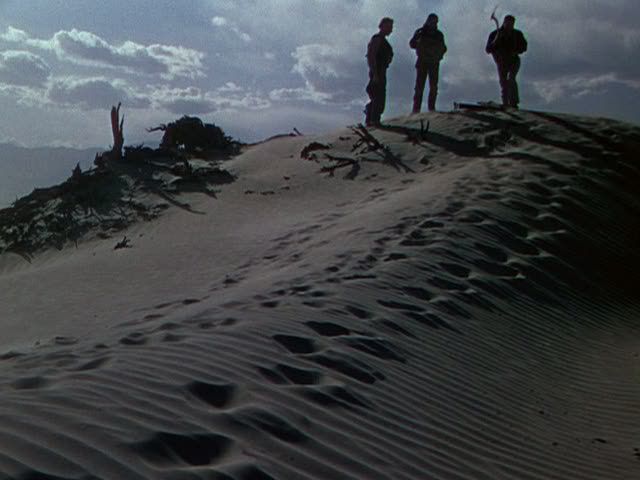
Ford introduces these men in an economical, fast-paced prologue, establishing their essential decency and then staging the bank robbery itself as a quick flurry of motion and gunfire, a harsh interruption of the tranquil, friendly atmosphere of this town, which seems to have earned its name as a welcoming place. The men then flee into the desert, where they'll wander for the remainder of the movie, hemmed in by the forbiddingly dry, desolate land and the sheriff's posse cutting off both their routes of escape and their access to water. With the sheriff's men staked out by the two closest water supplies, the three bank robbers must make a dangerous trek across the desert towards a more distant water tower where they can slake their thirsts and tend to the worsening bullet wound in William's arm. Ford, always a master of landscape and location, makes the isolation of the desert felt intensely, shooting his three anti-heroes as fuzzy silhouettes within wide shots in which the blank white expanse of the cracked desert hardpan is matched only by the open blue of the sky, a stray fluffy cloud or two scrawled across its surface. Many of Ford's compositions divide the frame horizontally between sand and sky, with the outlaws' staggering forms positioned right at the boundary line, trudging through the sand and pushing forward against high winds and overpowering heat.

The film's visual palette is thus simple, in the way that a Mark Rothko painting is simple: an area of pale blue hovering above an area of white, with a hazy horizon line and a few indistinct black blotches separating the two color fields. These stark compositions, like Rothko's, create subtle tensions and resonances between the halves of the frame. Sand and sky both serve to isolate the protagonists within large open spaces. The sheer scope and grandeur of these images suggests spirituality, or at least an understanding of man as insignificant within the scale of the world — let alone the universe. This is why the opening bank robbery is quickly forgotten, and the motivations behind it and the outlaws' other crimes never explained. Those are petty human concerns, and this film quickly positions its protagonists in a setting where concepts like material wealth are increasingly remote. As soon as these men are out in the desert, it doesn't matter that they've made off with a sack full of money, and indeed the money is never mentioned again. The money is perhaps in one of the parcels they shed during their trek, shrugging aside their worldly possessions as these things become too burdensome. As with Rothko, one gets the sense that for Ford, size itself is a signifier of spiritual feeling and philosophical inquiry: the pale expanse of the sky and the salty white ground envelop these men, inescapably confronting them with their own mortality. One begins to suspect that this film, and not the more recent antecedents so often mentioned, is the true predecessor to Gus Van Sant's existential desert movie Gerry.


The three outlaws of the title wander endlessly through the desert, trying to reach their amorphous destination, which is at best only a momentary resting place, a way station for them to recover slightly before continuing their flight. But even these uncertain plans are disrupted when the men stumble across a covered wagon abandoned at a water station whose tanks have been drained dry. Inside the wagon, they find a dying woman, pregnant and on the verge of delivering her baby, left behind by an incompetent husband driven half-mad by lack of water. They help her deliver the child, a boy who she names after all three men — Robert William Pedro — and then, before she dies, she exacts a promise from them, a promise to protect her baby, to take him from the desert and bring him to safety.

This is an extraordinary situation, but the three outlaws take this promise very seriously. Despite the constant threat of the posse catching up to them, and the desperate lack of water and food, they are determined to bring this child safely out of the desert. In his quiet way, Ford completely shifts the driving force of the movie: the men are no longer trying to escape themselves, but only trying to help this baby survive, even if it means forgoing water for themselves completely, even if it means that some of them will not survive the journey across the desert. Ford never makes a big deal of it, but finding this baby is a moment of redemption for these men, the moment at which they cease caring about themselves and start caring about the pure, innocent fledgling life they hold in their arms. There's no sudden shift, no hesitation, because these are three decent men to begin with; being charged with the care of this baby simply reminds them of their inherent decency, redeeming them from their outlaw lives. In the latter half of the film, their journey increasingly takes on Biblical overtones, reflecting the journey of the three wise men to visit the baby Jesus on his birth. That the film's denouement takes place on Christmas is only the most obvious of the parallels between the stories, though this heavy-handed symbolism merely makes explicit the themes and ideas already apparent in the film's more subtle moments.

At the same time, Ford's treatment of these symbolic religious elements gives the film's final act a kind of sentimental poetic spirit, embodied in the broad emotional strokes of the climax, which subverts traditional Western ideals and denies the lawman his cathartic showdown with the last outlaw standing. Instead, the ending is a moving affirmation of family bonds and community, providing John Wayne's Robert with a much more optimistic resolution than the one he'd receive as Ethan Edwards a few years later in The Searchers, another film that ends with Wayne's character returning a child to its proper family. Ford holds out the hope of redemption to his characters, the idea that one can re-embrace society and family and spirituality after stumbling off the path. This is a warm, moving, often even humorous film, inflected with patches of folksy comedy to offset its bleak, deadly landscapes. Painting with the earth tone palette of the desert, Ford composed a large-scale tribute to spiritual redemption and determination.

The Duel at Silver Creek


Don Siegel's The Duel at Silver Creek is a sturdy Western actioner, a minor but enjoyable B-movie built around rugged location shooting and a good amount of fast-paced action and gunplay. A gang of claim-jumpers led by the slimy Rod Lacy (Gerald Mohr) is tearing through the West, forcing the owners of small mines to sign over their deeds before filling their victims with bullets so they can never be identified. They terrorize the small mines scattered around the area, until they run into some trouble at the mine belonging to Luke Cromwell (Audie Murphy) and his father; the gang kills Luke's dad, but the quick-drawing kid takes down three of them, causing the rest to flee. The film then shifts its focus away from Cromwell, turning instead to "Lightning" Tyrone (Stephen McNally), the Marshal of a nearby town, who goes out with a posse after the claim-jumpers, and while he's gone also loses his own father figure, an older lawman who's shot in the back while the marshal is out of town. When Tyrone returns from his unsuccessful jaunt after the outlaws, sporting an arm wound that has crippled his ordinarily formidable skills with a gun, he finds his friend dead and a new mining operation set up in town. He also has a new love interest, the sexy and deadly Opal Lacy (Faith Domergue), whose "brother" Rod is the secret leader of the claim-jumpers. Opal's introduction is certainly memorable: she appears as a fine lady in an ornate outfit, volunteering to help nurse a man who could potentially be a witness against the claim-jumpers. But when everyone's out of the room, she strangles the man with his own handkerchief, while Siegel holds a tilted Dutch angle closeup looking up at her face, her pretty features expressionless, her placid beauty hiding an inner evil.

Opal is contrasted against small-town beauty Dusty (Susan Cabot), the good girl who's waiting for Tyrone at home — but who he thinks of as just a little sister. Enter Cromwell back into the picture, sporting a new nickname (the Silver Kid) and a hard new attitude. The scheming Opal tries to set the Kid and Tyrone up for a gun battle, hoping to get the marshal out of the way, but instead Tyrone makes the younger man his deputy. At this point, the static melodramatics of the small town threaten to bog the film down, as too much time is spent with Tyrone courting Opal while the Kid makes a play for Dusty — and in the background, Lacy and his gang scheme against them all, employing local hoods like the inventively monikered but kind of lame Johnny Sombrero (Eugene Iglesias) and Tinhorn Burgess (a cigar-chomping bit turn for Lee Marvin). In between the rousing action of the opening and the extended climactic shootout, the film meanders around aimlessly, stretching out its meager plot to fill time between action set pieces.

That said, it's fun to watch the two girls fleshing out their cardboard cutout roles, with Cabot projecting a feisty, frontier gal energy and Domergue opting for sleepy seductiveness. And it's equally fun to watch Marvin make the most of his small role, thrusting his thin face forward with his cigar jutting forward even more, as though trying to imprint his visage in the minds of anyone who watches. This scenery-chewing from the sidelines fortunately helps distract from the boring leads, especially McNally, whose soporific narration certainly doesn't help in dragging the film out of its roughest patches. Murphy, with his usual stoic manner and baby face, has a certain low-key appeal, but he's more of a negative presence than anything else: one feels the absence of emotion in him, the absence of acting, even when he witnesses his father being killed.


If the film falters throughout its mid-section, it picks up again for a viscerally satisfying and intelligently filmed climax, in which Tyrone, the Kid and their posse head out after the claim-jumpers to stop them for good and rescue the kidnapped Dusty in the process. There is much to admire in the economy and elegance of Siegel's action filmmaking, in the exciting chase and gunfight sequences at the beginning and end of the film. His set pieces make excellent use of distance, of the space between combatants. This is true not only of the traditional Western main street shootout — shot from behind the back of one of the fighters, the perspective emphasizing the empty space that simultaneously separates and connects them — but of the much more complex trajectories of the final battle scene. When the Marshal is chasing Lacey during the climactic fight, Siegel's wide shots accentuate the space between the pursuer and his quarry, as well as the line-of-sight threads connecting them, the paths along which bullets can travel back and forth. Their showdown takes place not at close range but across a large distance, the two men laying low and warily maintaining their cover and their separation.

The geography is what really drives the action: Siegel is unusually attentive to how the characters get from point A to point B, how the angles of the gunfire are distinct for a gang member hiding high up on a rocky outcropping or a deputy crouched beneath a wagon. This is what makes Siegel's action sequences so thrilling and potent, the impression that everything is in its right place and that complex trajectories are being plotted out in the air, which is thick with bullets. Siegel's maybe a bit like Budd Boetticher in this respect, though unlike Boetticher the precision of his staging is largely confined here to the fight scenes. The violence in this film is frantic and seemingly chaotic, and yet also carefully balanced, every motion carefully planned — like the way the marshal rides off in pursuit of Lacy, sending a bullet at a diagonal towards a henchman on the way. The impressive staging of the action sequences, along with some eye-catching supporting performances and the natural color beauty of the landscapes where these battles take place, redeem the film from being just another mediocre B-Western.