Showing posts with label Woody Allen. Show all posts

You Will Meet a Tall Dark Stranger


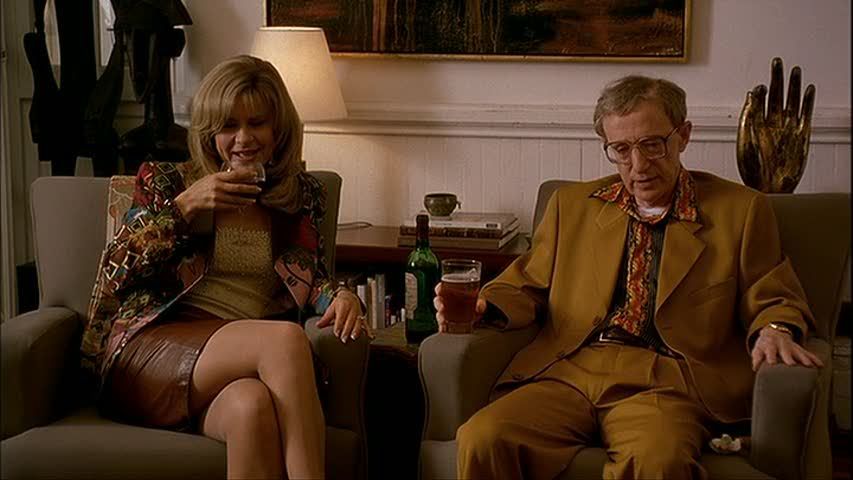
It's usually taken for granted, but it's a little amazing that Woody Allen, well over 40 years into his career as a writer-director, continues to be so prolific, to work at the fevered pace of a young man, delivering a film, almost without fail, every year. Granted, not every one of those films is any good — and there are plenty of people who will tell you (mistakenly, I believe) that most of them aren't — but Allen's inexhaustible desire to create, to tell his stories, remains impressive. In recent years, he's delivered at least one masterpiece (the melancholy, incisive Vicky Cristina Barcelona) and a string of variably successful tales about those characteristic Woody subjects: murder, infidelity, dissatisfaction, the desire to be creative and engage with culture. Last year's You Will Meet a Tall Dark Stranger — not even his most recent film, because as a I write this Midnight In Paris is in theaters and another film is already in the works — strikes me as an utterly typical Woody Allen film. It's not a great film, sometimes not even a good one, but rather an embodiment of the Woody ideal. It's what people think of when they think of his work: wry, cultured people cheating on one another in picturesquely filmed settings, eloquently expressing their disappointments. It feels, at times, like Woody by numbers, like even the director himself has internalized the popular conception of his sensibility and has turned out a film that diligently hits all the expected notes of a Woody Allen movie. For all that, the film is often emotionally compelling and, after a rather wan opening act, opens up into a film with some surprisingly intense emotions bubbling up beneath its familiar surface.

The film focuses on several troubled relationships, centering around the family of married couple Roy (Josh Brolin) and Sally (Naomi Watts). Roy's a once-successful, now struggling writer, and Sally is an assistant at an art gallery, both of them in characteristic Woody Allen professions. Sally's parents have gotten a divorce: Alfie (Anthony Hopkins) is possessed by a fear of getting old and becomes obsessed with appearing youthful and vigorous, an obsession that his wife Helena (Gemma Jones) can't share. The film follows these characters as their relationships splinter and new possibilities become apparent; this is Woody's essential subject, the follies of love and desire, intimately linked with the follies of how his characters view themselves, their ambitions and their dreams. The film's situations are familiar in every sense, all following similar romantic comedy templates: Roy becomes fascinated with the beautiful young woman, Dia (Freida Pinto), whose window faces his, Sally grows infatuated with her boss Greg (Antonio Banderas), Alfie falls for a trashy young prostitute (Lucy Punch) who he impulsively asks to marry him, and Helena begins visiting a psychic (Pauline Collins) who reassures her that her future is rosy. These various subplots are predictable, but Woody manages to extract some surprising depth from these old stereotypes.


The scenes between Naomi Watts' Sally and Antonio Banderas' Greg are the film's most emotionally compelling and indeed startling moments, largely because Woody gets such a powerful performance from Watts, who becomes the fiery emotional core of this film. At one point, Greg invites Sally to go to the opera with him, and Sally, who has been nursing increasingly strong feelings for her boss, is excited for the opportunity. There's a great shot of Sally looking obviously stirred by the music at the opera, her eyes slipping sideways to admire Greg with a slyly upturned smile on her lips, her eyes shining, moved by the music and by her attraction to her companion. It's a wonderful moment, wordlessly communicating the intense emotions she's feeling, and this shot's intensity is carried over into the duo's awkward but charming conversation in the car later, as Greg drops Sally off at her home. The romantic tension lingering between the pair is obvious, and the possibility that one or both might lean over at any moment for a kiss hangs between them, unfulfilled, as they stammer and banter.

This emotional subtext is carried over into the later moment when Sally at last hesitantly admits her feelings for Greg, while he awkwardly tries to steer the conversation away from the subject without hurting her feelings, without openly admitting that he does not reciprocate her desire. But Sally refuses to drop the subject until she's gotten some closure; she is obviously determined to follow this through to the end so she knows if what she wanted could ever have been possible. Woody inserts a closeup of Sally, her mouth straining with forced smiles, her eyes barely holding back tears, her face growing increasingly red as she realizes that she's opened up her heart while Greg has shunted her feelings aside, as gently as he could but still painfully. Woody cuts between the two to emphasize the distance between the suave, unmoved Greg, who doesn't seem to fully understand his employee's overwhelming emotions, and the frazzled, disintegrating Sally, who presses on even as she realizes that she's not getting through, that any connection she imagined only existed in her head. Sally's face is heartbreaking: there's such hope in her expression, mingled with despair and desperation and also the dawning understanding that she was wrong.


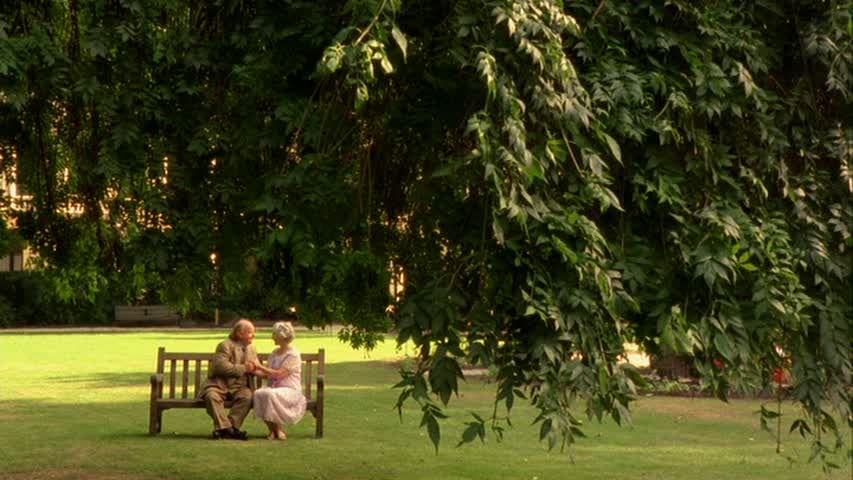
At the same time, Roy is developing a flirtatious friendship with Dia, their neighbor across the way, who he spies on from his window, watching her play guitar or strip out of her clothes to make love to her fiancé. The two begin spending afternoons together, walking in the park in scenes that recall the cinema of Woody's longtime influence Eric Rohmer, particularly The Aviator's Wife, in which an afternoon spent in a lakeside park similarly flirts with infidelity. The flowery natural beauty of these scenes, coupled with the somewhat eye-rolling romanticism of the fact that Dia always dresses in red, suggests that these scenes are more symbolic than actual. Roy speaks of Dia as his muse, his inspiration, and though he desires her strongly he hardly seems to think of her as a person. That's why it's so surprising when, late in the film, Woody suddenly confronts Roy's romanticism head-on, abruptly revealing that the character's romantic conception of this affair was not necessarily shared by the director or the film. In one scene, after Roy moves out of his home and into Dia's apartment, he looks across the way and sees Sally stripping out of her clothes into black underwear, looking sexy and desirable, just as earlier he'd watched Dia. The shot reinforces the truism that one always wants what one doesn't have, and suggests the first moment of self-awareness for Roy, the first suggestion that he was chasing after a dream and might come to regret it. It's a self-awareness he flinches away from, sadly closing the blinds on the view. In another scene, Dia is angrily and tearfully confronted by her fiancé and his family after calling the wedding off, another reminder that the romantic plot between Roy and Dia is not without its casualties, that what seems so wonderful for Roy is bitterly painful for other people.

You Will Meet a Tall Dark Stranger often seems light and cheerful, if not outright comic, so such moments of emotional catharsis are bracing and powerful when juxtaposed against the generally pleasant tone of the film. It's not often a full-on comedy, though Woody's wit does cut through in places, often wedded to the film's darker emotions. In one scene, Helena says about her new boyfriend, "He left me for another woman. A deceased one. They're often the stiffest competition." And then, as though realizing that in her grief she's accidentally told a joke, adds in the same shell-shocked monotone, "no pun intended." The joke itself is classic old-school Woody humor, somewhat corny even, but it's made funny — and also sad and true — by the way it's delivered, an offhanded acknowledgment of the accidental humor that resides in even the saddest stories, a nod to the kinship between tragedy and comedy.

In that regard, this film's navigation of those two dramatic extremes is much defter than the thematically similar Melinda and Melinda, in which Allen tried to separate the two impulses to explore their connections and disjunctions. The link between the funny and the pathetic is much more organic here, and the film knowingly climaxes with dual scenarios that hint at the murder plots of other recent Allen films, without quite heading in that direction. This isn't a great Allen film. It takes a while for the clichés of the film's various plots to resolve into something deeper, and as a result the early stretches of the film are often unsatisfying and awkward. The voiceover, a convention that Woody has increasingly embraced, seems especially tacked on here, and the pat way in which the narration frames the film with references to Shakespeare is just silly. But despite these flaws the film finds Woody investing these overly familiar situations with wit and emotional life, with sparks of energy that go far beyond the basic templates that he is drawing from. Even Alfie's story — by far the most clichéd with its male crisis jokes about Viagra and dumb blondes — climaxes with a moment of surprising emotion in which the hapless Alfie suddenly channels some of Hopkins' sinister intensity, projecting the deadly-serious emotions of a man who's been treated like a punchline for too long. Such moments of emotional revelation, in which Woody unexpectedly overturns and subverts the clichés of the romantic templates that drive the film, make You Will Meet a Tall Dark Stranger much more than it initially seems to be. In a way, that's the theme Woody is dealing with here: life may follow familiar patterns, but just because a story is familiar doesn't mean that it's not real and painful and exciting and full of surprises for those actually living it.

Whatever Works


Woody Allen's latest film, Whatever Works, is a shambling, loose-limbed dark comedy about the improbability of finding love and acceptance amidst the insanity of life. It is, by turns, awkward, painful (or just painfully bad), funny, insightful, aggravating, startling, sweet, bitter, and lots of other stuff too. It is as though Allen, having just made one of his most formally precise and carefully constructed films, the quietly affecting Vicky Cristina Barcelona, was determined to follow it up with one of his messiest, strangest movies, a frenzied patchwork that despite its often awkward construction and uneven performances, emerges as an oddball success by the end. At its center is one of Woody's most unlikable characters, the relentless pessimist and misanthrope Boris (Larry David), a man who's convinced that he's a genius and that nearly everyone else are morons — although what does it say about him that he's proud to be a genius among "inchworms?" He's a thoroughly unpleasant man, which makes it more than a little unlikely that so many people would like him and gravitate to him, seemingly instantly attracted to his unceasing stream of insults and his superior attitude. This is a typical trope for Woody, one he's never been able to get over, even when he's not the one playing the central figure: no matter how rotten and unsympathetic his protagonists are, he can't help also making them magnetic and charismatic in some weird way that the audience can't see but the people in the film, apparently, can. To the audience — who Boris addresses in the opening scene with a frontal assault of invective and complaints, a virtual invitation to walk out — Boris is mostly just a jerk, a guy with an inflated sense of his own importance, a once-brilliant physicist who now gets his jollies beating eight year-olds at chess.

Boris' schtick keeps vacillating back and forth between funny and enervating, and sometimes both at once. His non-stop flow of words, his negativity and despair, is exhausting. And the film is at its worst in its tentative first half-hour, as Boris meets a young Southern runaway named Melodie (Evan Rachel Wood) and takes her in. The premise is so unbelievable that even Woody seems to know it, and the scene where Boris invites her up to his apartment is one of the most poorly staged and acted in the film, an obligatory few lines of stilted dialogue to change this guy's entire life; it's like a shrug, an acknowledgment of the flimsiness of the material, and everyone involved just seems to want to get it over with. It's equally hard to take Boris' condescending attitude, and Woody's willingness to caricature his heroine into a cartoon rather than a person — she's so dumb, so airheaded, so empty, and Boris just piles the verbal cruelty onto her as she smilingly takes it, uncomprehending. It's nasty and uncomfortable, and Wood's labored acting only makes the experience more painful.

Even when the film's at its nadir, though, there's something buzzing underneath, an undercurrent of vitality, the zing of the occasional funny lines that sneak through the misogynist abuse. And then something strange starts to happen. One day, Melodie's mother Marietta (Patricia Clarkson) shows up on the doorstep, desperately searching for her runaway daughter. She's a typical religious Southern housewife, another caricature, and yet already something seems different: she's witty and sharp and has depth. She's not an airhead, she's a real woman, and when she arrives Woody's hobbling script, salvaged from a wood-shedded 70s screenplay, suddenly blossoms into a real movie. Clarkson's a phenomenal actress, which is part of it, but it's also that the film opens up beyond its claustrophobic concentration on the improbable relationship between Melodie and Boris, and instead begins to branch out in all sorts of interesting, unpredictable ways. And when Melodie's even more straight-laced father John (Ed Begley, Jr.) shows up, the film's delirious satire really takes over.

What's going on here, actually, is a vision of New York as a place of seduction, not even just a place but a symbol for an entire lifestyle and way of thinking. Woody's film imagines New York as a permissive liberal Gomorrah, the nightmares of right-wing hysteria incarnate, a place that can suck in decent, God-fearing Southern folk and warp them into being promiscuous, or gay, or, worst of all, artists. It's an ecstatic vision of New York, the city Woody has always loved so much, as a place of transformation, a hub of freedom and choice and individuality, an incarnation of Boris' oft-repeated philosophy that whatever you can do in life to get a little happiness, a little pleasure — whatever works for you — that's a good thing. It's a marvelous twist on the old cliché (and Boris hates clichés) of the horrified small town hick who comes to New York and is puzzled or repelled by it — a twist on those hilarious Tina Fey impersonations of Sarah Palin coming to New York, "home of the liberal media." Woody is celebrating the aspects of New York so often mocked from afar, he's celebrating the artsy fartsy galleries, the intellectualism, the culture, the movies you have to read, the free love and affairs and unusual sexual situations, the openness to homosexuality, the rejection of religion. This is, more than anything, Woody's heartfelt celebration of liberal excess, and the most refreshing thing about it is that he doesn't portray the Southerners as simply stuck-up, close-minded, judgmental Bible-thumpers — when confronted with what New York has to offer, it turns out, they're open-minded and accepting and, hey, they kinda like it.


This is rich stuff, and richly funny, too. Woody races through the actual plotting, but not the emotions underneath — the transformations of Marietta and John are dizzyingly fast, but they make sense for the characters. Once the film gets past the awkwardness of its opening half-hour, Woody seems more assured, which is strange because one would think that if Woody was comfortable with anything here, it'd be the older man/young girl romance that's so familiar from his past work. Instead, it's the film's second half, which harkens all the way back to the madcap farce and rapid pacing of his earliest films, where the film really comes alive. Even the moments that should be weaker, like Melodie's romance with a ruggedly handsome actor (Henry Cavill), yield some unexpected comic delights. There's a charmingly funny scene where Melodie, still under Boris' intellectual sway, spits back a garbled version of some of his nihilist philosophy even as she's seduced by the young man. She manages to make Heisenberg's Uncertainty Principle sound sexy, subtly shifting its meaning until it's an apologia for sexual passion and promiscuity.

Even better are the interactions between the older members of the cast. For the most part, Woody seems a little uncomfortable with the younger actors here, most of whom come across as bland and a little spacey, as though they're not sure what they're doing here or what they're saying — part of it is a lack of acting talent, part of it probably a lack of strong direction and the fact that Woody only sporadically gives them anything interesting to say. The older actors are looser, more comfortable in their skins and with this material, which is really all about the acceptance of mortality and the pursuit of pleasure in the face of death's approach. The comic rapport between David, Clarkson and Begley is natural and fluid, and their scenes together, in any combination, are simply packed with layered comedy and nuance. David in particular comes across as so frenzied, constantly blathering, and yet his timing is brilliant and precise. His best lines seem tossed off, as though he considers them throwaways, and yet it's hard to miss the way he always manages to place them perfectly into some momentary gap in the flow of the dialogue, as carefully placed as though he was building with words. Check out his attempt to ease John into understanding Marietta's new polyamorous living situation: when asked what her new boyfriend is like, Boris deadpans, "he's got four arms and two noses."

If the first half of Whatever Works finds Woody stumbling, even indulging in some rather nasty and hateful caricaturing, the second half of the film unexpectedly opens up into a charming, open-minded sex comedy, one that really believes in its title phrase. Perhaps only Woody Allen could make such an endearing and compassionate ode to perversity. The aesthetics are slapdash, and the camera always seems to be wandering around the set, constantly finding obstructions — pillars, furniture, walls — with which to obscure the characters from view. There's something appealing about this sloppiness. The film's surface is permeable, its artifice slight. Boris breaks the fourth wall whenever he feels like it, occasionally calling the audience aside for a chummy little chat or some obnoxious hectoring, though when he tries to get the rest of the cast in on it they play dumb about the audience's existence. This makes us accomplices to Boris' ego, an audience who actually pays to hear about his life, to learn his "wisdom." What we're actually paying for, of course, is the privilege of seeing one of our great directors craft a weird, messy, unwieldy little film, an odd pastiche that shouldn't be quite as entertaining and enthralling as it is actually is. But hey, whatever works.

Melinda and Melinda


Melinda and Melinda starts with a premise that might be derived from a college creative writing exercise. A group of people, talking over dinner, begin debating whether life is essentially tragic or comedic. Two of the men (playwrights — one a tragedian and the other a humorist) try to prove their respective points by taking the same facts of an anecdote and telling the story two ways, once as a tragedy and once as a comedy. It's an obvious formal exercise, a writer's conceit, and Woody Allen seems to be in an experimental mood by expanding it from a sketchbook exercise into a feature film. The result is an interesting, uneven film anchored by an astonishing central performance — Radha Mitchell as both versions of the titular Melinda, the only character to exist in both versions of the central story.

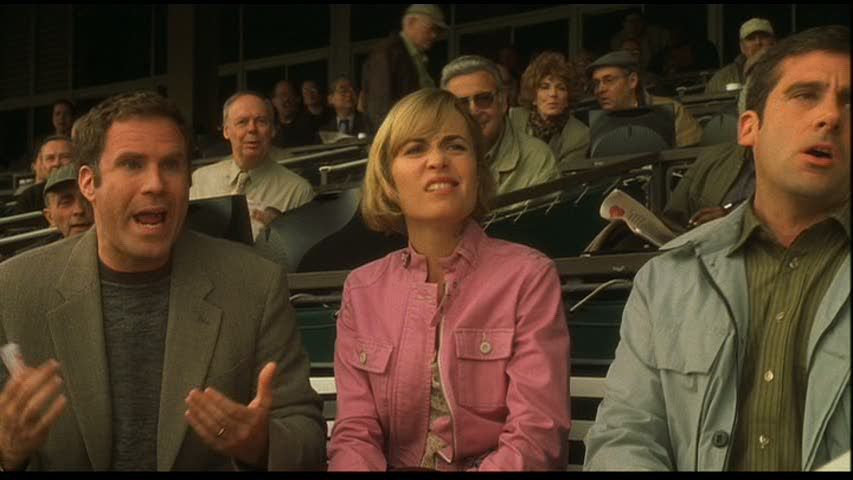
This story's basic outline consists of a triggering incident when the distressed Melinda stumbles into a dinner party. In the tragic version, she is worn out and fidgety, recovering from a suicide attempt and trying to forget the disintegration of both her marriage and the affair that ended it. She drops in unexpectedly at the apartment of her old friend Laurel (Chloë Sevigny), who is entertaining a theater producer who may be able to offer a job to Laurel's out-of-work actor husband Lee (Johnny Lee Miller). In the comic take on this scenario, Melinda is actually in the midst of committing suicide, stumbling into the apartment of her neighbors, the indie movie director Susan (Amanda Peet) and her struggling actor husband Hobie (Will Ferrell). What's striking is that the scene doesn't play out that much differently from the tragic one, with the exception of a tossed-off gag about Susan's insistence that her guests continue to eat while she and Hobie try to help their neighbor. This underlines the problem with the film: though it attempts to create a contrast between tragedy and comedy, the comedy here just isn't that funny, consisting mostly of reheated lines familiar from Woody's schtick in countless other films. The opposition of comedy and tragedy here is as superficial as giving the comedy a happy ending and the tragedy a sad one, without really delving into the interesting questions about why we find humor or pathos in various situations.

Instead, the supposedly "comic" story plays out like a light, fluffy tale of continually obstructed love, when the unhappily married Hobie falls hard for his flighty, troubled new neighbor Melinda. One wonders why Woody would cast Ferrell, or the gifted, naturally funny Steve Carrell (in a bit part as Hobie's buddy) if neither actor really gets to do anything funny; Carrell in particular seems wasted, mostly just delivering a few platitudes about marriage and honesty. Ferrell gets a few stale Woody one-liners and lets even them die; it's as though everyone thinks they've been cast in the dramatic half of the film. Maybe that's the point — that the only difference between comedy and tragedy is the way the story ends — but surely the script could've found a better way to indicate this idea than draining a comedy of its humor.


Fortunately, the "tragic" material in the film is handled much more substantially and intelligently — and what, exactly, does that say about a director once known wholly for his comedy? Radha Mitchell isn't given much to do in the lighter version of the story, but as a tragic heroine she comes into her own. She invests her character with an entire language of gestures and poses, ways of moving her face and speaking, a fully developed body language that communicates this character's emotional essence with every slightest move. It's a truly remarkable performance. It becomes hard to tell if Woody's writing is really that strong, or if Mitchell just brings out the hidden depths in this character so well that it wouldn't have mattered what Woody actually wrote for her. She's a shattered woman trying to regain some semblance of her life, some reason to want to live, and finding it, if only briefly, in a piano player with the unlikely name of Ellis Moonsong (Chiwetel Ejiofor).

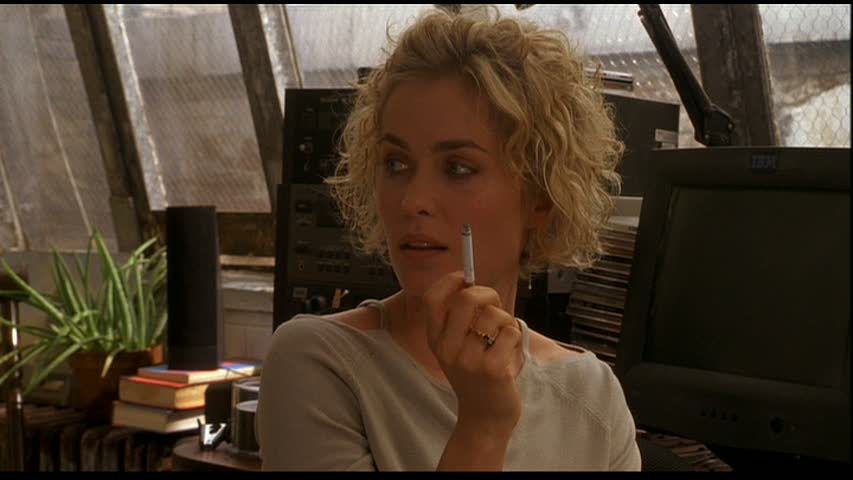
Mitchell's every scene is quietly compelling, never overstating the naturally melodramatic emotions of her story. She has a restrained intensity that comes through especially in the scene where she tells Ellis about how she killed her unfaithful lover and got away with it. Her disheveled hair and black-ringed eyes, the way she smokes a cigarette with just the slightest tremor in her hands, her neurotic pacing and jittery mood swings: Mitchell builds this character from the smallest details up, creating a busy but always realistic performance that makes the tragedy of Melinda hit hard. Without her performance at its core, it's hard to imagine what Melinda and Melinda would be, but with her it's at least half a good movie, and even occasionally a great one. Mitchell, Sevigny and Ejiofor together craft the emotional foundations for a compelling drama in half the ordinary time for a feature film; the story is basic, even trite, but the quality of the acting fosters the necessary emotional investment in these characters. One feels their shifting attractions and breakdowns and self-justifications in the subtleties of their voices, the exchange of glances. Woody frequently frames the two actresses in tight closeups, allowing all the nuances of their performances to come through in their expressive faces: Sevigny's fluttering eyelashes and downward glances, a few tears gathering at the corners of her eyes; the hard lines of Mitchell's mouth and her flashing, fiery glare.

In short, this is a well-made drama wedded to a mediocre comedy. The film purports to establish a contrast between tragedy and comedy, but it actually provides an instructive example of the difference between vibrant, emotionally rich storytelling and bland storytelling that traffics in clichés. It hardly matters that the story in the film's tragic half is ugly and depressing, while its comedic half is light and, ultimately, happy; the former is viscerally engaging and the latter simply deadening. That in itself illustrates, better than anything else in the film, the message that Woody's shooting for here: it's not the story that matters, but the way it's told. He just probably didn't mean to get across his theme in quite that way.

Anything Else


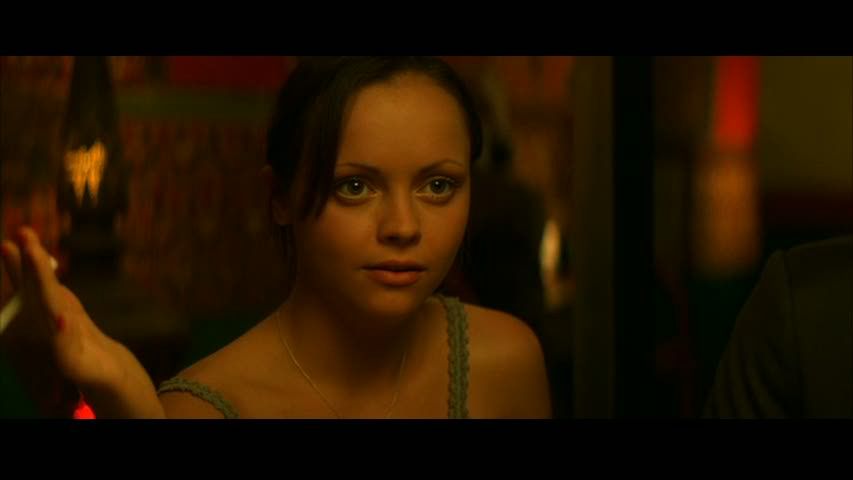
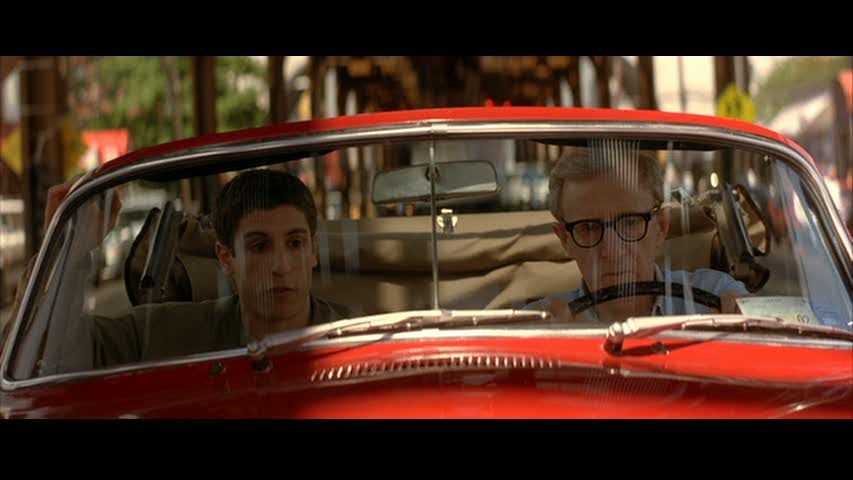
Anything Else must be, bar none, Woody Allen's most underrated film. Perhaps because it was released right at the tail-end of his disappointing Dreamworks period — and immediately following two of his absolute worst movies — or because it prominently features an actor otherwise best known for having sex with a pie on screen, this great film has been ignored, critically maligned and lumped in with the perceived downward spiral Woody's filmmaking supposedly entered from the mid-90s onward. In fact, it's a poignant, funny, bittersweet take on love and relationships and doing what one wants in life. It's quite possibly Woody's best and most perceptive relationship film since Manhattan, a film it recalls in both its gorgeous, atmospheric cinematography and its humorous but unflinchingly honest look at the ways in which men and women in love interact. The film is also improved by Woody stepping aside, for once letting his young cast take center stage rather than trying to shoehorn himself into yet another improbable relationship with a much younger, attractive woman, as he had in recent years with Téa Leoni, Helen Hunt and Julia Roberts. In this film, the focus is on the troubled relationship between the struggling young writer Jerry Falk (Jason Biggs) and his sexy but kind of crazy girlfriend Amanda (Christina Ricci), who drives him wild in every sense of the word.

Jerry is a typical Woody Allen character: neurotic, nervous, insecure, plagued by troubles, in psychotherapy at twenty-one and terminally afraid to break away from anything, no matter how negative its influence on his life. As he says, he's not a "leaver." That's why he's been in analysis for years, even though his therapist (William Hill) never says a word and never helps him with his problems — he's more interested in his patient's supposedly telling dreams about the Cleveland Indians working at Toys R' Us. Jerry's also trapped in an exploitative contract with an inept manager (Danny DeVito) who bleeds his client on percentages but can't get him any real work, and who has an inexplicable love for clothing store metaphors. By the same token, Jerry can't seem to give up his love for Amanda, despite the increasingly outrageous difficulties between them. They haven't slept together for months, Amanda is flighty and unfaithful, and she moves in her wreck of a mother (Stockard Channing), who's practicing to start up a new cabaret show and brings over sketchy boyfriends to snort cocaine.

The relationship between Jerry and Amanda sparks some of Woody's best comic writing, with practically every other line being a quotable gem, including some deadpan one-liners. When Jerry asks her if she still loves him, she looks at him with shock: "What a question. Just because I pull away when you touch me?" What's great about the way this relationship plays out is that Woody allows the audience to see both what's enticing and lovable and desirable about Amanda, and what's infuriating about her — and how the two qualities tend to blend into one another. She's impulsive and always up for anything, always willing to go running off on a crazy trip. When Jerry and Amanda first meet, this attracts him to her almost irresistibly; she has such an adventurous streak that when she says, in passing, that she'd love to take a trip down the Amazon, he's convinced that she means that very night. This initial meeting is mirrored with a later scene in which Amanda proposes a sudden late-night drive out to Montauk, just as she'd suggested heading to the Hamptons when she first met Jerry. The mirroring is subtle, and suggests the extent to which what drew Jerry to Amanda in the first place is now driving them apart.


It helps that Ricci embodies her character, with her strangely cute, off-kilter attractiveness, her bug eyes and crooked smile and compact body. Her casual, breezy delivery of Woody's dialogue is both appealing and maddening, like her character. She tosses off subtly ironic lines as though she doesn't see the contradictions in what she's saying, as though she sees things in a very self-evident way and expects everyone else to understand. There's a hilarious scene where she tries to explain to Jerry how sleeping with her acting teacher was just therapeutic, that she was doing it for Jerry's sake — it's ridiculous and funny as hell, but the weird thing is that one actually kind of believes her, or at least believes that she believes it. Biggs, surprisingly, is a fine comic foil for Ricci, getting off some great one-liners and portraying his character's sexual frustration with a comedic grace that doesn't take the bite off the frustration itself. A lot of the film's best scenes are both funny and uncomfortable; Woody's humor here has a real edge to it, an edge of truth that makes the laughs catch in one's throat at times. Biggs often stumbles over the top in trying to impersonate Woody, to copy his director's fumbling manner and characteristic stutter, and this can be distracting. The film is much better when Biggs tones down his Woodyisms, plays it more like the everyman he is.

For the most part, though, Biggs' performance is perfectly in key with the film's tone, and he's at his best in his interactions with Woody himself, who plays the aging, paranoiac schoolteacher David Dobel, who's making a late-in-life run at becoming a writer himself. Woody's casting of himself solidifies the sense that this is a passing-the-torch film, that Woody is consciously making the long-delayed transition from comic lead to elder statesman, the mentor figure trying to pass on his ideas to the younger generation. Dobel is a typical Woody character, stuttery and neurotic and more than a little nuts, with a real Jewish persecution complex — he's convinced that the Holocaust could be back with a vengeance any day now, and has prepared a survival kit to prepare for the eventuality. But he's also a dispenser of Woody's accumulated wisdom, which of course comes in the form of a constant stream of jokes derived from old stand-up traditions.

The film is about Jerry growing up, breaking free of the unhealthy attachments he can't seem to shake, realizing that he has to make his own way in life. It's a mature statement from the perennial jokester, but of course Woody can't help but deliver this lesson with a smile; Jerry learns about life through humor. It's part of what makes this film such a bittersweet gem. Woody is laughing at the foibles of romance, but also showing his wholehearted appreciation for the folly of love, perhaps even yearning wistfully for the innocent romanticism of Jerry's character. This film is a long distance away from the cynicism and bitter humor of some of Woody's other late films, like Celebrity or Deconstructing Harry. Anything Else doesn't share the wide-eyed naivete of Jerry, but its perspective on life and love isn't jaundiced, as evidenced by the beautiful, expressive cinematography. The portrait of New York here is as deeply romantic as the one in Manhattan, painting in moody, muted colors what the earlier film did in black and white: the oceanic blues of the sky behind a black skyline, the shifting shadows of the trees with light sifting through in Central Park. These are some of Woody's most gorgeous, affecting images in years, a beautiful counterpoint to the film's depiction of young love and the wayward path to maturity.

Hollywood Ending


When people say that Woody Allen's career has gone downhill in recent years, I suspect many of them are especially thinking of Hollywood Ending. It's ironic, for a film about vision and filmmaking, that this is one of Woody's most indifferently shot and conceived films, a film of such staggering incompetence and awkwardness that one can hardly believe it when sporadic moments here and there actually work: it's downright bizarre to see flashes of Woody's comic brilliance shining through in the midst of such a train wreck. It's impossible to watch the film without wondering if Woody intended it to be this bad, if we're meant to be watching the film made by Woody's character within the film, a struggling director whose comeback chance is sabotaged when he develops a psychosomatic case of blindness. It's otherwise hard to account for the bland television aesthetic of so many scenes, the horribly stilted acting and torturous dialogue, the bursts of lively comedy alternating with long stretches of dead time.

Watching the film as someone who's enjoyed even most of Woody's supposed "lesser" works, it's as though all the popular criticisms of the director have suddenly come true. His dialogue has always been wordy and contrived, but in the past he's managed to make it sound, if not quite natural, then at least fluid and stylish and, most importantly, funny. In this film, as in The Curse of the Jade Scorpion, Woody's dialogue is flat, dead on the page, its artificiality and silliness all too apparent. As the director Val Waxman, Woody fares best, probably because he's basically playing himself — and that too is a problem, because the schtick, the flailing neurotic hypochondriac thing, is wearing dangerously thin. But it's worse when he puts his lines in someone else's mouth. As his ditzy girlfriend Lori, Debra Messing is oddly off-key and empty, maybe even emptier than the part seems to call for. As the Chinese translator who helps Val hide his blindness on the set, Barney Cheng is more like a robot, unfamiliar with humanity's strange habit of conversation, than a foreigner, so exaggerated is his stilted accent and mannered tone. Woody's never exactly been subtle in his treatment of non-white characters but this is egregious. And the introduction of Val's green-haired, rodent-eating, heavy metal-loving son Scumbag X (Mark Webber) is simply embarrassing: it's meant to show how out of touch Val is and only ends up proving how out of touch Woody is.

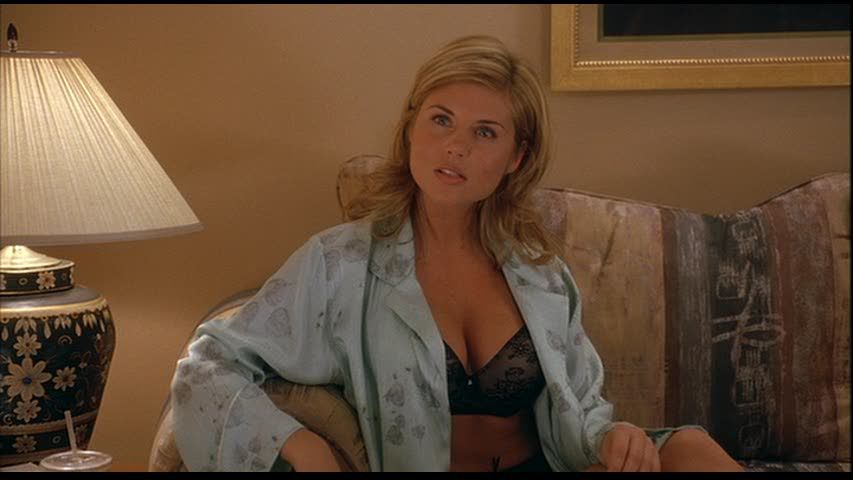
To continue recounting the absurd scenes in this mess of a film would only be painful — why prolong the misery? — though special mention should probably be made of Woody's utterly inept attempts at shilling for 7-Up and Pepsi through some hilariously obvious product placement. What's really perverse about Hollywood Ending is that a lot of it, surprisingly, actually works in spite of the tremendous odds against it. There are stretches of comedy that Woody handles with his usual light touch and supple wit, like a great scene featuring Tiffani Thiessen in a cameo turn as a seductive actress whose feminine wiles are wasted on the blind Val. And Woody's sputtering delivery often stumbles into some typically clever lines, much of it admittedly variations on familiar material ("For me, the nicest thing about masturbation is afterward, the cuddling time.") but no less funny for its familiarity.


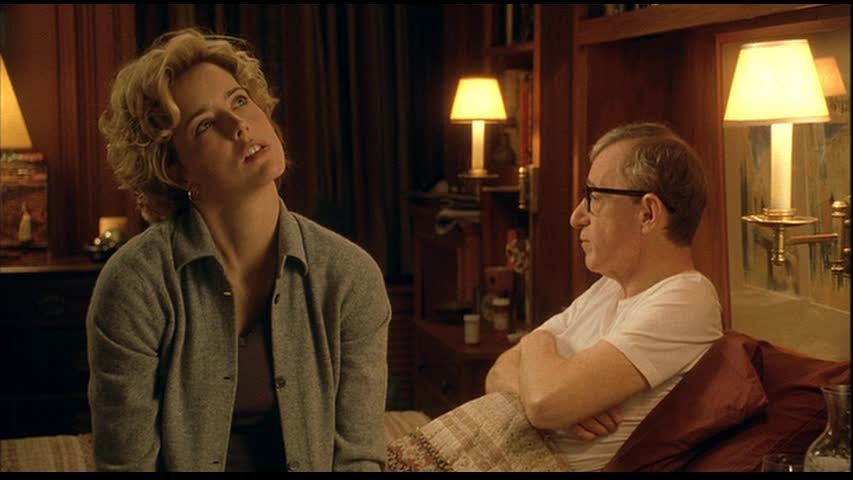
It's as disconcerting as ever to see the aging Woody cast himself in romantic comedies opposite much younger women, but Téa Leoni is nevertheless a welcome presence here. Woody's rapport with Leoni, as his ex-wife Ellie, is certainly nowhere close to his best comic pairings (Diane Keaton, Mia Farrow), but it's also not nearly as flat and affectless as his doomed attempt at sparking some humor out of Helen Hunt in Jade Scorpion. Leoni's an effective comic actress, and she invests her scenes with a subtlety and attentiveness that the often lackluster script hardly demands of her. In one of her best scenes, as Val waxes nostalgic about their past together, Ellie sits on the edge of his bed in the foreground, wearily rolling her head around, half paying attention and half simply trying to work out the kinks in her neck. It could have been broadly overplayed for comic effect, for a cheap punchline, but the way Leoni plays it it's not even a joke: it's just a woman tired after a long day and in no mood for reminiscences.

Other scenes go on so long that they have time to shift from annoying and off-putting to outrageously funny, like the early scene, before Val's hysterical blindness, where Val and Ellie meet for a drink to discuss the plans for the upcoming movie. Val keeps shifting fluidly from casual shop talk about who he wants to hire and what he wants to do, to outraged ramblings about the way Ellie had cheated on him with the producer Hal (Treat Williams) and destroyed their marriage. Woody's neurotic schtick is initially just aggravating, but he keeps it up so long, and handles the transitions from businesslike to ranting so smoothly, that it's soon hard to resist the scene's hysterical flow, and the material becomes funny almost in spite of itself. The capper is Val's list of very specific gripes about the ways in which he was tipped off to the affair, like getting a bill for a room and escargot from the Plaza Hotel: "sex and snails with that roast beef from Beverly Hills!"

Hollywood Ending can, in spurts, be as funny as any of Woody's best material — but then, the film throws out so many one-liners and sketches that some of them were bound to stick. Many others don't, and much of the film is a pile-up of bad ideas, half-realized scenes and dead-on-arrival jokes. It's like a Woody Allen sketchbook committed to film with no self-editing or polishing up, an accumulation of discarded routines in which the good moments are swallowed up by deep abysses of bad acting and careless staging. This film has more ups and downs than its relentlessly dull and mediocre predecessor Jade Scorpion. The funny bits are funnier, but when the film is bad — as it too often is — it's worse than Woody has ever been before in his entire long career.

The Curse of the Jade Scorpion


The Curse of the Jade Scorpion is Woody Allen's tribute to the Hollywood films of the 1940s, the hard-boiled detective noirs and screwball comedies in which hapless men and tough-talking women sparred against each other. It's clearly a loving, affectionate tribute, a well-meaning attempt to capture the atmosphere of films that mean quite a lot to the director. But while there are moments of witty brilliance here and there, the film as a whole is too often awkward and overwritten, its tortured lines, written to be delivered at the amphetaminic pace of the best screwball farces, coming out slow and hesitant in the mouths of such definitively non-screwball actors as Helen Hunt and Woody himself. Woody's sense of humor is simply not the humor of the 40s comedies; he's too neurotic, too jittery, even at his wittiest too slow in his delivery to get across material like this. As insurance company detective CW Briggs — a nebbishy figure right out of Woody's beloved 40s noir Double Indemnity — Woody's sparring with his company's "efficiency expert" Betty Ann Fitzgerald (Hunt) comes off as flat and unfunny.

The dialogue is inert, dead, pulpishly overwritten: it might've seemed funnier on the page but both Woody and especially Hunt often seem to be tripping over it, struggling to get it all out. The lines lose their bite when delivered this way. Lines this purple and self-conscious need to be spit out in one long breath with the pauses all spliced out, like the way Cary Grant would handle the big ungainly chunks of dialogue he'd be given in a Howard Hawks movie, or the way Jimmy Cagney stomped his way through Billy Wilder's insanely funny One, Two, Three. Woody, even in his "early, funny ones," never had this kind of speed. He has always interspersed his more manic moments with comparatively laidback interludes, and often let his best one-liners slip out almost unnoticed from the casual flow of his schtick. Even his early comedies have a sense of deliberate pacing, as though he always wants to leave some air, some breath, in between the jokes. The Curse of the Jade Scorpion, if it were to be truly successful, would require a different treatment, one that Woody doesn't seem able to deliver; the result is a comedy that's all air, all breath, with few enough jokes.

To the extent that the film banks its success on the chemistry — both venomously hostile and, suppressed underneath, romantic — between Briggs and Fitzgerald, the film can only be a failure. Hunt is a fine actress, but she's badly miscast here, unable to make anything of her character's generic ambitions or the mostly ludicrous dialogue Woody gives her. Her parting shots at Briggs, meant to be funny because of the incredibly specific death wishes she spits at him, are always so flatly delivered that they never fail to kill the scene completely. It seems like Woody is striving for the kind of antagonistic relationship that so often drove the best screwball romances and their more serious counterparts, the noir hero's relationship to the femme fatale: Grant/Hepburn, Grant/Russell, Lombard/Barrymore, Bogart/Bacall. These classic duos had an easy, casual patter that belied the amount of dialogue they were throwing back and forth. They could toss around elaborately written lines, embedded with subtle jokes and sexual double entendres, and make it seem like they were just having a normal, perfectly laidback conversation. Woody doesn't quite have that knack here, and whether it's in the writing or the acting isn't always clear; either way, neither he nor Hunt is ever able to make this script sound the least bit natural or aesthetically satisfying as dialogue.


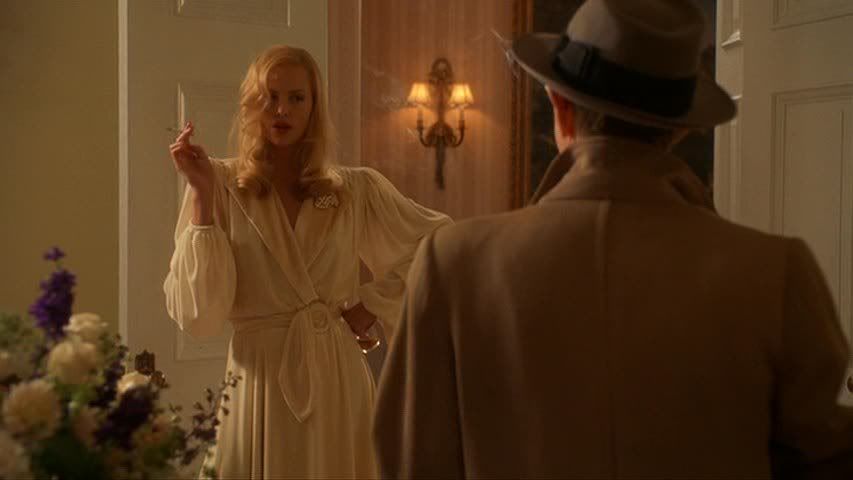
Woody makes much better use of Charlize Theron, whose cameo as the seductive heiress Laura Kensington recalls both her former hilarious bit turn as a nymphomaniac supermodel in Celebrity and the wild, sexy society heiresses played by Lauren Bacall and Martha Vickers in Howard Hawks' The Big Sleep, one of Woody's many obvious 40s touchstones here. Theron, at least, has a handle on the way this pulpy dialogue should be delivered: she drawls it out, with a sexual frankness that makes its artificiality irresistible rather than, as it so often is with Hunt or Woody, distracting. It helps, perhaps, that her character is the film's most blatant artificial construct, the archetypal noir femme fatale, with her performance especially derived from Bacall's onscreen persona. Theron gets it down perfectly, from the sultry way she smokes a cigarette to the wry, raised-eyebrow way she delivers her literary come-ons. Every second she's onscreen is a second spent imagining a much better, infinitely funnier movie centered around her character. Her cameo here, as in Celebrity, shuts down everything else for as long as she's around; she dominates the screen so easily that one wishes she got more work in comedies.

Theron's performance aside, the film has some amusing moments here and there (like the way Woody recontextualizes Hitchcock's famous fireworks kiss into an actual fireworks factory in Chinatown), but its fluffy plot and inert parody of screwballs and noirs drag it down. Even Woody himself doesn't get off a lot of great lines. Usually, the one thing that can be counted on in a Woody Allen comedy is plenty of quotable, witty dialogue, but when Curse's script isn't torturously overwritten, it's simply dull and generic, with a lot of dead space and unnecessary lulls. It spends much of its length evoking the much better films it's striving to pay homage to, but its awkward imitations inevitably make one wish one was watching The Big Sleep or His Girl Friday instead.

Small Time Crooks


Woody Allen's much-maligned residency at Dreamworks Pictures in the early years of the new millennium is generally viewed now as the nadir of his career, the low point for a once-great director who many critics had long since given up on anyway. However, though the first film of this period, Small Time Crooks, represents a clean break from the work Woody had been making in the preceding years, it's a fine, funny film when taken on its own merits. Certainly, this is the most straightforward the director had been since his "early, funny ones," and that's not necessarily a bad thing. Directly after making a trio of his most pitch-black comedies yet — culminating with Sweet and Lowdown, a faux-documentary biography of a misogynistic, drunkard jazz musician — Woody retreated into the simple good humor of this farce about dumb criminals, a conscious nod to his first directorial feature, Take the Money and Run. This film includes some of Woody's most inspired physical comedy since, probably, Sleeper, or at the very least the great helium-fueled chase sequence in Broadway Danny Rose. In any event, though there's still plenty of fast-paced patter, this is the first time in many years that the comic known for his verbal wit allowed himself to fully indulge in more madcap setups. The result might feel like a bit of a step back, a nostalgic film that fits more comfortably in Woody's past than as a product of his mature career, but it doesn't make it any less funny.

The film's central characters are typical Woody figures in at least one way, however: they're average folks looking to move up in the world. The failed bank robber Ray (Woody) and his manicurist wife Frenchy (Tracey Ullman) are discontented, tired of barely scraping by. So Ray concocts what he thinks is an ingenious plot: they'll buy a closed pizza parlor that's a few stores down from a bank, drill a tunnel beneath the shop's floor, and break into the bank that way. They buy the pizza place and convert it into a cookie shop, with Frenchy doing the baking, while Ray enlists three of his crook friends to help out with the scheme in the basement. Woody proves he hasn't forgotten how to stage physical comedy, and the sequence where the drilling immediately ruptures a water line — literally almost as soon as Ray has touched the drill to the wall — is delirious slapstick. It helps that Woody also surrounds himself with a trio of great comedic actors as his larcenous buddies: Denny (Michael Rapaport), Tommy (Tony Darrow) and Benny (Jon Lovitz). The crooks have a naturally funny rapport, particularly in the manic flood sequence or the mathematically impaired discussion of fractions or the scene where Denny tries to convince Ray that their mining helmets look so much cooler when they're put on backwards. Meanwhile, as the crooks are bungling their way through tunnels that lead anywhere but the actual bank, Frenchy's cookie shop is becoming a surprise success, with lines stretching down the block and news crews coming to document the big sensation. The bank robbery is soon abandoned, and the whole crew winds up forming an accidental cookie empire instead.


Ray and Frenchy are like so many Woody characters in that they have a desire to do better, to rise above the lowly hand they've been dealt in life. In this case, they are literal social climbers, nouveau riche pretenders who want to be able to fit in with "high society" — at least, Frenchy does; Ray just wants to be able to get a good cheeseburger and watch a ballgame on TV. Woody mines Frenchy's outrageous taste for some rather mean-spirited jokes about lower-class junk taste, similar to the mockery directed at Mira Sorvino's gauche stripper in Mighty Aphrodite. As in the earlier film, however, the jokes about the tackiness of the decor are tempered by the overall sympathy and affection the film has for the character of Frenchy. Despite the cheap shots at people whose taste runs to leopard-skin-pattern chairs and gold-plated, well, everything, Woody evinces a genuine understanding for both Ray's desire for simple pleasures and Frenchy's perhaps misplaced but no less earnest urge to make herself into a better, more sophisticated person. To that end, she begins hanging around the debonair art dealer David (Hugh Grant), who agrees to educate her in the finer things while making a play for her newfound wealth. Woody's allegiances become clear at this point: he may mock Frenchy's tacky interior design, but he saves his really brutal satire for the portrayal of an avant-garde dance performance where Ray, with ample justification, falls soundly asleep.

Woody's sharp-tongued dialogue propels the film through the sometimes creaky structure of its second half: the drastic shifts and time-jumps in the narrative make it seem like an epic even at a trim hour and a half. The film especially shines, however, whenever Woody is paired off with the great comedienne Elaine May, who plays Frenchy's daft cousin. The chemistry between Woody and May is electric, and their scenes together are alive with the thrill of watching two fantastic comics bounce off one another. May, playing an unbelievably stupid woman, gets some of Woody's choicest dialogue: "he said he reminded me of his wife, who's dead, but I assume he meant when she was still alive." During a late scene where the duo attends a fancy party together, she gets some equally great moments solo — like the way she too-literally takes Ray's advice not to talk too much, to stick to "the weather or something," instructions she follows precisely by intoning a verbatim TV weather forecast to everyone she meets. The film's pacing sometimes goes a little slack in its second half, but it is usually quickly buoyed back up by the great performances from May, Ullman and Woody himself. This lightweight, frankly disposable comedy isn't one of Woody's best, but it's fun and funny, an enjoyable diversion that harkens back to the director's earliest joke-packed episodic comedies.

Sweet and Lowdown


Woody Allen had originally wanted his second film, his follow-up to Take the Money and Run, to be a dramatic fictional biopic of a 1930s jazz musician entitled The Jazz Baby. Needless to say, the idea didn't fly with studio execs of the time, who were expecting the young comic they'd just signed to turn out another comedy; he complied, and made Bananas instead. So when Woody revived the basic idea thirty years later as Sweet and Lowdown, it had had the longest gestation period of any of his films. The film takes the form of a documentary of fictional jazz guitarist Emmet Ray (Sean Penn), with Allen and a handful of jazz experts appearing as talking heads to narrate his story and introduce selected anecdotes from his rough-and-tumble life, the accounts of which are filled with inconsistencies and pure myth. Among other things, the film comments on the impossibility of constructing a definitive biography of a figure like this — the interweaving of a slim body of known facts with a healthy dose of speculation and outright rumor is reminiscent of the real-life history of blues guitarist Robert Johnson, whose biography as it's known today was constructed from a similar hodge-podge. At one point, the fabric of the story breaks down completely, and Woody provides three different mutually contradictory versions of the same event, with the caveat that in all likelihood none of them is "true."

Within this patchwork framework, Emmet develops as a hilariously unlikable protagonist who is nevertheless somewhat poignant. He's arrogant, nasty and demeaning to the women in his life, a drunkard, and notoriously unreliable whenever he has a gig, which is why he never keeps a steady job for long. And yet his arrogance is tempered by an acute awareness of the one man in the world who is a better guitarist than him: Django Reinhardt. Emmet's egotistical instinct is to declare himself "the greatest guitarist in the world," but even his ego can't prevent him from immediately qualifying himself by invoking Reinhardt. Sometimes he corrects himself, "well, at least in America," or he counts himself "one of the top two," always referring to "this gypsy guitarist in France," as he invariably calls the rival who he has never met, and whose playing makes him cry or faint whenever he encounters it. Emmet's constant qualification of his title comes to be downright funny, but there's also something sad and pathetic about it: this egotistical man who's forced to admit that his ego is not entirely justified, that he cannot call himself the best without endless fudging and backpedaling.

Penn's performance is excellent, giving a wry, blunt charm to Emmet, a crude lout who just so happens to be a musical genius as well. He does a lot of acting with his eyebrows, raising and arching them whenever he's playing the guitar. At moments like this, Emmet goes off into another place, the crudity and temper vanishes from his face, and his eyes seem to be far-off, his face comically contorting as his brow furrows and his eyebrows dance. He looks peaceful and content when he's playing, like this is what he's meant to be doing, and all the other nonsense in his life, the drinking, pimping, gambling, sloppy relationships and money problems, that's all just extraneous to whatever's going on inside him while he's playing. Woody keeps this mystery intact, the central mystery of creativity, despite the probing attempts of Emmet's wife Blanche (Uma Thurman) to investigate his soul.


Blanche is a debutante and a would-be writer, and she tends to view everyone she meets as though they're characters ready to be adapted into her work. She's drawn to Emmet for his harsh nature and his wild life, and she continually attempts to psychoanalyze him, to draw out his thoughts and feelings. She asks what he thinks about when he's playing music, and Emmet memorably responds, "that I'm underpaid, I think about that sometimes." Her questions get only blank, uncomprehending stares from her husband, who doesn't understand what she's getting at; he doesn't think, he just plays. When she asks him why he likes to watch trains so much, he gets it even less, and her psychosexual ramblings prompt him to deadpan, "it sounds like you want to go to bed with the train." This is a blunt, no-nonsense guy, and the film's central question, danced around but never answered or even asked outright, is where art comes from: if a guy like this can make great, beautiful art with his instrument, what does that mean for the more romantic notions that art comes from the soul, from the emotions?

In some ways, the answer to that question lies in the character of Hattie (Samantha Morton), who though never married to Emmet is the closest he ever gets to love in his life. She's something of an unlikely match for the guitarist, a mute laundress who's perhaps a little slow, with a childlike innocence and a shy, awkward nature. Woody reportedly told Morton to play Hattie like Harpo Marx, and she gives a phenomenal performance without ever saying a word: it's all there in her subtle gradations of smiles, her downcast eyes, her shuffling walk and the flapper hat pulled tight over her curls, partially shading the upper half of her face. Hattie is a genuine, sweet, loving young woman whose silence is remarkably communicative because of her expressive face. She becomes an unacknowledged anchor for Emmet, who resists being tied down to one woman and inevitably leaves her, though she continues to linger in his thoughts in a way that no other woman does. He says that Reinhardt haunts him, but Hattie is in some ways a more potent force in his life. When he loses the chance to be with her again, towards the end of the film, Woody and the other commentators step in to proclaim the music he made afterward the best of his career, making him finally an equal of Reinhardt.

Morton's Hattie is thus the film's heart and its soul, as well as the unspoken inspiration for Emmet's finest music. She is the answer to the riddle of how a seemingly unemotional and brutish man could produce such lovely and enduring art. It's typical of Allen that these foundational questions concerning the origins of art and creativity are hidden within a light, airy, cleverly constructed film that's essentially comedic in form. Sweet and Lowdown is a fine effort from Allen, a nod to his earlier period mock-documentaries like Zelig as well as to his idol Fellini, whose La Strada provides the domineering man/childishly innocent woman template for the relationship between Emmet and Hattie. Woody continues to be fascinated by the intersections of love, relationships, and artistic creativity, and these perennial subjects continue to drive his best films.

Celebrity

This summary is not available. Please click here to view the post.

Deconstructing Harry


For such an angry, caustic film, Deconstructing Harry is almost shockingly entertaining, turning rage and neurosis into a vaudevillian blend of fantasy and imagination, a series of comic skits that flow into and out of the problems of the "real" world. With this film, Woody Allen confronts head-on the assertions of critics around the time of his 1980 Stardust Memories, which many interpreted as an autobiographical expression of Allen's own antipathy towards his fans and admirers. Although Allen has always maintained that his films are not autobiographical — at least not directly — Deconstructing Harry presents a character who does turn his life into art in this way: Harry Block (Allen), a successful novelist who is continually recycling his own life, and the lives of those close to him, into his books with only the thinnest of disguises laid over the real incidents and people. He is someone who, as he realizes eventually, is more comfortable living in fiction, where he can control and manipulate what happens, than in the chaos and unpredictability of reality. His stories sometimes reflect his psychological state, as in a hilarious short story where an actor (Robin Williams) becomes out of focus with the rest of the world, eventually requiring his wife and kids to wear special glasses in order to see him correctly. More often, though, the stories Harry writes are direct reflections of events in his life, especially his three somewhat tortured marriages and endless affairs — his lovers, wives, and friends show up, in slightly altered form, throughout his novels.

The form of the film incorporates Harry's fictions and Harry's reality on a more or less equal plane, assembling a massive cast to play both the real-life people and their fictional counterparts. The film shifts subtly and seamlessly back and forth between the two states, presenting a collage of incidents that reflect Harry's life both as he sees it and as it really is, often making clear the differences between the two. These differences are sometimes merely comic: an illicit sex scene between Harry stand-in Ken (Richard Benjamin) and Ken's wife's sister Leslie (Julia-Louis Dreyfuss) is played for broad comedy, and runs completely off the rails when Leslie's blind grandmother walks in at the very end, asking them to stop fixing martinis and walk her outside. In other cases, Harry's inventions are revealing, as when his novel turns his ex-wife Joan (Kirstie Alley) into the shrewish Jewish zealot Helen (Demi Moore) by incorporating details from the life of his half-sister (Caroline Aaron), who really did become a devout Jew after marrying an Israeli man. The way Harry takes details from his half-sister's life in order to make his ex-wife less sympathetic indicates his profound discomfort with religion, as does the over-the-top short story where he delves into the "dark secrets" in the past of a stereotypical Jewish father, who it turns out is secretly a murdering, philandering cannibal. The film is a prolonged analysis of Harry, using the material of his stories and his life to engage in psychoanalysis, literary critiques, and multi-layered investigations into what makes him tick.

This process of analysis is complicated, of course, by the addition of Allen himself into the mix. If Harry is a novelist who is more comfortable with his fictional characters than the real people they represent, where does that leave Allen, the man who himself created Harry and everybody else in the film? The film ends with Harry receiving a celebratory dream/fantasy recognition from the assembled throngs of his characters, who gather to applaud him and compliment his work. And though Harry's specific life story and cast of characters don't map particularly well onto Allen's own life, it is nevertheless tempting to see this valedictory finale as Allen's version of Fellini's famous denouement to 8 1/2, a parade of familiar faces from fiction and reality alike. This impression is aided by the revolving door cast, who gather all in one place only for the last scenes. The film brings together familiar Allen players like Julie Kavner, Judy Davis, Mariel Hemingway, and Julia Louis-Dreyfuss, their appearances inevitably recalling earlier Woody films — Hemingway especially, in her minimal role, is an echo back to one of Woody's most iconic moments in Manhattan, and her shrill, angry character here indicates the gulf between the outlooks of the two films. If earlier Allen films were sometimes quietly nostalgic, warm, and funny in their treatment of the central neurotic character played by Woody himself, Deconstructing Harry eliminates this sympathy and warmth. Harry is revealed for what he is, an egotistical jerk with little capacity for connection to those around him, a serial philanderer who rationalizes his inability to be faithful, and who nevertheless expects love and devotion in return. Harry isn't all that different from Manhattan's perpetually immature Isaac Davis, realizing too late that he loves the girl he rejected — Elisabeth Shue's Fay takes the place of Hemingway's Tracy here — but where Isaac was likable and sympathetic despite his failings, Harry is pretty much an asshole.


There's little to like in Harry, and to the extent that it's a self-portrait, it's one in which the brushstrokes are furiously violent, an unflattering image of a whiny, insecure, horny little misanthrope. In a way, Harry is Woody Allen as depicted by his harshest critics over the years. Allen is taking the vitriol of the press, loading it into a gun, and aiming it at his own head. This is especially apparent in the scene where Harvey Stern (Tobey Maguire), a Woody stand-in by way of a Harry stand-in, invites over an Asian prostitute for a night of fun, and she arrives looking like an Eastern femme fatale from an old movie serial, the Dragon Lady come to life in a bright red kimono and dark purple lipstick. It's hard not to interpret this scene as Allen's response to the media frenzy over his relationship with Soon-Yi Previn, a baroque exaggeration of the seediness that Allen's critics saw in his romance with the much younger adopted daughter of his former lover Mia Farrow.

The film reaches its climax with Woody's glorious fantasy of Hell as seen through the eyes of Harry, who takes the opportunity of a story set in the underworld as a perfect chance for some Dantesque settling of grudges with those he hates. The story doesn't quite progress as expected, though, and Harry's self-analysis turns a new corner when he realizes that he no longer wants to condemn his father, who he movingly forgives and frees from Hell — though the old man would rather go to a Chinese restaurant than to Heaven. Harry descends into this vision of Hell, Orpheus-like, in order to rescue his love Fay from the clutches of his friend Larry (Billy Crystal), here reimagined as the Devil himself. Even this aspect of the plotting goes off the rails, though, and Harry must acknowledge that his attempts at controlling life through fiction are doomed to fail. Of course, his response is merely to transform this realization itself into fiction, reigniting the cycle of fantasy and reality that he sought to escape. Allen enters the film obtrusively at this point by literally illustrating Harry's state of mind: as Harry types a sentence about his character's "fragmented" life, the film stutters in a series of jumpcuts, as Woody, Harry, and Harry's character come together in the same cinematic framework.

Wild Man Blues


Barbara Kopple's Wild Man Blues, a documentary of Woody Allen's 1996 European tour with his New Orleans-style jazz band, confirms what everyone has long suspected, that Woody Allen the man is pretty much the same person that audiences have come to know from the characters he plays in films. He's neurotic, compulsively nervous about everything from boat rides to his own health, and he's very funny, in the casual, natural way that his conversational style tends to hone in on jokes at every opportunity. Woody's idol Groucho Marx was famous for always being in character, on camera and off, and it seems as though Woody has achieved a similar fluidity between his public and private personae. Kopple's cameras follow Allen rigorously throughout his whirlwind tour, capturing him on-stage with his band and off-stage in a variety of settings, from the required meetings with foreign dignitaries to signing autographs for fans to lounging around in hotel rooms with his sister Letty Aronson and his then-girlfriend, soon-to-be wife Soon-Yi Previn. Kopple catches many an unguarded moment, including some wonderfully intimate time spent with Woody and Soon-Yi, but what's remarkable is that the film hardly reveals anything new or particularly surprising about the director — instead, it often feels like watching a Woody Allen movie.

What is revealing in the film, though, is the attention given to Allen's music, which is often given short shrift in discussions of his work, but which he apparently considers a very important part of his creative life. Allen took up the clarinet as a very young man, moved by his longtime love of jazz, and he has been performing in jazz bands for longer than he has been making movies — he first started sitting in with some New York groups early on in his stand-up career in the 60s. Seeing Woody on-stage in this context is a new and seldom explored dimension to the performer. His love of jazz — and specifically this outmoded, rarely played form of New Orleans jazz — fits comfortably with his general nostalgic outlook, his affection for old artforms, for places with a sense of cultural history, for earlier eras. Kopple captures his performances with fluid, expressive camerawork, going for intuitive framings and reframings, the camera restlessly roaming over the faces of the players. The music is vibrant and fun, and the best parts of the film are its concert segments.

Unfortunately, Kopple doesn't focus as much as one would expect on the music itself, which is somewhat disappointing. Throughout the film, Woody laments that many people only go to these concerts for his celebrity status, not for the music, and Kopple's documentary occasionally seems to fall into the same trap. She's very interested in the reception Woody gets abroad as compared to in the US, and in his relationship with Soon-Yi, but to some extent the concerts themselves get short shrift. There are only two long, uninterrupted excerpts from the performances, one at around the halfway point of the film and the other towards the end, from the group's final concert of the jaunt, in London. Many of the other performances are chopped into very small segments, or worse yet interrupted by unnecessary voiceovers from Woody or his band leader and banjoist, Eddy Davis. It's rare that Kopple provides an opportunity to watch a performance develop over time, to get a sense for the structure of a whole song or the interplay within the band, or the ways in which their sets develop from night to night. Considering Woody's obvious desire for people to take his music seriously, it's unfortunate that the documentary itself mostly treats the music as filler, chopped up and played in short excerpts that serve as dividers between the material from backstage and during off-hours. It's not really a document of a working band and their music so much as it is a profile of a famous figure who just so happens to be touring in a band at the moment.


That said, the two occasions when Kopple does choose to focus on the music at greater length are very enlightening indeed. The excerpt from the band's final London concert provides a great opportunity to watch the improvisation within the band, the way the three horn players — Woody, trombonist Dan Barrett, and trumpeter Simon Wettenhall — pass off solos to one another in turn, a perfect example of the sensitivity to jazz structures and development over time that is missing from the rest of the film. Even better is the earlier long concert segment, in which Kopple excerpts a lengthy part of a performance starting with Woody's clarinet solo and running straight to the end of the song. Woody's solo is somewhat unusual, marked by very breathy, wheezy playing that mostly just sends air circulating through the instrument in quick, choppy breaths, only sporadically generating any actual notes. The music seems to emerge, tentatively, from the constant bed of static generated by the soloist's breathing. This tender, mournful solo, sometimes lapsing towards the threshold of inaudibility, surprisingly elicits laughter from the audience, who seem to think that Woody's kidding around, that his failure to produce clear melodic notes is a joke. They're seemingly unaware that his playing is intentional, and derived from a long lineage of similar techniques running through jazz history, and especially common in free jazz and post-jazz experimental musics. It's a telling moment, indicative of a gulf between the audience and the musicians. Woody knows full well that most in the audience are not there because of a genuine love or understanding of jazz, but because he's a famous director and media figure.

One only wishes that Kopple, having obviously grasped the importance of this moment by singling it out and dwelling on it, would have followed up on it, delving further into Woody's feelings about his music. She lets Woody talk about his music but seldom goes further into it with him. Some of the only direct, interview-style questioning in the film occurs towards the end, and it concerns Woody's relationship with Soon-Yi and the scandal that followed. Kopple also fails to really visualize some of Woody's most interesting observations about his music, like his repeated discussions of the balance he tries to strike between throwing out one "crowd-pleaser" after another and playing some more difficult, esoteric material. One would guess that Woody's breathy solo falls into the latter category, while most of the rest of the music in the film is relentlessly upbeat, danceable, and fun; certainly crowd-pleasing. But the film never develops any sense of how the band balances these two tendencies in concert, or how they structure their sets in general. There is some discussion of changing sets between nights, and Woody's conscious attempts to make some nights more challenging than others, but Kopple's presentation of the music in mostly sound-bite fragments doesn't provide any sense of how this actually works, or what the difference might be between one night and another. There's a disconnect between Woody's serious, intellectual consideration of his own music and the essentially fluffy presentation of that music in the documentary. The music segments are always enjoyable, not to mention beautifully and inventively shot, but there remains a sense of missed opportunities every time Woody makes an analytical statement about the music that is not followed up in the concert extracts.


Though this failure to really explore the band's music in depth is unfortunate, Kopple's attention to Woody's behind the scenes life does yield some interesting results. One of the most welcome of these is the most uncensored, unfettered view possible of the relationship between Woody and his young love, who at one point he playfully introduces as "the notorious Soon-Yi Previn." It is impossible to walk away from this film with anything other than a positive view of this relationship, which seems genuinely loving, affectionate, and comfortable. The couple, captured in quietly intimate moments by Kopple's unobtrusive camera, completely dispel the taint of perversion and iniquity generated by the rumor-hungry press who hyped up Woody's love for his then-girlfriend Mia Farrow's adopted daughter into a scandal of mammoth proportions. Kopple patiently accumulates a portrait of the couple through a wealth of details: Woody's casual compliments, Soon-Yi's gently scolding tone, the affectionate way she kisses his head when he's feeling sick or complaining about something or other, the way she squeezes his arm on a cozy gondola ride in Venice, their playful joking around with one another. Best of all is a great scene where Soon-Yi talks about Woody's films, admitting that she's never seen Annie Hall — which Woody says is the only one she should see — and that Manhattan is her favorite, while she says that she couldn't sit through Interiors. It's a warm, funny, unguarded moment, one of many in the film's backstage footage.

Wild Man Blues is not the in-depth examination of Woody Allen's under-documented music that it might have been, but it is nevertheless a certain delight for any of Woody's fans. For its joyous, lovingly filmed music, and its intimate documents of Woody's private time, the film is one of the best touchstones for those who wish to know what the famous director and actor is like when he's not making movies.

Everyone Says I Love You


Woody Allen's tribute to the American musical comedy, Everyone Says I Love You, is a ramshackle ode to a mostly lost artform, occasionally failing in various ways but more often succeeding by being as moving, funny, and charming as the films it seeks to emulate. Allen conceives of his plot as simply an excuse to assemble a large and star-studded ensemble cast, constituting the members of an upper-class extended family and their various love interests, both fleeting and enduring, and to stage a dazzling array of musical numbers. The stories (for there are several) all center around the family of Steffi (Goldie Hawn) and Bob (Alan Alda), two typical faux-intellectual Woody Manhattanites: he's a lawyer, she's an ultra-left do-gooder whose pet cause is prison reform ("they should be able to decorate their own cells"). Their daughter Skylar (Drew Barrymore) is getting married to her average joe boyfriend Holden (Edward Norton in an early role), but she still harbors secret fantasies of a "white knight" sweeping her off her feet. Meanwhile, Joe's two daughters from a previous marriage (Gaby Hoffman and a teenage Natalie Portman) have their own romantic foibles. Steffi's daughter DJ (Natasha Lyonne) — from an earlier marriage to Joe (Woody Allen) — narrates the film, providing wry commentary on her family while running through her own seemingly endless gamut of week-long affairs, with each one being the dreamiest, sexiest, cutest one yet.

The cast is big enough as it is, even before adding in all the rest of the maids, friends, momentary love interests, and extras, and the film would threaten to careen out of control if it weren't held together by DJ's flighty but no-nonsense narration, which allows the plot to skip haphazardly from one incident to the next, sometimes forgetting about characters and subplots for long stretches of time before belatedly doubling back to stitch up the loose ends. It's a charming conceit, and the distinctive, oft-underused Lyonne pulls it off well with her sarcastic lilt. The semi-random plot and large cast also provide Woody with all the excuse and opportunity he needs to stage one musical number after another. A few of these are flops, like a misconceived funeral home number where the singing, dancing ghosts are sabotaged by some of the lamest special effects ever committed to film. It's also unfortunate that Woody was unable to convince Drew Barrymore to sing in her own voice as the rest of the cast did. One of the most charming facets of the film is the spontaneous, free-wheeling quality of most of its musical numbers, the sense that these are real people simply bursting out into song for the hell of it. Few of the actors have actual good voices, but it hardly matters, since they're clearly just having fun and going with it. In the one scene where Barrymore's character gets a song, the distance and artificiality of the obvious overdubbing hurts the moment, all the more so since it's meant to be expressing introspective and heartfelt sentiments for the character.

For the most part, though, the musical numbers work beautifully, and some of them are downright stunning. Probably the best is an early scene, the first big musical set piece, at a Manhattan jewelry store where Holden is preparing to buy a ring for Skylar, when he begins singing Nina Simone's "My Baby Just Cares For Me." The scene progresses naturally for the first verse or so, with the store sales clerk nodding indulgently along with the lyrics, as though Holden were simply talking to him. At first, it seems that Woody has solved the age-old problem of the artificiality of musical conventions by simply ignoring it — but at this point the scene abruptly bursts apart into a fully choreographed and joyously vibrant musical pastiche. With a quick burst of motion, Holden leaps to his feet, his chair pulled away behind him as the salespeople in the store join him for a wonderfully executed song-and-dance number. The camera setups are simple, with Woody mostly taking a straight-ahead view on the dancers and simply letting them perform, reveling in the vibrant, shifting patterns they create in front of him.

It's a scene of pure fun and a heartfelt tribute to a cinematic form Woody clearly loves but hadn't had much opportunity to nod to in his previous films. Other scenes provide still more models for the kinds of musical numbers Woody can execute when the inspiration hits him. The opening number, with Holden singing his love to Skylar, begins with a slowly panning shot across a fountain, its jets of water periodically blocking and revealing the view of the lovers behind it, as they laugh and embrace and walk together in pace with the camera's tracking. Then, as Holden continues to sing, Woody cuts away to a series of languid, unpopulated images of springtime New York beauty, all bright and warm with the colors of flowers and brilliant sunlight. It's a conception of a musical number in which images of the city stand in for choreography. Woody also has a lot of obvious fun with a number where a bunch of Parisian Groucho Marx imitators stage a French-language song-and-dance for a chorus of Marx brothers, who slouch and shrug their way through the steps with bushy eyebrows flailing. A tribute to one of Woody's favorite artists, the scene creates an admirable pastiche of the musical interludes from Duck Soup. Even better is the meditative, magical dance between Woody and Goldie Hawn towards the end of the film, in which she is lofted into the air with a floating grace and easy defiance of gravity. The casual way in which this magic happens, its inexplicable beauty and simplicity, makes this one of the enduring images from Woody's filmography — shot from a distance so as to emphasize the reality of this magic accomplished with no visual trickery, doubles, or cuts, only wires and the graceful moves of the two dancers.


Not everything in the film works quite so well or so effortlessly. Allen has often been criticized for failing to include a more ethnically diverse (and thus true) cross-section of New York in his films, which is understandable but beside the point most of the time. His films are unabashed fantasies, and are generally concerned with a pretty constricted social set. There's nothing intrinsically wrong with the choice to limit his stories to his characters' vision of the city they live in, which is of course a fairly whitewashed vision. Everyone Says I Love You makes some token gestures outside this blinkered worldview, but they're mostly unwelcome diversions. For one exception, I never though I'd hear rap music in a Woody Allen movie, but that moment — dropped casually and unexpectedly into the middle of a musical number — feels real and funny and works well in context. It's more discomfiting to see Woody wholeheartedly embracing the stereotype of the turbaned cab driver, or trotting out a bunch of little kids in ethnic outfits for a disastrous Halloween number that's basically Woody's version of the insipid Disney ride "It's a Small World After All." Woody's films always present fantasy versions of the cities they take place in, but moments like these cross the line from knowing fantasy to uncomfortable stereotypes.

Even so, the film is mostly an utter delight, a celebration and a chance for the director to stretch out in an unfamiliar style. The result is typical Woody in many ways, borrowing plot conceits from earlier films (the spying on a psychiatrist from Another Woman recast as a comedy device) and sporting many typical (and very funny) Woody one-liners like, "I haven't touched my treadmill in weeks — 572 weeks, that's 11 years." But the musical form furnishes this familiar material with a very different feel, lending the freshness of experimentation to what otherwise might've been a fairly standard film for Woody. The atmosphere of recycling especially weighs down his character Joe's romance with the improbably gorgeous Von (Julia Roberts), which seems primarily like one more excuse for Woody to pair himself with a beautiful leading lady who's way out of his league. Even the script seems to acknowledge the improbability of it all, stacking the deck in Woody's favor so that it seems inevitable that he'll land the girl. The whole thing is mostly played for a few (admittedly solid) gags, and then the whole affair just puffs away like a wisp. The film has a breeziness, aided by Lyonne's chatty narration, that occasionally does a disservice to deeper development but is otherwise the film's greatest asset. The breezy style is perfectly suited to the whirlwind romance that develops between Skylar and the crude ex-convict Charles Ferry (Tim Roth, in a hilarious bit part), who Skylar briefly believes might be her white knight. Certainly, he has a passion and spontaneity that is lacking from her fiancé Holden. When he tells her that he'd make love to her in every room of the house, on every rug and tabletop, she breathlessly deadpans, "we also have some lovely early American chandeliers." This episode is one of the film's funniest self-contained stories, a momentary diversion for some laughs (and Tim Roth's side-of-the-mouth attempt at a thug love ballad) before the film moves on.

The film is packed with such moments, and nearly everyone in the cast gets a chance to shine, even if only for the space of a few lines of song or a one-liner. One of the best gags comes late in the film, revolving around a character who is otherwise barely present in the story, Steffi and Bob's son Scott (Lukas Haas), whose inexplicable streak of conservatism in this liberal family is explained away as the result of an undiagnosed medical condition. Everyone Says I Love You is a charming, farcical ode to love, music, and the cities Woody adores — besides New York, there are loving mini-tours of Paris and Venice that foreshadow Allen's recent fascination with filming abroad. The exuberant, fluffy result is one of Allen's lightest, airiest, silliest, and most fun concoctions.