Showing posts with label film noir. Show all posts

The Third Man


Harry Lime. Harry Lime. Harry Lime. The name is spoken so frequently in Carol Reed's The Third Man that it becomes a mantra, a way of signifying the continuing importance of a man whose absence defines the film and drives its plot. The war is over, and as the pseudo-documentary introduction describes it, the city of Vienna is in turmoil, bombed-out and divided, split into sectors by the victorious Allied powers (just getting ready for the colder war to follow) and rife with corruption and black market dealings. The pulp fiction writer Holly Martins (Joseph Cotten) arrives in the city at the behest of his friend Harry, who has offered him a job, but virtually the first thing that Holly learns when he arrives in Vienna is that Harry is dead, the victim of a strangely suspicious traffic accident. Harry's left behind Anna (Alida Valli), the beautiful girl who loves him, plus a string of business associates who seem very shady and evasive, and a dogged police inspector (Trevor Howard) whose interest in Harry's illegal activities hasn't quite faded now that the man himself is beyond his jurisdiction.

So Holly — who Anna instinctively and repeatedly calls Harry, evidence of Harry's ubiquity and also a suggestion that she's already beginning to think of this newcomer as a possible replacement — stumbles into a shadowy, foggy Vienna where sinister dealings are obviously happening down every dark alley and in every night club. The people Holly meets, his friend Harry's former associates, like the solicitous "baron" Kurtz (Ernst Deutsch), radiate menace and sinister intentions, drawling out seemingly banal dialogue that barely disguises the unspoken threats and insinuations hiding just behind their friendly surfaces. It's instantly obvious that something strange surrounds Harry's mysterious death, something much more sinister than the traffic accident that everyone insists it was, and Holly becomes particularly obsessed with discovering the identity of an unknown "third man" who carried his friend's body away from the accident along with the baron and his fellow conspirator Popescu (Siegfried Breuer).

Interestingly, this mystery, which gives the film its title, ultimately seems incidental to what's really going on here, and isn't even resolved explicitly within the film. The film's first half is driven by mystery and investigation, but the specifics of this mystery don't seem nearly as important as the general sense of tension and intrigue generated by Holly's attempts to discover the truth. The script, adapted by Graham Greene from his own novel, crackles with suggestive, potent dialogue, particularly in the exchanges between the mourning Anna and Holly, who is clearly falling in love with his dead friend's girlfriend even as he probes deeper and deeper into the sordid truth about Harry Lime. Although Harry himself is the central, unseen presence for much of the movie, Anna and Holly (with his strange name so resonant with Harry's) get most of the screen time, dealing with Harry's absence and trying to make sense of life now that he's gone. In one great scene, a tearful Anna asks Holly to tell her things about Harry when he was younger, and Holly tells a series of incomplete, faltering stories that amount to moments and glimpses rather than full scenes in themselves. It seems even when he was alive, Harry was a somewhat enigmatic figure, difficult to understand or describe. (Much like the "third man," who is described by the one person who saw him as entirely normal and non-descript.)
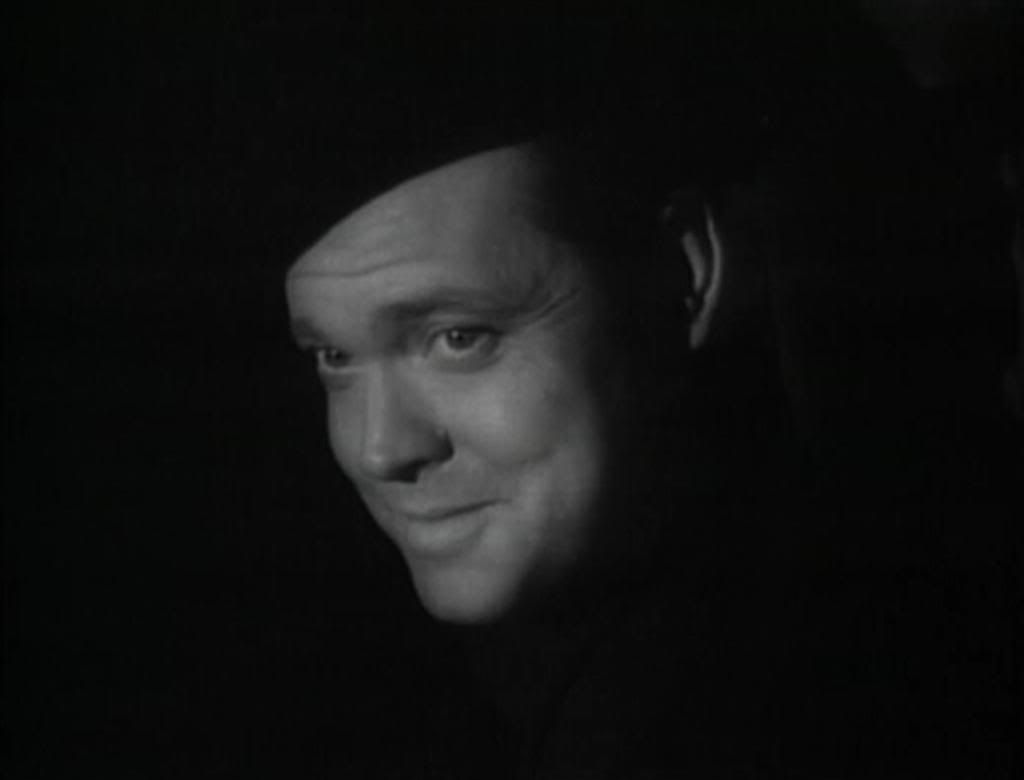

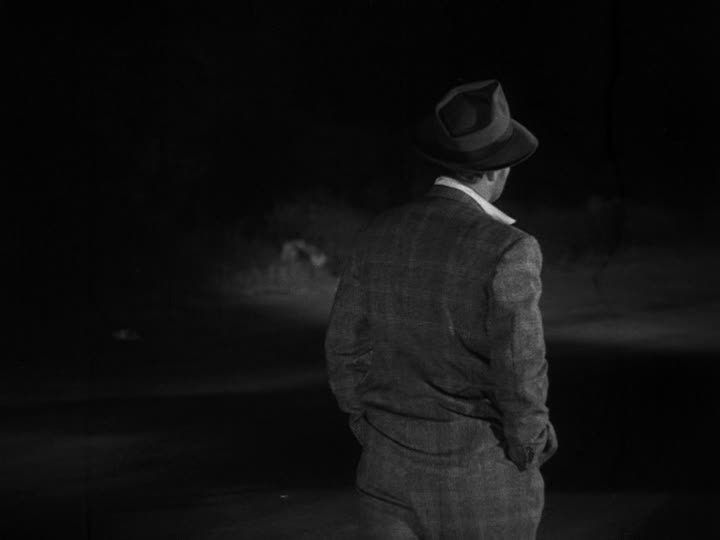
Of course, in the movie's final third it turns out that everything is not as Holly and Anna had thought, and after being an unseen presence/absence for over an hour, Harry Lime himself finally makes his first appearance, incarnated in the smug smirk and cheery eyes of Orson Welles. Harry's first appearance is iconic and unforgettable, first as a shadow in the night, a pair of shoes standing in the shade of a doorway, the rest of his body vanishing into the surrounding shadows. Then a light comes on and illuminates his face, and there's that playful smile, those twinkling eyes, devilish and rakish, a sinister face hovering in the darkness. Having an actor as powerful and iconic as Welles play Harry, and holding back his first appearance for so long, really intensifies the effect. The audience is as stunned as Holly is, in a way, because just as Holly is shocked to find his friend alive, the audience, who might have suspected as much, is simply shocked by the impact of Welles' arrival and the oversized charm that he brings to Harry.

That's even truer in the subsequent scene, later in the film, where Harry finally gets his first lines — and is revealed not as the loving boyfriend idealized by Anna or the fun, steadfast friend described by Holly, but an amoral sociopath who willingly snuffs out lives just to make some money. Harry feels no guilt that the black market medication he was selling killed many and drove others mad. As he and Holly ride a ferris wheel, he looks down and speaks as though he's a god, as though other people are simply abstract dots to him, their lives and deaths of no import to his schemes. Harry is a real product of the war, a lowlife echo of the Nazi indifference to life and the god-like delusions that drive some men to believe their desires are more important than the very lives of others. Harry is a demon, a charming demon, and the sinister vibe of his friends is echoed in his own demeanor. His first conversation with Holly is infused with just-barely-unspoken threats and telling looks. He maintains a casual air as he opens the ferris wheel's door and tells his good friend that he has a gun, that he could eliminate him if he wanted to. And then, when Holly tells Harry that the police have dug up the latter's grave and found the man buried inside it — essentially telling Harry that his problems wouldn't end by getting rid of Holly — Harry's demeanor changes entirely, and he once again becomes solicitous and charming, the menace in his voice replaced by syrupy good cheer and friendly offers. He's good old Harry again, the merry prankster Holly had earlier described in those fragmentary stories from the good old days.

The film climaxes with a crawl through the sewers, in which the witty dialogue and insinuations are replaced by a nearly dialogue-free chase sequence in which Harry is pursued by an army of police with dogs and flashlights, with Holly accompanying them. The sewer sequence is a marvel of noir style, all striking angles and shadows, occasionally pierced by the blinding white light of the pursuers. Harry's face, now not so dashingly confident, is striped by shadows in the dark of the sewer, his eyes wide with fear as he runs this way and that, hemmed in and cut off everywhere, attempting with mounting desperation to find a way out. His earlier smirk is replaced by a grimace of terror. In the sequence's most unforgettable image, a wounded, crawling Harry reaches for a sewer grating, and Reed cuts away to the street above, where Harry's fingers stick up through the grate, waving around like stalks of grass in the wind, which whistles by on the soundtrack, the eerie only noise. It's a haunting ending for a legend who was disappointingly revealed as just another corrupted man, a sad echo of the war's evils.

The Prowler


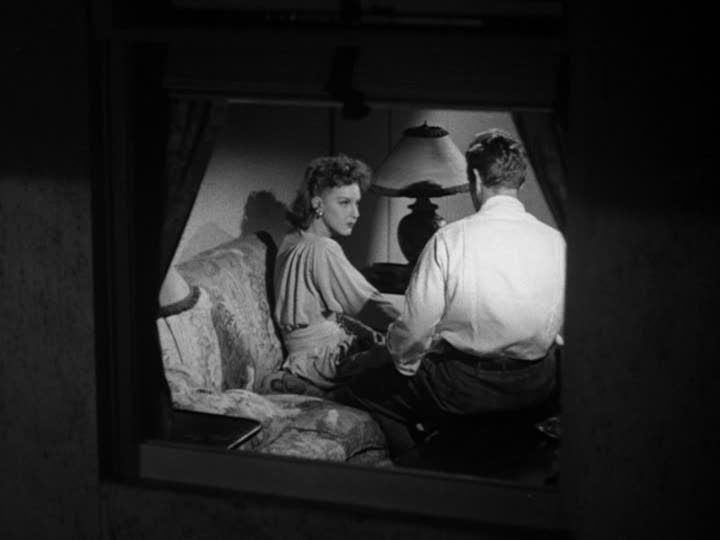
Joseph Losey's noir The Prowler opens with a shot that immediately tweaks the audience by placing the viewer in the voyeuristic position of a creeping pervert. The first shot of the film gazes through a woman's bathroom window as, inside, she dries herself off after a bath, putting on a robe. Her body remains teasingly just out of view beneath the window's frame, which functions like a cinematic frame within the frame, and Losey's camera, tracking slowly in to get a closer look, heightens the voyeuristic sensation of leering in. Then, the woman seems to notice the camera, looking out the window with concern and horror as she realizes that someone is watching her, and she quickly pulls the blinds shut, cutting off the view. It's not the camera she actually sees, of course, but a peeping tom whose perspective the camera had been taking. The titles roll then, and in less than a minute Losey has effectively signaled that, like all films about voyeurism, this too will be about the cinema, about those people out in the audience, watching eagerly from their hidden spots in the dark. The black humor of this set-up is made even more apparent when, after the credits, a pair of cops visit the frightened woman, and one insinuates that maybe she shouldn't have tempted the prowler by offering herself up for view like that, framing herself in the movie screen of the open window. After all, for a culture growing increasingly acclimated to the cinematic experience, peeping in on such living movies is second nature (and the woman herself is a failed actress, used to being watched).

But the real voyeur of the film turns out to be not the unseen prowler outside the window but one of the cops, Webb Garwood (Van Heflin), who is immediately attracted to the prowler's victim Susan (Evelyn Keyes) and begins aggressively courting her at night, after his shift is over. When Webb and his partner Bud (John Maxwell) first come to investigate the incident, Budd questions Susan while Webb remains outside, prowling through the bushes, looking into the house. The compositions suggest that he too is a voyeur, peeking through the windows, watching Susan from afar, and when he appears at the bathroom window, he startles Susan every bit as much as the original prowler had. Webb represents law and order in his crisp police uniform, but really he's an outsider, discontented with his life, feeling like he's watching other people's happiness and success while he's had nothing but "bad breaks."

Susan, it turns out, is from his hometown in Indiana, but while that fact draws the pair closer together, it also awakens a reserve of bad memories for Webb. He'd been a star athlete in high school, but his college scholarship had ended early after a quarrel with a coach, and his youthful dreams evaporated at that time. Unlike Bud, a model of contentment who loves being a cop, loves his wife, and loves his mind-numbingly dull rock-collecting hobby, Webb wants something more and can only dwell on all the missed opportunities and bad luck he's had in his life. Above all, he had the bad luck to be born poor and to grow up poor; while Susan grew up rich and married an even richer man, Webb was from the wrong side of the tracks and had to watch his poor father squander countless opportunities for improvement, settling for stable middle class mediocrity instead. Webb is an outsider in the spacious mansion Susan shares with her radio announcer husband; he looks in and sees the life he wants, the comfort and security he wants, maybe even the woman he wants.


The film's script, by Hugo Butler and an uncredited Dalton Trumbo, isn't exactly a model of sedate realism: it winds through multiple twists and turns and dramatic shifts in mood. The story is melodramatic and blustery, and its central romance goes through so many unconvincing reversals that it's hard to know what to think of the weepy, malleable Susan. A late revelation suggests that maybe this tonal confusion, too, is purposeful, since even Webb doesn't seem to know what he wants. Heflin, with his big, expressive eyes and perpetual hangdog look, is perfectly suited to Webb's chronic dissatisfaction and the sinister undercurrents that occasionally come bubbling up from deep within him, but Keyes delivers a much less satisfying performance that leaps wildly from one emotion to another. The film's shifts in locale and tone, however, are handled adroitly by Losey, whose direction of this lurid, intense material locates the proper balance of absurdity and tension.

Losey has an especially keen grasp of background diegetic sound, which he uses to comment on the images and foreground events of a scene. Susan spends her nights listening to her radio announcer husband, who ends every broadcast with the cheery sign-off, "I'll be seeing you, Susan." This turns out to be very convenient once Webb starts spending his nights with Susan while her husband is at work, since as Webb says, they always know where he is. The two budding lovers canoodle on the couch, lounging around together, laughing and kissing, and all the while the husband's voice murmurs away in the background, his words offering sly commentary on what goes on at his own house while he's at work, unaware. He describes the pleasure he feels when relaxing on an evening at home, being served a snack by his wife, and as he sets the scene, Susan lays out a tray of sandwiches for Webb, who leans back and lights a cigarette, the first tendrils of smoke wafting up into the foreground of the frame just as the announcer describes smoking his own first cigarette of the evening. Webb seems spooked, joking that he feels like the guy is watching them.

The announcer likes to babble on about his wife on the air, describing her cooking and their domestic contentment, and his happy words overlay the images of Susan and Webb having their fun in the time before that final sign-off indicates that the husband is on his way home. Later, the announcer's voice, played back on a record, has an even more sinister meaning, his affectionate sign-off now interrupted with the violent scratch of the turntable's needle being yanked out of the grooves.


It's obvious enough where all this is heading, but the inevitable homicide merely marks the film's halfway point, and the script has plenty of surprises left. Though the shadowy noir cinematography (by Arthur C. Miller) is effective and eerie in the Los Angeles scenes, the film really becomes interesting when the action shifts away from these typical noir locales. At one point, Losey signals the couple's decision to retreat into the desert with a fade to black, which is immediately followed with a gorgeous, haunting image of a car, isolated in the middle of a blank wasteland, kicking up dust in its trail as it cuts through the sand. The rocky western ghost town where the couple holes up is far from the usual noir haunt, and instead of shadows and grimy interiors (like Webb's cheap apartment from earlier in the film, with a silhouette target forebodingly hung on the wall) there's a grim, barren wasteland where nobody visits, "not even the coyotes" that are nevertheless heard howling plaintively at the film's climax. The way that Losey frames scenes of domestic idyll and hopefulness against this rocky and desolate setting suggests just how short-lived the film's cheerier moments are destined to be.

The Prowler is a rich and idiosyncratic noir that explores the archetypal noir themes — greed, violence, ambition — in some unusual ways. The actual prowler of the opening, it turns out, is incidental to the story, a plot device and a red herring. The real prowler, the real creep, is the outsider who so desperately wants what he can only look at from afar, the guy who waits in the darkness, watching and desiring but separated from what he sees by seemingly insurmountable barriers. Webb's voyeurism is a matter of class, primarily; he looks at the wealth and success of others and he wants what they have. Perhaps Losey is suggesting that the cinema works similarly by presenting visions of glamor and beauty to dazzle audiences, who watch from the darkness, voyeurs who desire the purity and wonder of what's up on the screen, the window through which they peer.

He Ran All the Way


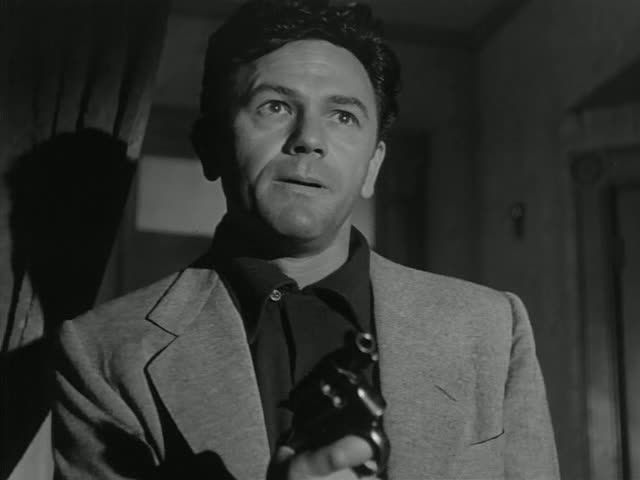
He Ran All the Way is an emotionally and narratively incoherent film that is, nevertheless, compelling in its raw examination of a family under pressure and a man without a family falling to pieces as he realizes just how unloved he really is. Nick Robey (John Garfield) is a loser with no real connections in the world, and no real hopes. The opening shot is a pan across Nick's messy, cramped apartment, finally resting on the bed where Nick thrashes around, yelling in his sleep, haunted by nightmares of endlessly running. He's woken by his mother (Gladys George), who obviously has not the least bit of affection for her son. She berates him for being so lazy, sleeping until nearly noon when he should be out looking for a job, and they get into a nasty argument that climaxes with her slapping him. This is a portrait of a totally unloving mother/son relationship; every time Nick calls her "mom," he spits the word out with such contempt that he makes it sound like a slur, a hateful curse. From the beginning, it's apparent that this is a man who has nothing.

Nick soon tries to pull off a payroll robbery with his weaselly friend Al (Norman Lloyd), but the plot of course goes wrong, Al is wounded and captured, and Nick shoots a police officer while escaping. There follows one of the film's most visually potent sequences, as Nick wanders through a series of desolate urban landscapes, living up to the film's title and fulfilling the prophecy of his nightmare about killing a man and being forced to run constantly. Director John Berry and cinematographer James Wong Howe perfectly capture that sensation of being alone in a dismal world, a never-ending flight from unseen pursuers who might be lurking around any corner. The images isolate Nick in his surroundings, until finally he manages to lose himself in the crowds at a pool. That early sequence of Nick on the run is important, because after Nick meets the innocent Peggy (Shelley Winters) and gets her to bring him home with her, the film settles down into a claustrophobic cabin fever drama with the paranoid Nick imprisoning Peggy and her family in their own apartment.

Howe's shadowy noir imagery is so eerily beautiful in the exterior shots that it's almost a shame that the bulk of the film is spent cooped up in an apartment from that point on, but Howe and Berry are equally adept at conveying the tight spaces of the few rooms where Nick imprisons Peggy, her parents, and her little brother. Unfortunately, though Garfield delivers a relentless, grim performance as the cornered, pathetic Nick, the film's narrative and characterization leap haphazardly around, making a hash of what could have been a thematically resonant study of family and love. Nick's initial come-ons to the sheltered Peggy are so schizophrenic that one wonders why she spends a minute with him; he's at best distracted and at worst seems sociopathic and nasty, and yet despite some initial resistance she invites him back to her family's apartment and awkwardly flirts with him.


Peggy is a pathetic character, weak-willed and malleable, a caricature of the good girl who doesn't know anything of the world or sex. It's kind of laughable when, late in the film, she makes an attempt to dress sexy and seduce Nick, who is also something of an idiot (or else just desperate for love) and seems wowed by her gussied-up look even though, it must be said, she basically looks exactly the same as she always had. There's an interesting idea here, no doubt about it. Nick is a guy with no connections: his only friend sells him out and gives up his name to the police, making his situation even worse, and when he tries to contact his mother she wants nothing to do with him. Nick doesn't care about anyone or anything, but his confrontations with Peggy's father Fred (Wallace Ford) are interesting as the collision of two totally different archetypes. Fred is a family man and a religious man, and all he wants out of life is to be left alone, to work, to spend time with his family. When Fred asks what Nick wants out of life, all Nick can do is wave a handful of money in the other man's face, as though this grubby handful of stolen bills is a substitute for the happy family life that Fred has.

The film's development of this theme is haphazard at best, and the long middle section of the film quickly enters a holding pattern in which nothing much happens. The tension merely remains static, neither building nor receding, and the family tries to go about their lives as best they can while Nick endlessly dithers. The script sometimes becomes almost comical in the heavy-handed lengths it goes to reinforce the family theme. In one scene, Nick buys the family dinner, but the mother cooks a stew for her family, and they all eat that while ignoring the comparatively lavish feast that Nick has set out for them. He then tries to force them to eat at gunpoint, and a very unlikely standoff occurs, with the father delivering a forced speech that feels much more like the script setting out its principles than like anything a man in this situation would actually say.

The ending is especially incoherent, as Peggy sometimes seems to be tricking Nick into thinking she loves him, and sometimes seems to be actually feeling something for him. There's a moment when Nick, thinking he's been betrayed, pulls his gun on Peggy and nearly shoots her, and the script treats this as though it's a revelation — "you were going to shoot me," Peggy sputters, unbelieving, as though Nick hadn't been consistently nutty and violent throughout the film. Either the girl is truly dense or the script is simply inconsistent in its portrayal of this unlikely quasi-romance. Nick, for his part, really is just dense, or really so desperate for someone to care about him that he'll accept even the most unconvincing declarations of love. In spite of all the film's narrative holes and half-realized characterization, though, the ending really is potent and emotionally raw. Nick is forced to confront, on a rain-slick, nighttime noir street, the reality of his complete worthlessness and disconnection. He ends the film literally staring into the light, having gained a measure of self-awareness about his own role in pushing away anyone who might care for him with his distrust and anger and brutality. It is, of course, a realization that comes far too late for him.

Films I Love #53: Touch Of Evil (Orson Welles, 1958)


Orson Welles' 1958 masterwork Touch of Evil came late in the generally accepted timeframe for the first wave of film noir, a form that especially thrived in the 40s and early 50s, but it is undeniably one of the pinnacles of the genre. It's a movie that's fraught with contradictions and compromises, like many of Welles' films, so often subject to meddlesome studio interference, multiple versions and budgetary constraints. It is on the one hand tightly, even meticulously, constructed, with each shot staged and composed as though for a photograph or a painting. Few directors controlled foreground and background as effortlessly as Welles, and nearly every shot features elaborate relationships between figures and objects, creating unforgettable visual resonances. And yet despite this formal rigidity, the film feels loose and spontaneous, as though all its complex compositions were simply fortuitous accidents. Its soundtrack is obviously overdubbed, which only enhances the artificality of Welles' aesthetic; voices seem to be at some remove from the people supposedly speaking, their voices drifting in through the dense fog that enshrouds the tiny desert town where the film is set. The plotting is also rough and ragged, dealing with various intersections and intrigues along the Mexican border following a car bomb explosion. The corrupt and corpulent American detective Quinlan (Welles) investigates, but his attempts to wrap the case up quickly, possibly even pinning it on the wrong guy, are hampered by the suspicious Mexican narcotics officer Mike Vargas (Charlton Heston, thoroughly if entertainingly unconvincing as a Mexican).

The loose, rambling plot allows plenty of room for entertaining diversions, as well as for subplots focusing on characters floating at the periphery. Among the many fantastic performances, Janet Leigh is languidly sexy as Vargas' wife Susie, who he continually places in harm's way with oblivious ease while he dedicates himself wholeheartedly to his work. Welles also lingers with the character of Tanya (Marlene Dietrich), a former flame of the washed-up Quinlan, who has declined so far by now that she doesn't even recognize him anymore. There's also a memorable cameo by Dennis Weaver as a twitchy, goggle-eyed motel manager, the kind of surreal touch that often makes the film seem like a bizarre nightmare. With this film, Welles took a rough B-movie plot and elevated into a grand and mesmerizing epic, a morality tale about corruption and self-righteousness.

Gilda


The thing that makes Gilda such a classic as a noirish love story is the way in which it boldly mingles love and hate, to the point where the two emotions, in their strongest and most virulent forms, become virtually indistinguishable from one another. This point is made again and again in the script, in the most literal terms, as all of the characters speak of how close strong love and strong hate are to one another, how easily one could be mixed up with the other, and how at times it can seem like the intensity of an emotion can be more important than the specific emotion that's being felt. The script is built around this idea, but, as befits such an emotionally charged concept, it's expressed most powerfully not in words but in the love/hate, push/pull sexual tension that develops in the midst of the film's central love triangle.

This is a film with some interesting things to say about triangles, for sure. The first triangle in the film develops, not between two men and a woman, but between two men and a weapon: the rich, corrupt casino owner Ballin Mundson (George Macready), the down-on-his-luck crooked gambler Johnny Farrell (Glenn Ford) and Mundson's cane, which hides a blade that he refers to, rather phallically, as his "little friend." Soon enough, Mundson pulls Johnny into his business and begins to refer to him, too, as a little friend, someone he can rely upon to help with his business, someone who's as trustworthy as his weapon. That threesome will change when Mundson marries Gilda (Rita Hayworth), who unbeknown to Mundson already has a history with Johnny, his trusty little friend. Neither Johnny nor Gilda is very happy with this state of affairs, especially Johnny, who's upset that his original, homoerotic triangle with Mundson has been broken apart by a woman — and as Mundson himself says before meeting Gilda, women are nothing but trouble for gamblers.

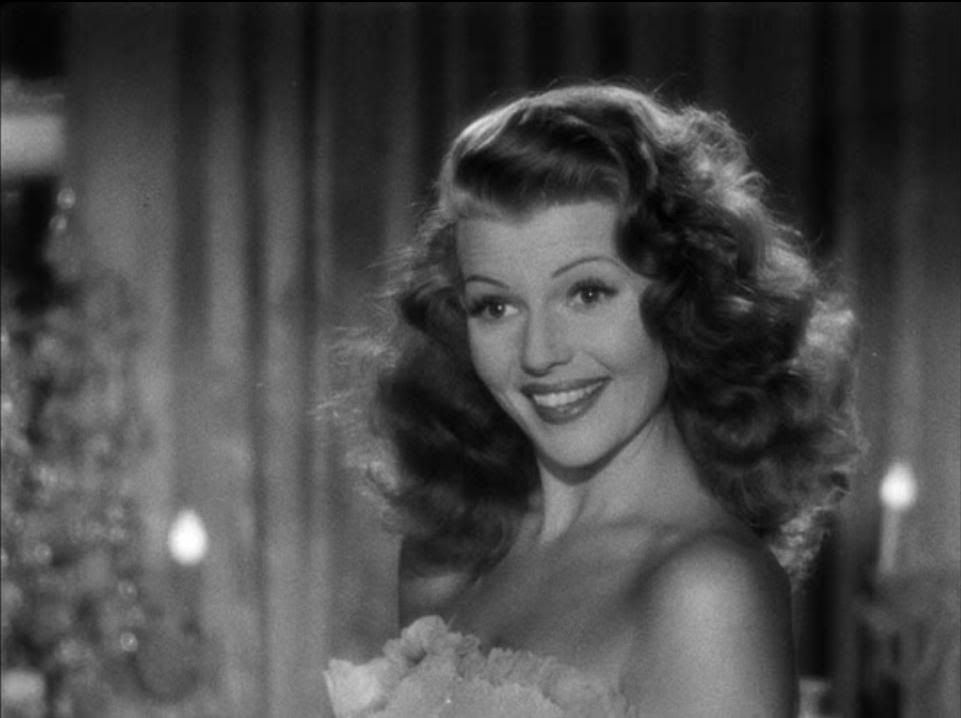
When Mundson introduces Johnny to Gilda, there's a weird tension between the three of them almost instantly. Mundson is swelling with pride, eager to show off his beautiful bride, but Johnny is jealous before he even sees the woman, as though he's jealous not of Mundson for scoring a beautiful woman, but jealous of her for taking away his friend and benefactor. Then Gilda appears, bursting into the frame, standing up into a ravishing, thrilling closeup, whipping her hair back, her dress hanging off her bare shoulders, a mischievous smile on her face as her husband asks if she's decent. Her lips curve up in that glorious smile, a little glint flashes in her eyes and she seems on the verge of answering him with a predictable wisecrack — "Me? Never," one imagines her saying, holding that same naughty smile all the while — but instead the smile fades a little when she sees Johnny, and she forgoes the banter to say that she is decent, as though already constructing her defense against Johnny's as-yet-unspoken accusations. The introduction is fraught with these tensions, as the dialogue crackles and sparks with barely submerged antagonism, particularly when she implies that she views Johnny as just some more of the "hired help," slighting him as forgettable and insignificant, even though something in her tone, nasty as it is, suggests that exactly the opposite is the case.


Hayworth plays Gilda, not as a tramp, but as a woman who's been told she's a tramp so often that she's started to believe it, that she's decided to live up — or down — to the reputation. She shamelessly admits that she married Mundson for his money — more than that, that she allowed herself to be bought, which makes it sound even more like prostitution, like a transaction. And once she's married she begins running around with other men almost immediately, more to make Johnny jealous than to have any effect on her husband, who seems to mean very little indeed to her. Over the course of the film, Hayworth betrays more and more of the insecurity and desperation lurking beneath her seemingly cavalier exterior — she's playing at being a femme fatale, but in fact she's been deeply wounded, and now she's trying her hand at wounding the man who hurt her so badly. Behind each of her smiles, each of her barely disguised insults and subtle slights, lurks a reservoir of hatred and anguish, a desire and a love so strong that it's curdled into contempt, and a correspondingly tangled self-image.

The film coasts by on the power of Hayworth's performance, on the complicated emotions that she projects from within her outwardly vivacious form, and on the quick wit of the verbose screenplay. The dialogue has real pop to it, real bite. It's a writer's picture, not a director's — Charles Vidor's direction is glossy but unexceptional — and it's no surprise to see that writer Ben Hecht was an uncredited contributor to this punchy script. These characters are constantly using words to hurt one another, slicing at each other with pointed jokes and barbed comments. Johnny even makes the comparison to weapons explicit when he says that Mundson's cane/blade — which Gilda is replacing as the third point of this bizarre triangle — must be feminine rather than masculine, because "it looks like one thing but right before your eyes it becomes another." Johnny's hatred of women, and especially of Gilda as a representative of women, is even more potently expressed in his nasty joke: "there are more women in the world than anything else... except insects." Gilda is more direct, expressing her hatred in especially naked terms, saying, "I hate you so much that I would destroy myself to take you down with me." Love, transmuting into hate, doesn't get any more intense than that.

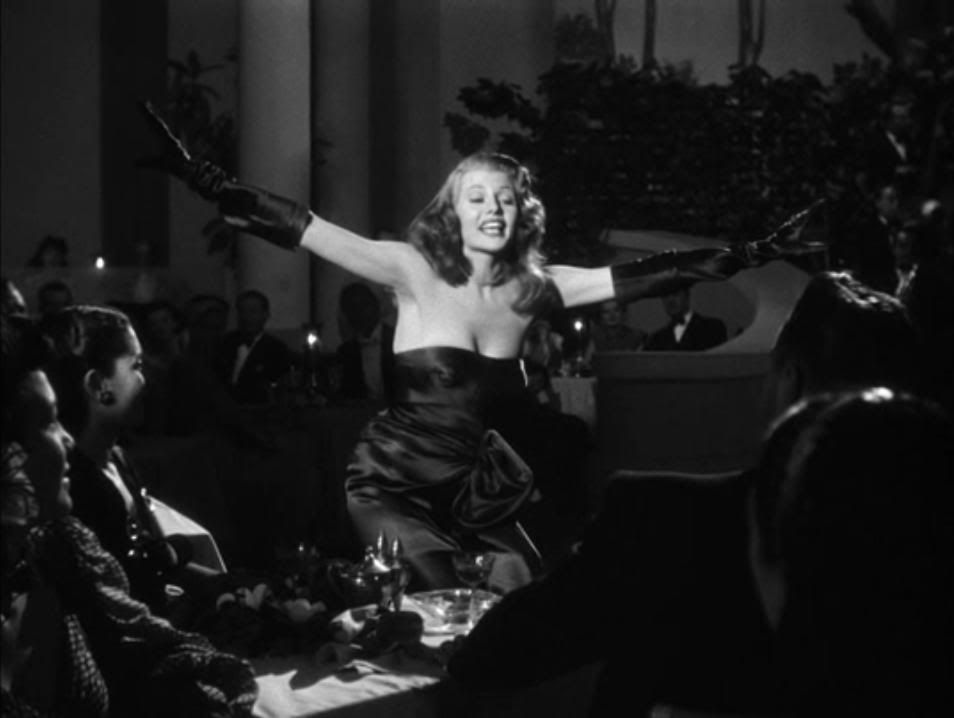
That's the core of the film, and it's embodied almost exclusively in Hayworth. Ford and Macready, as the other points of this triangle, glower and mope but seem pint-sized, insignificant, in comparison to the bold, exuberant womanhood of Hayworth's Gilda, who seems to feel so much, so intensely and generously, that she dwarfs the men with the magnitude of both her smiles and her tears. Hayworth even transforms a seemingly joyful song-and-dance striptease number — her hip-shaking, devastatingly sexy performance of "Blame It On Mame" — into an expression of her inner turmoil. To the appreciative crowd, she looks like she's having a ball, gleefully stripping off her black gloves and throwing them into the audience, bending over to allow her cleavage to spill out of a ludicrously low-cut dress, even tossing away the necklace from around her neck, and finally, naughtily, inviting some guys to come up on stage and unzip her dress, keeping a big grin on her face the whole time. In fact, she's doing it only to hurt Johnny, to cut into him by trying to live up, again, to his impression of her as a cheap tramp. She's rubbing it — her willingness to embody the woman he hates — in his face.

There's a plot in here somewhere, one that has nothing to do with the central love triangle, and which is therefore just a distraction from what really matters in this film. All the weird business about tungsten monopolies and shady international conglomerates just fades into the background in comparison to the sheer intensity of the tragic romance. The film's ending gets a little too tied up in those cops-and-criminals machinations, and turns more than a little too corny in its tidy resolution, but before that point it's a poignant, sexually charged examination of love and hate.

He Walked By Night


He Walked By Night is an early example of the realistic police procedural, a film that attempts to examine, with a documentary's attention to detail, the procedures and routines of a real police investigation. The film, credited to director Alfred Werker but apparently mostly directed by an uncredited Anthony Mann, is filled with striking sequences and darkly beautiful noir imagery. It is a continuation of Mann's series of docudrama noirs like T-Men and Raw Deal, and it was shot by frequent Mann cinematographer John Alton, whose shadowy images are among the most intense exemplars of the noir style. The film is based on the true story of a loner, a former police radio technician and World War II veteran named Roy Martin (Richard Baseheart) who kills a police officer while committing a string of robberies and stick-ups. The killer eludes the police for months, using a police radio scanner and his unpredictable intelligence to evade capture while holding up liquor stores, extorting money out of his former employer, and assembling various pieces of electrical equipment for a mysterious purpose.

The film adopts a faux-documentary style that purports to show the real workings of the police, but its attempts at realistic credibility often fall flat. The film is periodically marred by an overbearing voiceover that narrates the police's activity, describing pieces of equipment or procedures. The film aims for the routine: emphasizing the fact that much policework is boring and repetitive, consisting of searching through files or asking the same questions of countless people. The exaggerated drama of so many noirs and mysteries is drained from the policework shown here, replacing it with a slow-burning suspense as every avenue of inquiry is patiently exhausted in the search for any tiny clue. This aspect of the film's realism is appreciated, even if it means that some scenes — like the slow process by which the police assemble a composite sketch from the testimonies of various witnesses — are stretched out far beyond what their visual or narrative appeal would warrant.

At other times, the flat, unemotional voiceover is simply distracting. In one sequence, as Martin escapes from a liquor store robbery by dodging into a sewer, the voiceover provides an explanation of the sewer tunnels beneath Los Angeles, layering dull exposition over the striking beauty of Alton's gorgeous images. The tunnels, black and slick, glow with the reflected beam of the fleeing criminal's flashlight as he's swallowed up by the darkness. The narration — which basically extols how clever the criminal is in choosing this escape route — is utterly extraneous. At times like that, the images aren't allowed to stand alone or communicate the story; instead, the narration explains what's happening with its portentous style.


The moments when the narration falls silent are far more effective, and thankfully much of the film's climax, as the police slowly close in on Martin, plays out silently. Indeed, in many sequences the film eschews any form of sound, even music, though there are generic string cues scattered along the soundtrack at especially dramatic moments. The film's best moments are calm and quiet. When the police try to trap Martin at a meeting place, the scene plays out silently as the criminal creeps around a shadowy office, circling around the police as they try to catch him. Not only is there no music, but there's hardly a trace of any sound whatsoever. The footsteps of the criminal and police make no noise, and the silence is eerie and almost unnatural. It's as though any trace of sound has been artificially extracted from the environment; only when Martin pounces on one of his pursuers does the sound return, with an abrupt crash that shatters the stillness.

Later, the buildup to the final showdown is set in a similar unnatural quiet, as the police surround the small house where Martin has holed up. The tension builds as the film crosscuts between Martin inside, growing suspicious as his dog yelps and growls at the unseen cops, and the cops as they lurk in the shadows, moving in and spreading out around the area to trap Martin. The silence emphasizes the emptiness of the suburban night, the complete absence of anyone moving around. It's only the police and the criminal, getting into position for the final confrontation. Martin paces around his darkened homes, the blinds on the windows casting slatted shadows on his body as he checks his gun and prepares for an escape. Outside, the empty street seems completely still, but the police lurk in the shadows, slowly approaching the door of Martin's house, seemingly cutting off all exits. The music cue that suddenly erupts when Martin finally sees a policeman running across the road signals the end of this patient build-up, and the beginning of the tense, viscerally exciting climax. As Martin once again escapes into the sewers, the police follow him, and the editing contrasts the sweaty desperation of Martin, running in circles and trying to find any unguarded exit, against the patient, methodical advance of the police, signaled by the line of their flashlights hovering in the darkness of the tunnels, moving inexorably forward towards the increasingly rattled criminal.

The film is at its best at moments like this, scenes of almost abstract tension. The story is rather flat and generic, with no explanation ever advanced for Martin's crimes, and the cops chasing him (led by Scott Brady's Sgt. Brennan and Roy Roberts' Captain Breen) are almost entirely without character. They're important as the men conducting this investigation, but their lives beyond the job, their characters or human dramas, are mostly incidental. Curiously, Martin seems far more human. His dog, who he devotedly cares for and feeds milk to, seems to be his only living connection, the only friend of a friendless, isolated man. There's also a very Mann-like scene where the criminal performs ad-hoc surgery on himself to remove a bullet from his side. As he pierces the wound and uses tweezers to pull the bullet out, the camera holds a prolonged closeup on his sweating face, beads of sweat standing out on his skin, his face screwed up into a grimace of pain, wincing and whimpering, his voice blending with the cries of the dog in the background. This emphasis on physical pain and suffering is very characteristic of Mann's work, and though it isn't the only sign of his presence in this film, it's one of the most striking. He Walked By Night is most effective in small, detail-oriented scenes like this, and in its understated but intense action climaxes.

The Sound of Fury


[This is a contribution to For the Love of Film (Noir), the second Film Preservation Blogathon hosted by Ferdy on Films and Self-Styled Siren. The blogathon has been organized for the benefit of the Film Noir Foundation, who do important work to restore and preserve the noir heritage. Please consider donating to the Foundation during this week. The blogathon will run from February 14-21, and during this time I'll be posting about some noirs to raise awareness of the blogathon and its worthy cause. The film I'm writing about today is the actual film that is going to be preserved and restored due in part to the efforts of this blogathon; every dollar contributed through the blogathon donation link will go to restoring this film.]

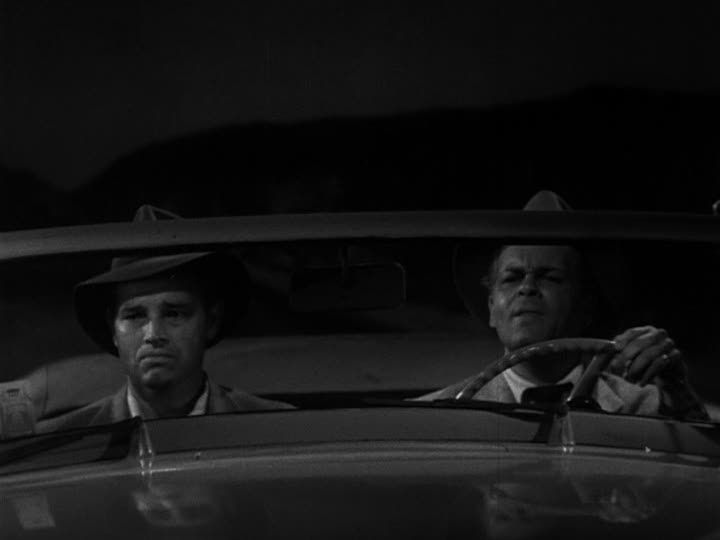
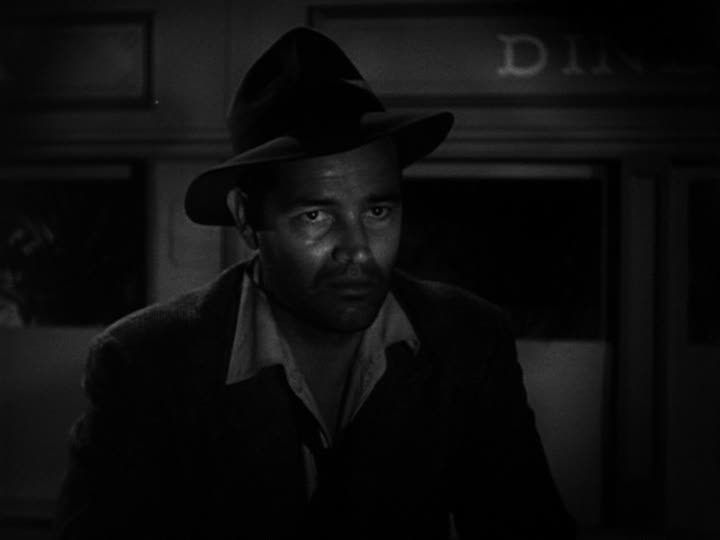
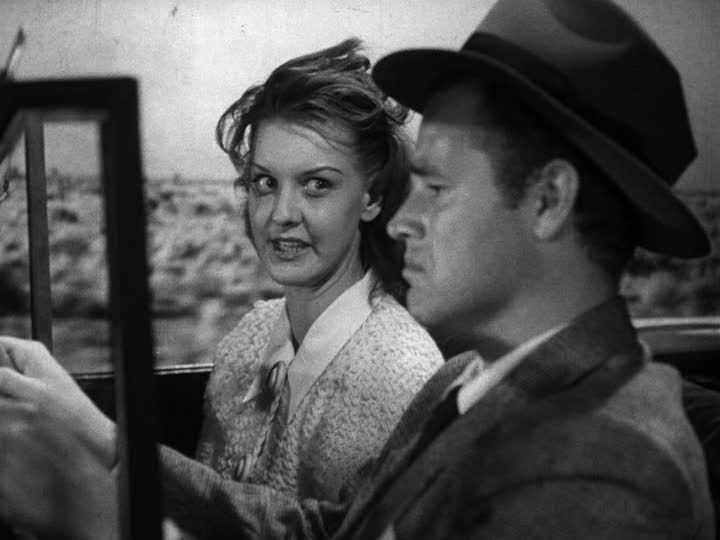
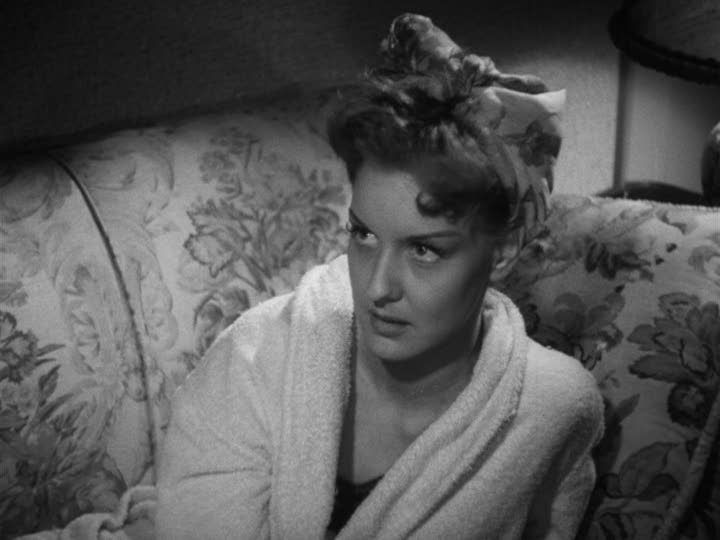
Cy Endfield's The Sound of Fury is based on the same true story as the Fritz Lang-directed Fury from fourteen years earlier, and both films are concerned with the mob mentality of lynchings and revenge. The films approach this story from very different angles, though, and they wind up being completely different films with somewhat overlapping themes. In Endfield's film, Howard Tyler (Frank Lovejoy) is a struggling family man with a pregnant wife (Kathleen Ryan) and a young son. Tyler is determined to find a job, but in a depressed economy he's not having much luck, and all his prospects come to nothing. When he returns to his home after a failed job-hunting trip, it's heartbreaking to see the hope and joy in his wife's face when she momentarily thinks that he's found something, as though she's been restraining her worries for so long that they finally burst out in a brief burst of hope. As in Lang's film, economic pressure is at the forefront here, straining what would otherwise doubtless be a good relationship, but unlike in Fury, Tyler is not an innocent man. Tyler cannot resist the temptations of crime, not when he can't find any other job, not when his wife breaks down crying at their kitchen table because they don't even have the money to buy groceries and they're quickly running out of credit. So when Tyler meets the smooth-talking Jerry Slocum (Lloyd Bridges), initially thinking that he's being an offered a straight job at last, he decides to become Slocum's accomplice on a series of gas station holdups.

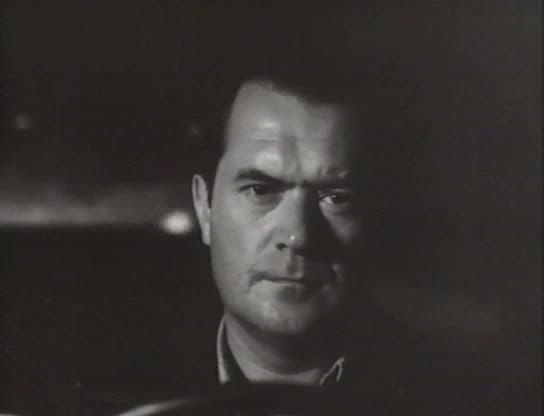
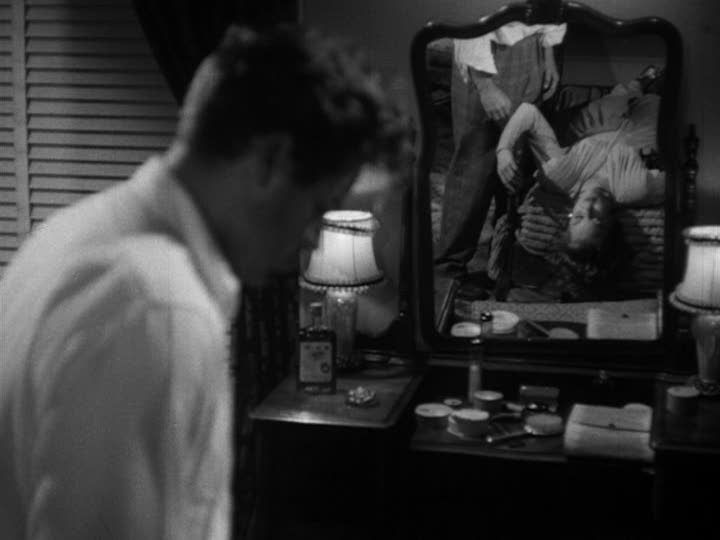
This is an archetypal noir scenario, the basically decent man who's corrupted by his circumstances. What's interesting about The Sound of Fury is the sympathy that's developed for Tyler, even as he willfully abandons his decent suburban life in favor of an escalating crime spree. He increasingly exists only at night, leaving behind his home and the daytime, spending his nights behind the wheel of a getaway car, watching Slocum rob gas stations and return to the car with fistfuls of bills. Endfield captures this ordinary guy's moral degradation with a direct, emotional style, contrasting Tyler's guilty conscience and hesitation against the smirking, sinister Slocum. Bridges seethes with intensity here, initially coming across as simply a cheery huckster — and something of a dandy, admiring his muscles in a mirror as he smears on cologne and puts on his silk shirts — who eventually reveals much darker undercurrents. The first scenes between Slocum and Tyler are staged like a seduction, as Slocum takes Tyler back to his apartment, where he shows off his wealth and his muscular torso. It almost seems like a gay come-on, but really what Slocum wants is to lure his prey into being his accomplise.
The darkness lurking beneath this dandy persona comes to the fore when Slocum hatches a plot to bring the duo's criminal partnership to the next level by kidnapping a rich man's son and holding him for ransom. The kidnapping is one of the film's best sequences, a tense and shadowy nighttime set piece as Slocum and Tyler kidnap the rich young man and try to stow him at an abandoned military base while awaiting the ransom's delivery. Of course, the plan goes wrong almost instantly, and Slocum reacts with a horrifying act of violence, fully revealing the raving evil that had been lurking just beneath the surface of his slick gangster image. Tyler tries to stop his partner, but when he fails Endfield frames Tyler in the foreground, his head in his hands, sobbing in despair and weakness, as in the background Slocum pounds a rock, brutally and repeatedly, onto the head of their victim.


The film also deals, like Lang's, with mob violence and the threat of lynchings. Throughout the film, Endfield occasionally intersperses Tyler's story with scenes involving the reporter Gil Stanton (Richard Carlson), a yellow journalist who believes that he's performing a valuable public service by stirring up public sentiment and appealing to the public's most virulent emotions. Stanton's editor convinces him to drum up circulation by exaggerating Slocum's scattered gas station robberies into a massive crime wave perpetrated by a vicious criminal gang. This is only the start of the newspaper's complicity in creating a public atmosphere conducive to punishing the criminals in the most violent possible way. As in Fury, these scenes are extremely didactic, hammering home the point that the justice system shouldn't be subverted, that innocence is presumed until a fair trial proves guilt, that journalistic sensationalism inflames ugly emotions by appealing to the worst in people. Stanton's friend (Renzo Cesana) provides the moralistic voice delivering these sentiments, lecturing his friend — and the audience — about the importance of fair trials and the dangers of the media's influence. Such concerns seem almost quaint now, in an era of widespread media saturation and sensationalistic coverage of everything and anything, but this film presents exaggerated newspaper headlines as though they're capable of tearing apart the fabric of the world.

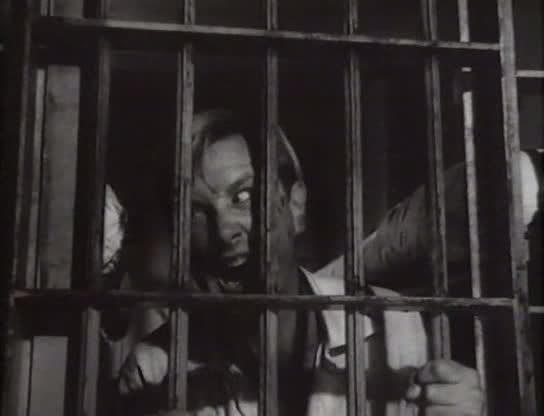
As a result, the film's climax takes on a hysterical tone as the jail where Tyler and Slocum are being held is surrounded by a massive angry mob, eager to pull the two criminals outside and enact mob justice without waiting for the courts. The soundtrack becomes shrill and deafening, dominated by the crowd's screams and the frazzled rants of Slocum as he rattles around in his small jail cell. The contrast between the resignation of Tyler — who knows that he's done wrong and feels crippling guilt as a result — and the caged-animal rage of Slocum creates a compelling tension in the scene, even beyond the slow-building tension of the mob gathered outside. The roar of the crowd, the constant noise clattering on the soundtrack, abruptly cuts off for the quiet finale as, nearby, the sheriff and the newspaper reporters wait helplessly as the crowd drags Slocum and Tyler away to be killed. The eerie silence of the scene is shattered twice, with a distant cheer like at a sporting event, one cheer for each man who's dying. It's a chilling scene, with the seeming joy of the crowd contrasting awfully against the horror of what they're celebrating.

Also very compelling are the earlier scenes in which Tyler and Slocum, before they're caught, go out with two girls, Hazel and Velma (Katherine Locke and Adele Jergens), as cover for their mission to mail the ransom note in a neighboring town. The justification for this outing is narratively flimsy, but what's fascinating about it is how Endfield briefly pulls the focus off of the main story to focus on these two girls, who know nothing about the kidnapping plot and simply think they're going out on a fun date. Velma is Slocum's long-time girl, a statuesque good-time girl whose relationship with this unpredictable sociopath is as volatile as expected, alternating between steamy passion and bouts of anger and mutual violence. Hazel is very different, a shy and lonely woman who says she's saving herself for marriage, and who immediately clings to Tyler despite his brooding manner. The scene where the two women prep for their date, chatting and exchanging their hopes and dreams about the happiness and glamour they'd like to experience, is an interesting moment precisely because it's so peripheral to everything else that happens, an acknowledgment that these characters, who would be mere plot devices in any other movie, have lives and dreams of their own. (Interestingly, the two girls are much more thoroughly developed than Tyler's weepy, melodramatic wife, an utterly boring personality vacuum.)

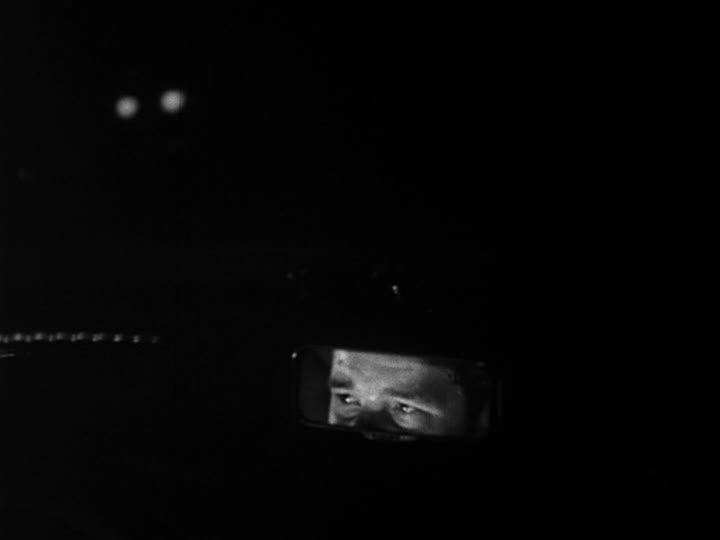
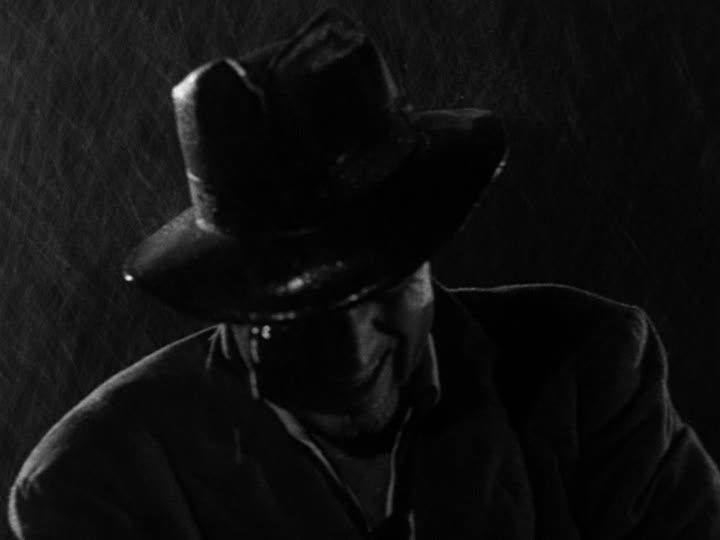
In the end, The Sound of Fury is a fine noir that chronicles the descent of a normal guy into crime, driven there by economic desperation, and though the film is unflinching in examining the consequences of Tyler's weakness, it's also a bold plea on behalf of justice and order, a rejection of the bloodthirsty drive for revenge. Endfield's film is very much deserving of the restoration effort being conducted by this blogathon and by the Film Noir Foundation. As one can no doubt see from the screen captures included with this post, the film, with its heavy blacks and dark atmosphere, is definitely in need of a restoration so that one could descend, with Tyler, more completely into the inky blackness of his sad fate.

Films I Love #51: Detour (Edgar G. Ulmer, 1945)


[This is a contribution to For the Love of Film (Noir), the second Film Preservation Blogathon hosted by Ferdy on Films and Self-Styled Siren. The blogathon has been organized for the benefit of the Film Noir Foundation, who do important work to restore and preserve the noir heritage. Please consider donating to the Foundation during this week. The blogathon will run from February 14-21, and during this time I'll be posting about some noirs to raise awareness of the blogathon and its worthy cause.]

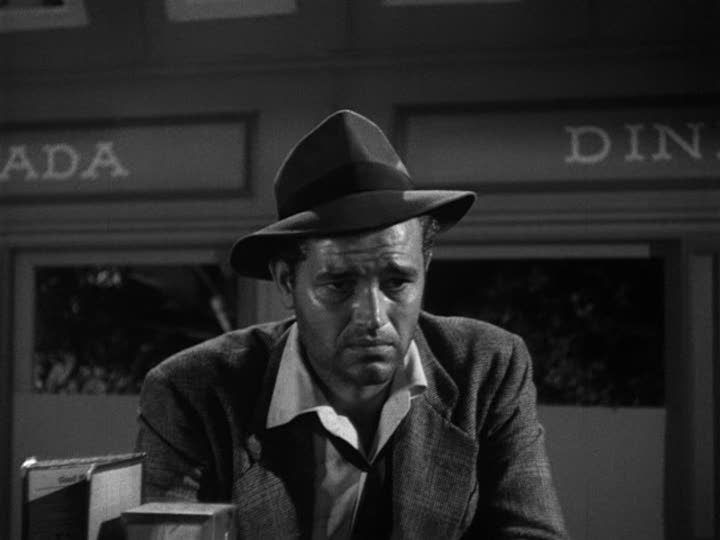
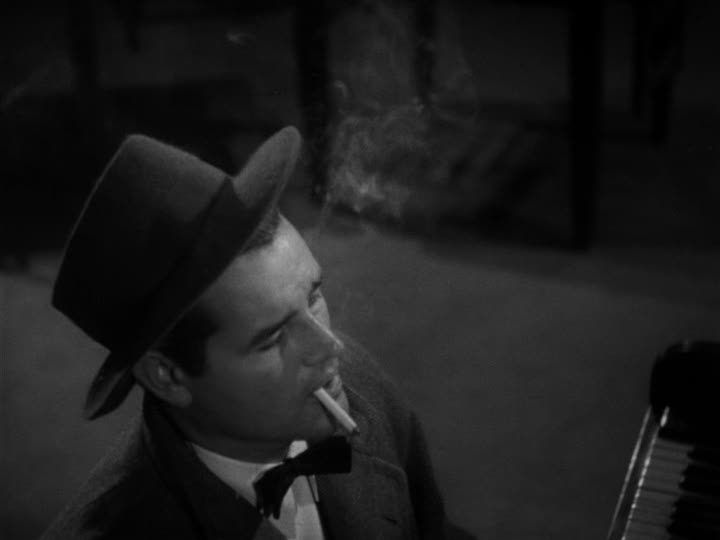
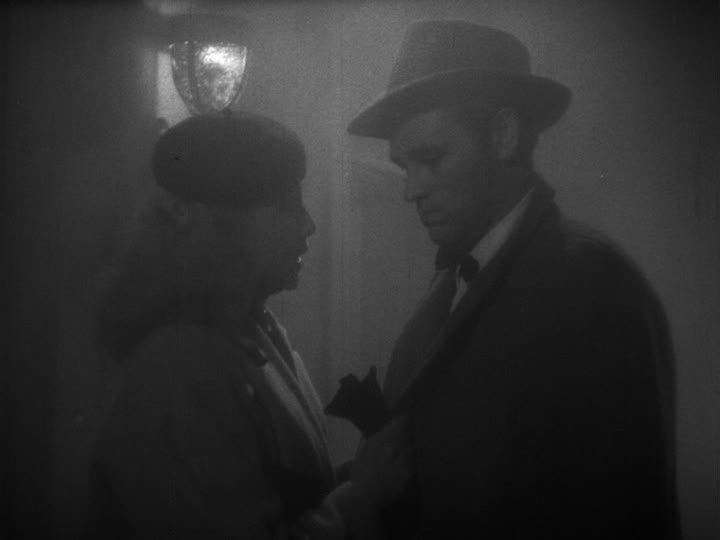
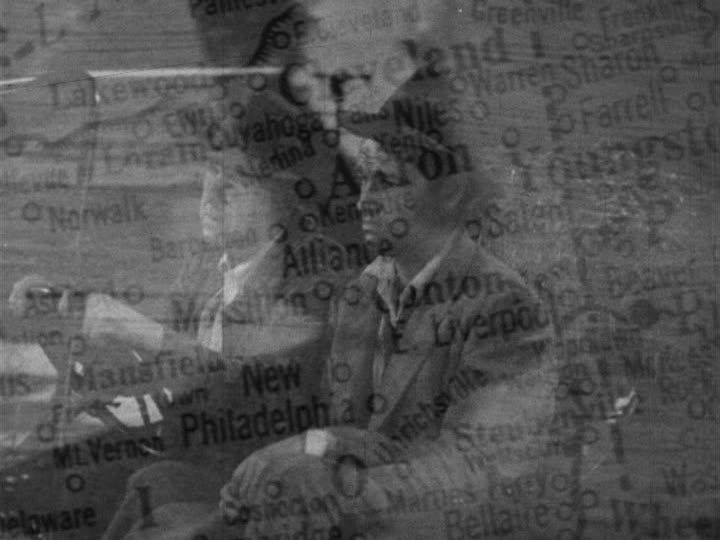
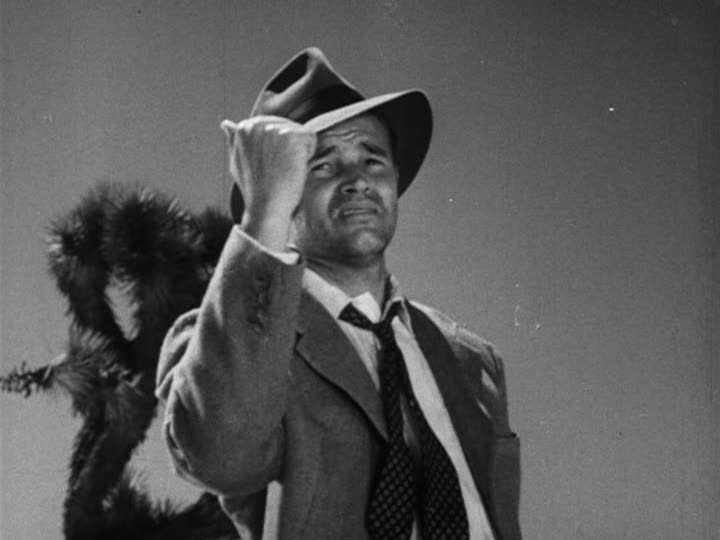
Edgar G. Ulmer excelled at making tough, gritty pictures on miniscule budgets: films that transcend their Poverty Row production values with a strangely haunting grace and beauty, a powerful aesthetic guiding every rough shot of Ulmer's work. The ratty B noir Detour is perhaps Ulmer's strongest film, a pithy hour-long ode to fallen men and dangerous women — or is it the other way around? Al Roberts (Tom Neal) is just an ordinary guy, a bit down on his luck maybe, a pianist whose beloved singer girlfriend Sue (Claudia Drake) has moved to California, hoping to make it in show biz. Roberts hitchhikes after her, but his journey to be reunited with his love goes awry when, through an improbable series of circumstances, he accidentally kills a man who has picked him up on the road. Knowing that the police would never believe his outrageous story, Roberts decides to hide the body and assume the other man's identity. But even this plan is foiled when he himself picks up a female hitchhiker, the fiery Vera (Ann Savage), who recognizes the car and knows that Roberts wasn't the one who was driving it not long ago. Roberts' sad story is told through a series of flashbacks, narrated in a shattered monotone by the antihero, who relates each new twist as though he still can't believe these things happened to him. Roberts is an everyman, with no money in his pockets and no luck, and he's easily manipulated by the sinister Vera. Savage's performance is truly eviscerating; she looks at Roberts like he's prey, with her eyes wide, gritting her teeth, her eyebrows gesticulating wildly, her voice a cold hard rasp.

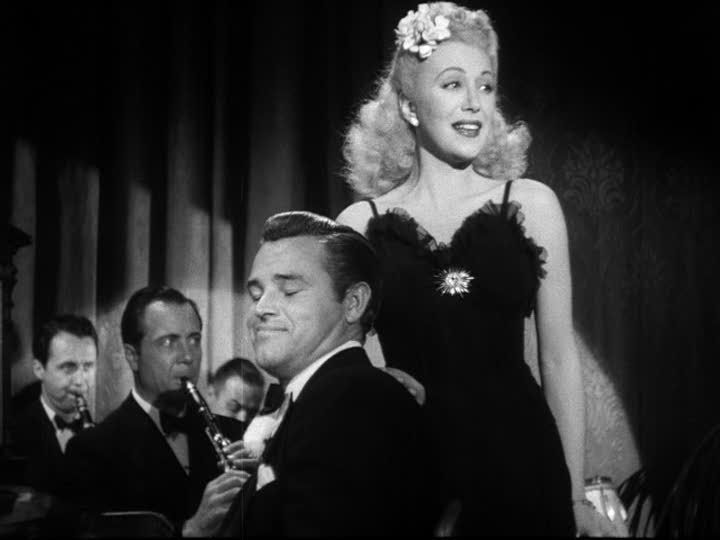
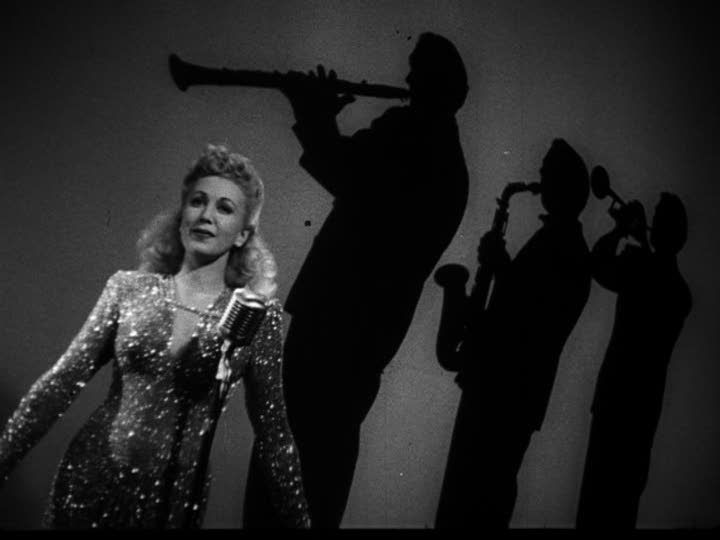
Ulmer's a true poet of the noir: his images have an unsettling potency and startling emotional depths. Even Vera, the wanton woman, has her moment of warmth, when she places a hand seductively on Roberts' shoulder and tells him, her words freighted with meaning, "I'm going to bed." She looks at him expectantly, and when he shakes off her implicit offer, her face hardens into her usual eagle-like mask, putting up a front of rage to disguise her disappointment and hurt. Ulmer's ragged poetry can also be found in the half-awake dream Roberts has while driving, a vision of Sue singing against a backdrop of shadowy jazz musicians — a surreal interlude that juxtaposes Sue's cheery, all-American sweetness against the dark, tawdry circumstances into which the dazed Roberts stumbles. Ulmer's images have a hazy, raw quality that is both hyper-real and disturbingly unreal, a nightmare imagining of a world determined to punish the innocent, to corrupt them, to make them guilty. But his vision is also sufficiently open-ended that it allows for another interpretation, in which the entire film is the delirious self-justification of a guilty man, spinning wild stories to assuage his conscience. Either way, Detour is a harrowing and unforgettable noir, a distillation of the genre's essential themes and images into their most untempered form.