Showing posts with label silent film. Show all posts

Paid To Love


Howard Hawks' Paid To Love is one of the director's early silent films, made before his style really crystallized during the transition to talkies. The film revolves around an utterly silly plot: the poverty-stricken imaginary kingdom of San Savona is trying to get a loan from the American banker Peter Roberts (J. Farrell MacDonald), but before it can, the King (Thomas Jefferson) must marry off his son Prince Michael (George O'Brien), who is more interested in cars than women and whose perpetual bachelorhood represents a threat to the kingdom's stability. The King and Roberts thus try to find a woman to attract Michael's attention, an "alarm clock" to wake him out of his disinterest in love and sex. After a trip to Paris, the King and Roberts locate the performer Dolores (Virginia Valli), who acts like a wild woman in Parisian bars to entertain gullible tourists, and they decide that she'll be perfect to seduce the Prince and draw his attention to the pleasures of women.

There's an obvious gay... well, it can't even be called a subtext it's so obvious. The clear implication initially is that Michael is gay: a bachelor, uninterested in women, who prefers to do guy things like fix cars and shoot at target ranges. In one early scene, he's contrasted against his cousin, the lascivious ladies' man Prince Eric (William Powell, delightful as ever even without the use of his voice). The two men enter the throne room in turn, each of them passing a pretty maid in the hallway. As each man passes, Hawks playfully inserts a closeup of the maid's legs below her skirt as she sashays past. Eric of course turns his head to look, so the closeup suggests his lecherous point of view, admiring the female beauty he sees everywhere (earlier, his face is hidden for the first few moments of his first scene by the girl who's passionately kissing him). Michael, however, seems blithely unaware of the maid and her legs, so when Hawks cuts to the closeup of the maid's legs, it's no longer a point of view shot but a reminder of what the Prince is missing as he walks by, barely looking at the maid. Michael seems totally oblivious to female charms, but naturally all it takes to change him will be a glimpse of the right woman, and immediately he'll fall in love.

The film's premise is the stuff of goofy sex comedy, but Hawks only delivers on the promise of sexy mayhem in small, concentrated bursts and some particularly effective sight gags. For the most part, the physical comedy is stiff and unfunny, and the film's pace is a little on the languid side for such a lightweight comedy. Hawks' slapstick is inert, though there are early signs of his interest in a comedy of humiliation, especially in the scene where Roberts is discomfited by his inability to straighten out his uncomfortable-looking suit for his first meeting with the royal family.

The film is at its best in the isolated moments when it displays bursts of naughty invention and sly humor. In one scene, Eric waits in hiding for Dolores, who, through some tortuously set up misunderstandings, has been seducing him instead of Prince Michael. As Dolores walks into the room, not noticing Eric sitting in the corner, she begins undressing, and Hawks keeps cutting between tantalizing glimpses of undergarments and flashes of fabric being pulled off and Eric, sitting quietly in the corner, leering and, hilariously, peeling a banana, suggestively touching its tip as he watches. It's one of those jokes so blatant in its symbolic sexuality that one can hardly believe the filmmakers dared, and those moments, though spread out thinly through this film, represent its best bits.

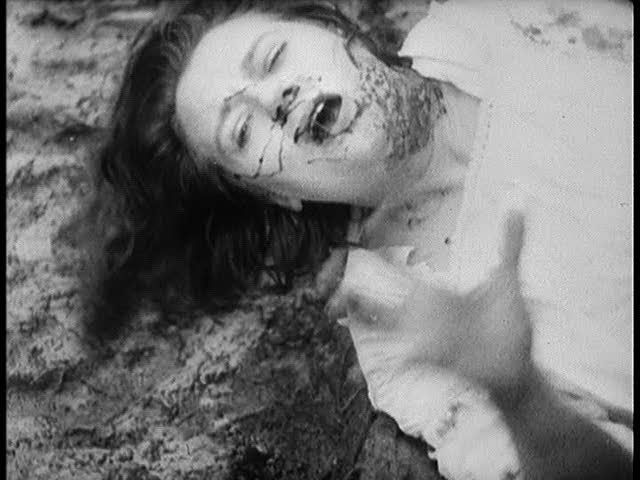
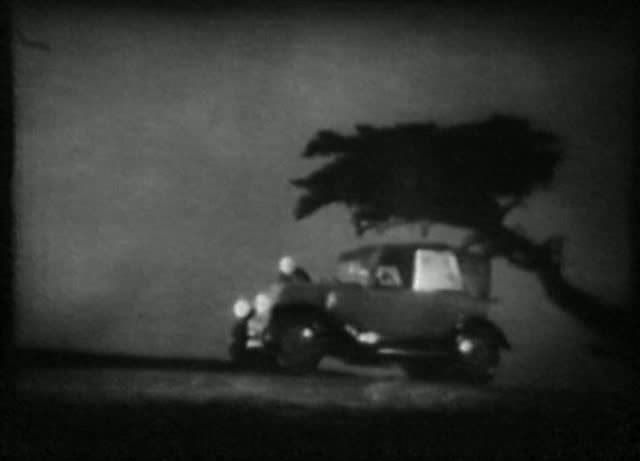
Hawks' style is simple and direct, though hardly static. He makes interesting use of slow pans and tracking shots, subtly suggesting connections and characters' thoughts with movements of the camera. In one scene, Dolores has arrived at Michael's home unaware that he's the man she's being paid to seduce — because, of course, the conventions of such romances require that the bad girl genuinely fall in love with the man she's planning to con. It's a rainy night and her car stalls out, and after a struggle through the mud and steep slopes outside she collapses at the Prince's doorstep. When she wakes up, she's naked in bed, a sheet draped across her body, and the camera pans around the room from her point of view, taking in the sight of her clothes strewn around the room, on the floor and draped on chairs, until finally her gaze settles on Michael. Without a hint of overt sexuality or nudity, this pan economically suggests the mental picture that's certainly running through Dolores' head at this point, of this stranger undressing her and slipping her naked body into bed.

Paid To Love represents a time when Hawks was still more or less a novice director rather than the fully formed master he'd develop into soon after the switch from silents to talkies. The mostly functional intertitles occasionally contain a wry pun or punchline, but the bulk of the film's humor is visual and physical; Hawks' gift for verbal banter couldn't really develop in text form, particularly since so many of his best later films featured torrents of words in a constant, fast-paced rush. This film isn't even as indicative of the director's future direction as the marvelous A Girl In Every Port, though there are certainly hints, here and there, of Hawks' sensibility forming even at this early point. For that, and for its moments of unsubtle sexual humor, it's worth seeing for Hawks' admirers, though the director's true breakthroughs were still several years ahead of him.
Passing Fancy


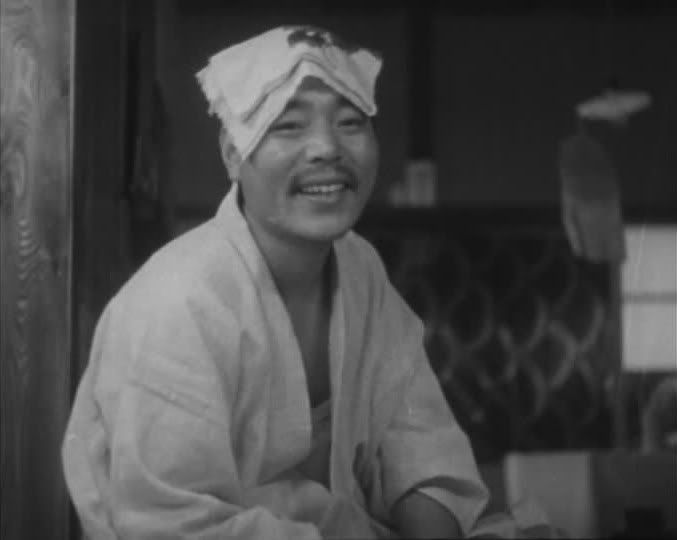
Passing Fancy is an early silent comedy by Yasujiro Ozu. Although many of Ozu's silent films are quite different from his later works, in Passing Fancy Ozu's mature style already seems to be almost fully developed. The film is a charming family comedy about the single dad Kihachi (Takeshi Sakamoto), his son Tomio (Tomio Aoki), and his friend Jiro (Den Obinata), and the tension that enters their simple lives when they meet the homeless and unemployed young woman Harue (Nobuko Fushimi). The middle-aged Kihachi immediately likes the much younger woman, helping her get a job and a place to stay at a neighborhood restaurant while courting her in his goofy but charming way. Harue, though, thinks of Kihachi as an uncle and prefers the younger Jiro, who makes sure to keep her at arm's length, though one suspects that despite his insistence that he doesn't like her, he's only pushing her away out of loyalty to his good friend.

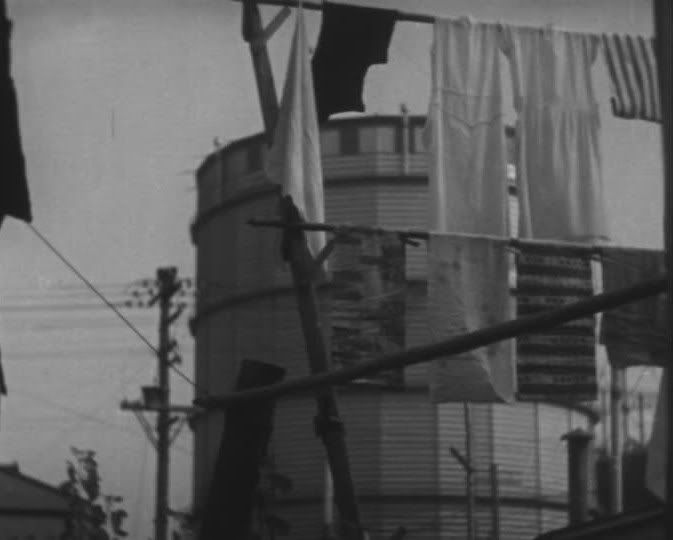
The film is mostly shot from Ozu's familiar low vantage point, his aesthetic already well-established by this time. In his films with children, the low camera placement seems to take on an additional purpose, as the low-to-the-ground framings are perfectly suited to a child's proportions — Tomio fits comfortably within the frame no matter how low the camera is placed — while the adults seem to tower outside the frame, their legs entering the frame before the rest of their body begins to appear in view. The compositions of the film are as meticulous and deliberate as later Ozu, with a constant awareness of how objects and people are arranged within the static frames; there is no camera movement, an aesthetic choice that would be totally codified in Ozu's late color films. As in his later work, striking use is made of bottles and other household objects positioned to counterbalance the actors within the frame; often the actors are placed into the background with some domestic object highlighted in the foreground. Ozu also periodically inserts static shots of the surrounding buildings and water towers to establish the setting, early examples of the "pillow shots" that would become such a powerful aesthetic devise in the director's postwar oeuvre.

Though there are elements of drama and melancholy in Passing Fancy, the film is largely a comedy, not so much in terms of broad slapstick as in its gentle but pervasive comic tone. Even at the height of the film's downtrodden section, when Tomio falls ill and Kihachi worries that the boy might die, Ozu breaks the tragic mood with a comic series of intertitles when Tomio's teacher asks Kihachi how the kid got sick, causing Kihachi to respond that "he ate fifty sen worth of sweets all at once," then enumerating all of the different flavors of candy the boy had eaten. Obviously, the illness isn't meant to be taken entirely seriously, but Kihachi's worries are heartrending anyway. Similarly, there's a strain of comedy running through the film centering on economic concerns in Depression era Japan, a concept introduced in the most humorous possible way in the film's opening scenes. At a theatrical performance, several men in the audience see a coin purse sitting on the ground and discretely peek inside, realizing that it's empty and then discarding it, only to have another man pick it up in the hopes of finding something inside. Ozu milks this gag for its gestural comedy, and also for its suggestion of poverty so extreme and common that none of these men think twice about trying to scrounge for money anywhere they might find a few coins. The physical comedy is then extended with a sequence where several men get up and dance around as though they have bugs crawling around in their clothes, another sign of the squalor of this neighborhood.


That economic hardship defines the film in many ways. Kihachi is embarrassed by his lack of financial security, by his inability to give his child everything he'd like to, and his desire for more leads him to extravagantly give the boy a coin, which Tomio then uses to gorge on candy since he's not used to having any money at all. More seriously, Kihachi proves incapable of paying the doctor who cares for his son, and scraping together the money for the medical bills proves to be an exceedingly difficult task. It quite literally takes the efforts of nearly everyone he knows to pay the doctor, with his community of friends and neighbors coming together to help him and his son.

Ozu often seems constrained by the stylistic conventions of the silent cinema; Japan was slow to switch to sound, and though Ozu often gets by here through gestural acting within the frame, this is a rather dialogue-heavy film with a lot of information and emotion conveyed through the text. In the scene where Harue and Jiro argue over her lack of romantic feelings for Kihachi, Ozu unleashes an uncharacteristic barrage of dialogue intertitles, alternating between static, repetitive images of Harue and Jiro, with more or less the same closeup of each repeated over and over again in between titles. It's one of the moments when the limitations of silent style for Ozu become obvious, as his visual sensibility must be subsumed to the necessity of staging a lengthy and emotionally complex conversation entirely in text.

Such glitches aside, Passing Fancy is a warm and gently funny work. The film's story is minimal, which allows Ozu to develop his characters and to use his slow, observational visual sensibility to create a portrait of an era and a neighborhood. The rich sense of community, the half-comic depiction of economic woes, the emotional nuance of the characters as they make the best of their limited circumstances, it all adds up to a lovely film that's very much attuned to the social milieu in which it is set.

Underworld (1927)


Josef von Sternberg's remarkable silent Underworld was a template for virtually the entire gangster film genre, an archetypal film that established much of the mythos and visual language of the genre. It is also, on its own merits and regardless of its subsequent influence and importance, a bracing and powerful film, a searing melodrama with a bluntly poetic visual style. The film's story is familiar now, focusing on a brutish gangster improbably named Bull Weed (George Bancroft), a man who believes he is above the law, that he can never be caught. He literally laughs in the face of law and propriety: a big, full-throated laugh, one that requires him to throw his head back and roar with forced hilarity when confronted with those who, unlike him, fear the law, or think he needs any help. Bancroft's performance is deliberately oversized, a big, bold performance for a big, bold man whose every gesture is theatrical and exaggerated. Bull is always performing, always putting on a show as a big man — he revels in handing out money, making a show of his generosity, and an equally big show of his toughness, as revealed by his habit of ostentatiously bending coins into U shapes, his face crunched up as he strains with the metal coin, demonstrating his strength and dominance. Bancroft's broad performance is perfectly suited to this gestural, hammy, outrageous figure.

This performance, and this character, was obviously a towering inspiration for the gangster genre in the years to come, as Bancroft's Bull Weed was echoed in later gangsters played by James Cagney and Paul Muni. Howard Hawks' Scarface, in which Muni broadly mugs as a similarly unflinching gangster, was especially influenced by von Sternberg's film. This influence on Hawks would reverberate into later works, and Hawks nodded to Underworld in Rio Bravo by naming his own heroine Feathers, after Evelyn Brent's character here, and paying homage to the sequence where a bully tries to get a drunk to go fishing for money in a spittoon. In von Sternberg's film, Feathers is Bull's girl, the bully is Bull's criminal rival Buck (Fred Kohler), and the drunk is ironically dubbed, by Bull, Rolls Royce (Clive Brook), a washed-up lawyer who still hasn't sunk so low that he'll go scrambling in filth for a few dollars. Rolls Royce isn't so proud, however, that he won't take Bull's money; when Bull befriends this drunk, perhaps seeing the nascent dignity and potential in him, he sets Rolls Royce up with some money and makes him his right-hand man.

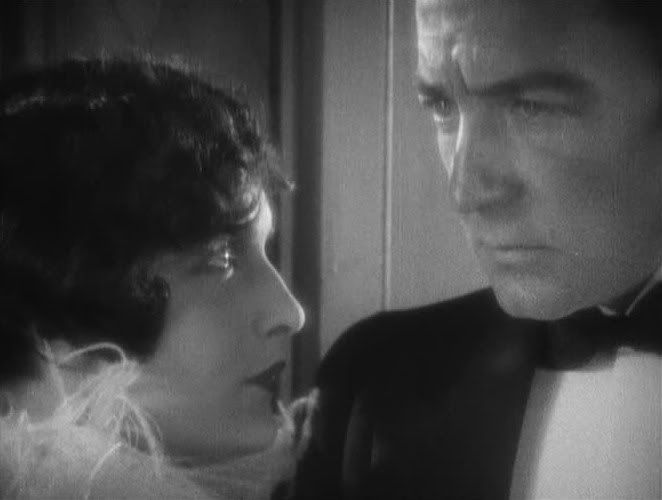
Feathers is similarly indebted to Bull, even though she quickly falls in love with the cleaned-up, intelligent Rolls Royce. She asks Rolls Royce what he was before he was picked up by Bull, and after acknowledging that he was a bum and a drunk, he turns the question around on her. The look in her eyes says it all, without any intertitle to clarify: she was obviously a lowly character, perhaps a prostitute, and now she's a woman who, covered in feather boas and dressed in glamorous clothes, can turn the head of everyone in a room when she enters. Von Sternberg stages moments like this in glossy but expressive closeups, glistening with light that reflects off the shiny eyes of the protagonists as they grapple with loyalty, desire, and shame. Feathers and Rolls Royce are deeply conflicted, in love with one another but also feeling loyalty to Bull, and simultaneously ashamed of their reliance on this gangster. They know that their lives are built on illegal activity, and Rolls Royce even helps Bull with his crimes, instructing him on how to frame Buck for a stick-up job.


Von Sternberg's aesthetic, with his intense closeups and strikingly framed medium shots in shadow-strewn back alleys and bars, is perfectly suited to this tale of pent-up and violent emotions. Bull, in contrast to Feathers and Rolls Royce, doesn't hold anything back. He expresses everything, alternating bouts of rage with fits of laughter and cheerfulness that are just as fierce. When he sees Feathers and Rolls Royce dancing, he flies into a rage, outraged not that they were dancing, necessarily, but that his assistant hadn't asked for permission first: he speaks of Feathers as though she were his property, as though Rolls Royce should have simply asked to borrow her. A moment later, the incident is forgotten and Bull is back to cackling hysterically, as though nothing had even happened. He burns hard and fast, never holding back his jealousy or his anger or his enjoyment of some bit of nonsense. Everything he feels is immediately embodied in his expressive face. At one point, while he's standing trial and awaiting his sentence, he's distracted from the judge's words by the sight of Feathers and Rolls Royce sitting together in the courtroom. Von Sternberg focuses on a closeup of Bull's face, his eyes continually shifting to the side, away from the judge, looking towards his friend and his girl together; it is a portrait of all-consuming jealousy, jealousy built from a seemingly innocent image of these two people simply sitting next to each other. In Bull's mind, it becomes an intimate moment between lovers, and von Sternberg shoots the pair as though subtly confirming Bull's suspicions in the closeness of their bodies, in the small comforting pat on the hand Rolls Royce gives to Feathers, in the confining intimacy of the way they're framed together.

What's so remarkable about Underworld is that it's a seminal film, the impact of which has hardly been blunted by all the films to follow its example. Like many of its successors, it frames its story of an unrepentant gangster in the thin gauze of a social message — and even has Bull repent in the final act, an out-of-character gesture that does little to change his essential nature. But also like many later gangster pictures, Underworld is far more convincing at establishing the fun-loving persona and larger-than-life vitality of this vicious character than it is at tut-tutting his excesses. The film is fun, and frequently quite funny, with flashes of wit in the titles, like Feathers' insult/come-on to Rolls Royce, a bit of naughty innuendo disguised with an automobile metaphor. Later, there's even a gangsters' ball where "everyone with a police record will be there," a cartoonish conceit that calls attention to the film's wry, fantastical perspective on crime and gangsterism. This is a brilliant, strikingly shot example of the American gangster icon in his early stages of development, his edges at their roughest, his nastiness cut with playfulness and joie de vivre, his brutality softened by an almost unthinking generosity and tenderness. He's the kind of gangster who will machine-gun a cop one moment and feed a kitten some milk from his finger the next, and kittens sporadically caper through the film, symbols of innocence and play, oblivious to the gunfire and violence. The film, like its laughing, scowling antihero, is rough on the outside but hides the playful, spirited soul of a kitten underneath.

I Was Born, But...


I Was Born, But... is an utterly charming, hilarious silent comedy of childhood by Yasujiro Ozu, displaying the lighter, more playful side of his sensibility. The film concerns itself almost exclusively with the child's point of view, focusing on the perspective of young brothers Keiji (Tomio Aoki) and Ryoichi (Hideo Sugawara). The boys have just moved to a new town with their father (Tatsuo Saito) and mother (Mitsuko Yoshikawa), since their father has moved to the suburbs so as to be closer to his boss. The film's genius is the way Ozu keeps unceremoniously cutting away from the film's adult dramas — the father's desire to advance at work and make a good impression on his boss — to follow the kids instead. It's like there are two entirely separate worlds coexisting here. When the father goes to visit his boss on the weekend early in the film, Ozu watches just long enough to establish that he's doing a little sucking up, looking obviously subservient with his stained jacket and nervous mannerisms, and then the camera chases off after the boss' son Taro (Seiichi Kato) as he runs away with some friends to go bully the new boys.

These scenes have an exuberance and energy that's nearly irresistible, as Ozu traces the way that small dramas can be of big consequence in a child's world. Keiji and Ryoichi must adjust to their new home, to new challenges from a bully and the gang he leads. They are dogged, too, by their father's insistence that they do well in school, even though they don't even want to go because of the bullies there. When asked if they like school, the boys immediately respond, "we like the walk there and the walk home, but in between is no fun." There's a real sharp wit in this film, a sense of pitch-perfect comic timing that's as present in the physical comedy as it is in the sporadic dialogue provided by the titles. When the bullies confront the two boys, it's staged like a dance, with each side stepping forward a little bit at a time, hesitantly posturing for one another, the leader gliding forward and the others behind him nervously inching up to support him or at least to see what's going on.

Ozu has great fun with all these scenes, enjoying the kids' mugging and goofing around, the way they make faces and stand on one foot, try to find sparrows' eggs because they think it'll make them stronger, and play a funny game of raising the dead, gesturing to make a kid fall to the floor, then crossing themselves and holding their hands out to bring him back to "life." There are plenty of wonderful comic set pieces and characters, like the beer delivery boy (Shoichi Kofujita) who teases the boys by pretending he'll forge a good grade on their faked homework assignment, then drawing a backwards character instead. Later, the boys convince the delivery boy to help them beat up the bully who's bothering them, because they tip him off when their mother wants to buy beer. Helping him get a sale earns the boys his temporary loyalty, but it's not enough to get him to also take on Taro: as he explains, Taro's family buys much more than Keiji and Ryoichi's family. This is a first indication, though the boys don't understand it at the time, of the concept of social status and hierarchies.

Their understanding of hierarchies is limited to the idea of who can beat up whom, of who's bigger and stronger, who's tougher. They don't get that the adult world has different priorities, that money and class dictate the separations and relationships between people once they grow up past childhood. Once the boys dispense with the bully, they take over leadership of the gang, including Taro, who becomes their friend and lackey. To them, they're equals at least, so it's puzzling to get some hints that things might be different for their parents. This conflict comes to the fore in the film's final third: after spending an hour dealing with light slapstick and goofy little set pieces involving the kids, Ozu unexpectedly introduces a note of pathos and drama when the boys see some amateur movies of their father acting like a fool at work, making funny faces and trying to amuse his boss. They had worshiped and respected their father, believing him to be an important man, defending him in the usual kids' arguments about whose father is the best. When they see these movies, they suddenly see him in a totally different light, as a clown, as someone who has to be obsequious with Taro's father, constantly bowing to him. And when their father tries to explain that he is only an employee, that Taro's father is above him in rank, the boys are only even more devastated, understanding in a flash that the world does not work the way they thought it did, that their father was not the "great man" they'd thought he was.


The film's final act is moving and nuanced in its treatment of this theme, replacing the humor of the earlier scenes with an honest, direct look at class and honor. The father sighs that coping with the limits of status, with settling for being just a lowly employee, is "a problem kids these days will face all their lives," suggesting that he sees a future, sadly enough, where his own sons will grow up to be just like him, cogs in the machine rather than truly important men. He watches them sleep, with tears drying beneath their eyes, and urges them to strive to be better, not to settle for a working man's life and status the way he had. It's deeply affecting, to see this man struggling with his emotions as he realizes how badly his sons' confidence in him has been shaken. He briefly sinks into despair, grabbing a bottle of liquor and threatening to drown his sorrow in it. Ozu captures this low point quite effectively, framing the image with the father leaning against the doorway in the right side of the frame, the liquor bottle in his hand hanging down into the foreground, as his wife sits in the center of the frame in the background. It's a wonderful image of resignation and sadness. It is also the payoff to Ozu's decision to stage the film so completely from the kids' perspective prior to this: this sudden shift to the father, to his long-subdued frustration and mild shame at his limited position in life, is striking in its emotional impact.

There are hints of this sympathy to the father's perspective earlier in the film, too. Ozu's editing frequently suggests the continuity between father and sons even before the theme comes up explicitly in the film's denouement, by drawing parallels between the generations through juxtapositions of images. At one point, the camera pans (a camera move much more frequent in silent Ozu than it would be later in his career) across a row of office workers hunched over their desks, writing. Ozu then cuts to a cluster of students at their desks, learning calligraphy while a teacher admonishes them for goofing around or staring off into space, and finally the camera pans across an open field where the two kids cutting school are sprawled out, also writing as they lie in the grass. In all three shots, the camera move is the same, even as subtle shifts in the angle calls attention to the cutting, preventing a smooth transition from one shot to the next. It is purposefully disjunctive and jarring, suggesting both that the generations are linked by similar behaviors and situations, and yet that there is some necessary break, some trauma, that leads from childhood to adulthood. That break, perhaps, is the children's later realization of their father's place in the social strata.

Ozu chronicles the changing relationship between father and sons throughout the film by returning several times to a particular primal scene, the father and the two boys leaving the house together in the mornings, walking together as far as a train crossing before splitting up, the boys going off to school and the father to work. When this scene recurs at the end of the film, after the boys have started to come to terms with their father's place in the world, it mirrors the earlier ones, in which the boys had unquestioned respect for their father. But there's a new emotional undercurrent here, a hint of hesitancy that's cleared up when the boys give their father permission to go greet his boss, confirming that they now understand and have once again gained respect for him, albeit a new, more realistic respect, one founded on simple love rather than a mistaken belief in the father as an idealized "great man." It is a poignant and warm ending to a wonderful film in which Ozu affectionately, sensitively explores the nature of familial bonds and the role of honor in a new world where social class is calcifying into a rigid hierarchy.

Tokyo Chorus


Tokyo Chorus is an early pre-war silent film from Yasujiro Ozu, whose silent work generally reveals quite a different director from the later static, patient sensibility of his mature oeuvre. Of course, there is still a continuity in terms of themes and subjects connecting these earlier silents to the sound films. Tokyo Chorus is, like almost all of Ozu's films, concerned with domesticity and family relationships, and with the changes wrought on the family by outside pressures and developments. In Ozu's post-war films, these pressures take the form of encroaching Westernization, of the old traditional ways transitioning into a new modern sensibility. Obviously, there are some slightly different concerns at the core of this pre-war film, made in 1931 with the Great Depression affecting Japan as much as any other country — as one character jokes early on, "Hoover's policies haven't helped us yet," a wry punchline made even more bitterly ironic by the retrospective knowledge that Hoover's policies didn't help anyone very much.

The film centers on one family struggling to make ends meet during this difficult economic time. Shinji (Tokihiko Okada) is introduced as a rebellious, goofy schoolboy, but a few years later he has a family: a wife (Emiko Yagumo), a son (Hideo Sugawara), a daughter (Hideko Takamine) and a baby. Ozu introduces Shinji in a lengthy and near-slapstick sequence as a stern school teacher (Tatsuo Saito) tries to maintain control over a rowdy line of students (though, admittedly, the fact that all these schoolboys look like grown men initially makes it hard for an outsider to figure out the context of this scene). Ozu pans across the line of students, his camera moving across a diagonal composition that is repeated several times throughout the film. Such motion would later become rare and uncharacteristic in Ozu's post-war work, but here his aesthetic is not pinned down to the static, low-height observation that would come to be his most salient visual characteristic. Instead, Ozu's camera tracks along with the characters as they walk, or passes along rows of people lining a street.

During the opening scene, Shinji and the other students goof around and play, as the instructor makes disapproving notes in a little book, calling them out to examine their outfits and their posture. Shinji gets in trouble for not having a shirt on under his jacket, and is left sitting alone, picking at something (bugs? stray threads?) on his pants as the rest of the students are led away. This introduction establishes the film's broad sense of humor, telegraphed through the loping gait of the students as they act surly towards the teacher, or the instructor's head-bobbing bounce as he surveys them. From this opening, Ozu cuts away to a few years later, when Shinji is working at an insurance company. It is not stated directly, but the gap is meant to represent the onset of maturity, the rowdy schoolboy gaining responsibility as he settles into life with a family and a respectable office job.


This stability is disrupted when Shinji loses his job after defending an older employee who he felt had been unfairly fired: his earlier insouciance towards authority manifesting itself again in an act of benevolent defiance. The scene is nearly played for comedy — Shinji and his boss get into a slowly escalating shoving match by tapping each other on the shoulder with fans — but there's no mistake that the consequences of this lost job are truly dire for a man with a wife and three children in the middle of a terrible depression, with no jobs available. The central theme of the film is this man's struggle to maintain his family's honor and his own self-respect when faced with the loss of his profession and, with it, his claim to respectability. Honor is central to the film, especially as expressed in the way that Shinji's wife looks at him; Ozu captures the impact of a look, the humiliation of seeing her husband in a menial job that is beneath his station, a job he only got because of a chance encounter with his sympathetic former teacher.

What's interesting, though, is that Ozu ultimately critiques, in his own indirect way, the concepts of honor expressed here. Shinji's wife at first resists her husband "stooping" to a job carrying banners to advertise his former teacher's new restaurant; when she sees him doing this, she is humiliated. In fact, it's a rare moment when Ozu reinforces her feelings with an intertitle that outright says she's humiliated; Ozu generally uses such titles sparingly, preferring to capture such emotional nuances in the actors' performances, using the editing to emphasize certain glances and expressions. This, apparently, was a beat that Ozu felt the need to hammer home more forcefully, however, hitting his audience over the head rather than risk anyone missing the wife's sense of disgrace. She tells Shinji that he should remain proud and not do anything so obviously beneath his status. But Shinji resists, insisting that he is doing the right thing, that all a man in his situation can do is take whatever opportunities come to him. His wife soon gives way as well, agreeing to help him in his new job and supporting him until, at the end, his former teacher comes through with an offer of a better job in education. The lesson seems to be that abstract concepts like honor and pride are not nearly as important as putting food on the table for one's family, just as keeping up appearances must be secondary to providing the necessities of life for one's loved ones.

Tokyo Chorus is a fine film if not a particularly distinguished one. It reveals Ozu's nascent sensibility in its earliest state, as he deals with his usual themes — family dramas, the conflict between traditional values and changing conditions, the rhythms of domestic life — in a less formally rigorous way than he would in later years. The film is unfailingly direct and straightforward in its approach, telling a simple story simply. It is thus not quite a peak Ozu film, but perhaps an important work in his development, a step towards the greater depth and aesthetic richness of his later films. It is, regardless, an affecting film, particularly in two scenes between Shinji and his teacher. In the first, when the teacher offers Shinji a job, the latter offers some token resistance based on honor, saying that if the teacher merely feels pity for him, then he can't accept, but that if it's a gesture of friendship instead, he can. Shinji is essentially constructing a way for him to take the job and still feel like he's not sacrificing his honor; Ozu captures the desperate yearning on Shinji's face as he fears that perhaps his teacher will withdraw the offer, and the knowing nod from the teacher as he accepts this face-saving gesture. Later, in the final scene, Shinji's former classmates have gathered together for a reunion, and are singing a song together. Shinji and the teacher both join in, but as Ozu cuts between closeups of the two of them, isolating them within the crowd, their faces are troubled briefly by sadness and introspection before they regain their composure and join the celebration. Even in a relatively straightforward and conventional film like this, Ozu asserts his mastery with shots like these, shots where complicated emotions arise from his probing of the faces of his actors, and the juxtapositions between uplift and loss that flow through this film.

Charleston Parade/The Little Match Girl


Charleston Parade is a totally bonkers short silent film from Jean Renoir, a nutso little experimental showcase for the animalistic eroticism of his wife, Catherine Hessling. The short is set in the then-distant future of 2028, a time in which, apparently, Europe has descended into apocalyptic disrepair while Africa is ascendant, its people traveling in globe-shaped UFO-like vehicles that hover through the air. Johnny Huggins plays an African explorer visiting the wasteland of Paris in just such a ship, and encountering the local savage Hessling, clad in skimpy shreds of lingerie and leering at him with a frankly lascivious interest. The film's conceit is especially interesting for its era since it more or less reverses the typical depictions of black men and white women in films of the time. Huggins plays in minstrel makeup, his big white lips often the only part of his face that shows up in the low-contrast images, but the film's narrative has the white woman feverishly pursuing the frightened black man for a change. She chases him with abandon and even ties him to a lamppost. The film doesn't exactly overturn stereotypes — Huggins' performance is pure minstrel show slapstick — but it does place them front and center for examination.

None of which should imply that Charleston Parade is a serious work about race, stereotypes, or anything else. It is, more than anything, a deeply goofy, silly film, an opportunity for Hessling to really cut loose and for Renoir to indulge in some of his more playful sensibilities. The depictions of Hessling seducing Huggins by performing a rough, sensual Charleston dance are particularly fun, as Renoir subtly slows the images into a sinuous, snake-like motion as Hessling sways and wiggles, kicking her legs high and leaping into the air like a frog. At the climax, when Hessling and Huggins perform the dance together, the images become frenzied and wild, as Renoir cuts in shots of the dancers' feet as they twirl and encircle each other, their feet bouncing wildly around.

There's also a playful crudeness to many of the effects shots, from the opening model shots of the explorer's aircraft taking off to the inserts of "angels" portrayed as disembodied heads with small wings floating beneath them; Renoir himself appears among the angels at one point, mugging broadly. At one point, Hessling hears a phone ringing, so she draws a phone on the wall in chalk, and when she's finished an actual phone fades into view atop the drawing so she can answer it. Later, when she's preparing to leave, her coat and umbrella sashay along the ground towards her, the coat crawling up to wrap itself around her and the umbrella leaping into her waiting hand. There's an offhand magic to these rough shots that's charming; the same goes for Hessling's playmate, a man in a grotesque ape costume who dances the Charleston along with her and weeps when she's about to leave. These images reveal a spirit of play and weird humor in Renoir that would later manifest itself in his kindred spirit antiheroes like Boudu. Charleston Parade is an oddity from Renoir, but it's a compelling and enjoyable oddity.


The Little Match Girl is another short silent film from Jean Renoir, based on the Hans Christian Anderson fable and starring Renoir's wife Catherine Hessling as a poor match seller named Karen. She is sent out by her family on a cold night to sell matches, but she can't find any business and she suffers in the cold and the snow, assaulted by boys with snowballs, ignored by potential upper-class customers, freezing in the dark as she peers into bright, warm, lively shops and pubs where people laugh and eat and drink. It is a maudlin but nonetheless effective piece of humanist social realism, contrasting the suffering of the poor match girl, who no one cares about, against the security and comfort of those who pass her by in the snowy streets. There is one especially potent shot in which Karen is scrambling around on the ground in front of a restaurant, desperately gathering up her wares after they've been knocked away by the boys who pelted her with snowballs. A policeman arrives and chases the boys away, then walks towards Karen. Renoir remains at ground level with Karen, on all fours in the snow, and behind her the policeman's clean, shiny boots pass by, then stop, not to help Karen, but to talk with the restaurant's owner, who had been hit with one snowball when she briefly came outside to yell at the boys for hitting her windows. The shot is utterly heartbreaking: Karen in despair on the ground, while the figure of authority, his boots in the background of the shot, ignores her to comfort the comparatively uninjured upper-class shop owner.

At around the short's halfway mark, this mix of hard realism with broad sentimentality — the match girl peering wistfully through the frosted windows of a restaurant — gives way to the crude effects and whimsical tone that Renoir also utilized in Charleston Parade. At this point, it would seem, the film becomes a surreal fantasy, a dreamlike imagining as the match girl, freezing in the snow, desperately trying to warm herself with the tiny flickering flames of her matches, instead dreams of happier things. She steps into a giant-sized toy shop, where she wanders among the toys as they come to life: ballet dancers dance, a shaggy stuffed dog balances a ball on its nose, and toy soldiers march in formation. The rough stop-motion animation effects are compelling, but what's really interesting and affecting about this diversion is that Renoir doesn't allow the fantasy to be a complete escape from reality. Although these animations are charming and playful, they are also poignant; as Karen is dancing through gauzy white curtains or juggling, or watching the toy soldiers march, it's impossible to forget that she's actually lying in the snow, alone and forgotten, losing herself in hallucinations brought on by starvation and frostbite.

In that respect, even as the film becomes a fantastical farce on its surface, it retains its edge of despairing realism: Karen has chosen to retreat from reality rather than face it any longer. It is a film above giving up, about losing one's grip on life, and this sobering undercurrent runs through even the most playful moments of the fantasy segment. Towards the end of this sequence, Renoir turns back to darker territory, introducing a toy soldier with a skull and crossbones on his hat and bone ribbing on his jacket. That's right: this film features Death as a toy soldier, pursuing Karen and her protector, another soldier, in a horse chase across the sky. The film's denouement transitions smoothly from the whimsy and escapism of Karen's wistful fantasy into a startlingly poignant depiction of the journey into the afterlife, as the dark soldier, this icon of death, throws Karen's lifeless body across his black mount and rides through the clouds with her. The rough superimpositions of these images lend a quality of eerie minimalism to the fantasy's final moments — culminating in Death, previously a forbidding, villainous figure, tenderly laying Karen down on a cliff edge beside a cross which then morphs into a budding bush. Then, the return from fantasy to the cold harshness of reality in the film's final moments only underscores that even this romantic vision of death is far from reality: the truth is sadder, more pathetic, without the heroic adventure of Karen's dream death. This is a poignant, moving, evocative short from Renoir, the cinema's premier humanist delivering a powerful depiction of how social class dictates life and death.

Fantômas: In the Shadow of the Guillotine/Juve Versus Fantômas


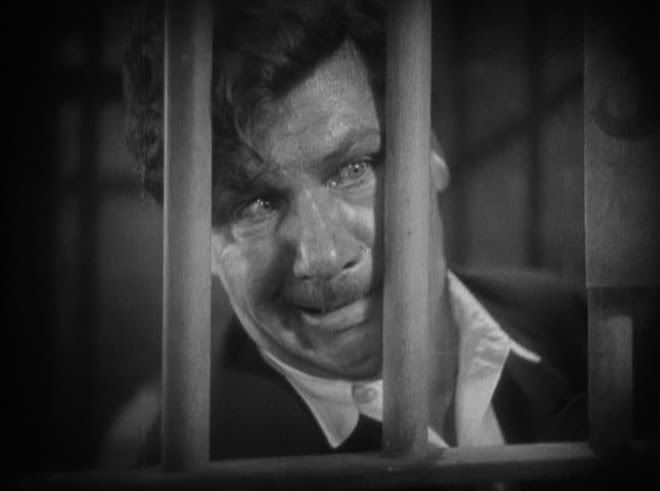
The pulp fiction villain Fantômas was one of the early cinema's first great criminal figures, as depicted in the famed five-film serial directed by Louis Feuillade. The first film in the series was Fantômas: In the Shadow of the Guillotine, which established the titular bandit and criminal (played in all five films by René Navarre) as well as his adversary, Inspector Juve (Edmund Breon), both of them taken from a popular series of novels of the time. Fantômas is a master of disguise, as hinted at in the opening montage, which fades between several different mugshot-like portraits of the villain in various guises and false beards. This hour-long opening chapter of the serial depicts Fantômas robbing and murdering, scheming with the Lady Beltham (Renée Carl) to kill her husband, and presumably take his money, too, though this is never spelled out. The interesting thing about Fantômas is that his crimes rarely seem to have any overriding motive; he's in it for the money, yes, but more than that he just seems to get a kick out of doing evil things for their own sake. But the clever Juve is on the trail, and with the help of his friend, the reporter Jérôme Fandor (Georges Melchior), he is soon able to apprehend Fantômas, sending him to prison to await execution.

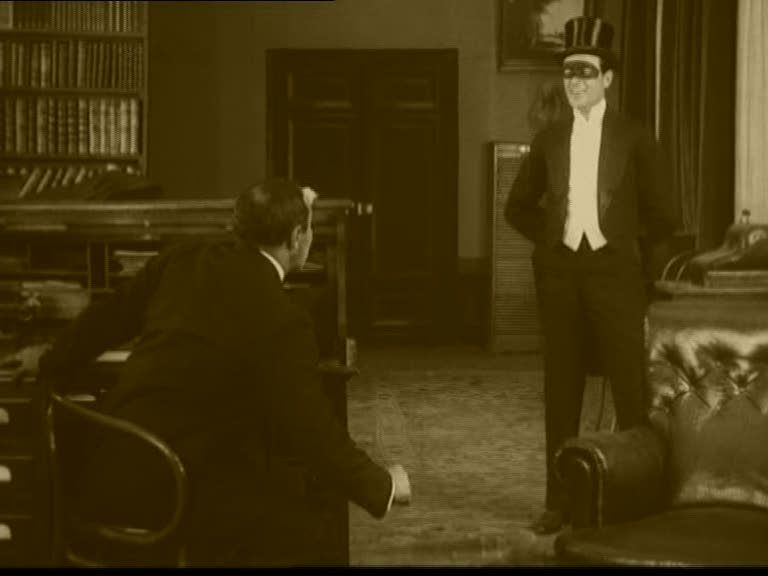
The second half of the film is thus dedicated to Fantômas' plan to escape from prison and his deadly fate. Interestingly, Feuillade more or less places the audience in a position of identification, not with Juve, but with Fantômas himself. With the criminal caught and sent to jail halfway through the picture, this can't be a typical police mystery where the audience is rooting for the detective to catch the criminal and solve the case. Once the case is solved, the big question becomes: how is Fantômas going to escape? It's a foregone conclusion that he will escape, that he'll live to rob and kill again another day, so the suspense is simply all about seeing how he'll do it, what clever plan he'll come up with. The plan turns out to be a good one, not necessarily in terms of its logic (which is non-existent), but in terms of the way its convoluted mechanics play out on screen. With the help of his accomplice Lady Beltham, Fantômas lures the actor Valgrand (Volbert), who is playing Fantômas in a stage re-enactment of his crimes and punishment, to appear at a house near the prison in his performance costume. Once there, he is substituted for Fantômas and sent to a rendezvous with the guillotine while the master criminal makes his escape. Juve saves the man at the last minute and vows to pursue Fantômas from then on. The film's final scene is its best: Juve, in his study, has a vision of his adversary, fading into view in the corner of the room, dressed in a top hat with a domino mask across his eyes, taunting the inspector to chase him down.

Feuillade's aesthetic is simple and direct, very much of its time. His camera set-ups are of course static, and even stagey. With the exception of a few, rare closeups to highlight an object (like Fantômas' clever calling cards, which appear blank at first before his name fades into view), the film is staged entirely in tableau-like medium shots, with all the action playing out for each scene within a single room, from a steady, head-on angle. Given the limitations of the cameras of the time, Feuillade often composed in depth, using his static shots to his advantage. An automobile parked alongside the curb is shot from a skewed angle that accentuates the sidewalk stretching away into the distance, calling attention to the man walking towards the car, who will prove to be important. Later, when Lady Beltham goes to watch Valgrand's performance as Fantômas, the scene is shot from her booth in the back of the theater, with the stage itself framed, like a cinema screen within the screen, by the boundaries of her booth. The multiple levels achieved within this shot are striking: the cinema audience watches someone else, who's watching another audience that's watching a play.

These layered, deep-focus compositions are the most interesting aspect of this first chapter in the Fantômas serial. The action here is slow and drawn-out, and the staging of some scenes — like Fantômas' first robbery, at a hotel — are awkward and clumsy, making the dashing villain seem very amateurish indeed. This installment mainly just sets up the characters and situations that would be exploited throughout the remainder of the series.


Already with the serial's second chapter, Juve Versus Fantômas, the pieces seem to be more firmly in place, and the action more elaborate and thrilling. Curiously enough, the story here is also more rambling and incoherent, often threatening to fall apart completely, as though Fantômas himself had forgotten what his plot was all about. A dead body appears, supposed to be Lady Beltham, but apparently not since she is alive later; in any event, the corpse is quickly forgotten. Instead, Fantômas plots to get a large sum of money from a businessman, although this too is unceremoniously dropped in the latter half of the film. Basically, this hour-long film is a string of inventive set pieces, in which Fantômas engages in a duel of wits and brawn against the combined forces of Juve and Fandor.

There's an exciting action sequence in which Fantômas and his gang of thieves hold up a train, uncoupling the last car in order to facilitate their getaway and trigger a horrible collision to eliminate any witnesses. Feuillade stages this by fluidly blending together model shots and images taken aboard a real moving train, and there's a propulsive rhythm to the editing during this scene that belies the static nature of the individual shots. Feuillade manages to convey the motion and energy of the trains without even moving the camera once. Even better is a shootout at a wine barreling plant, where Fantômas' hoods are hiding out in a large field of wine barrels, popping up sporadically between the rows to trade shots with Juve and Fandor. The whole thing is set up like a carnival shooting game, and Feuillade plays it for near-slapstick humor without ever dissipating the sense of danger. Feuillade likes to play with the entirety of the frame, often enlivening his static shots with bits of business tucked away in all the layers from foreground to background. In a scene at a nightclub where Juve and Fandor confront Fantômas' girl Josephine (Yvette Andréyor), the frame is packed with activity and small jokes, distractions at the edges or in the extreme foreground, like the drunk guy who keeps nodding off to sleep in the corner of the frame. Finally, there's a rousing concluding set piece at Lady Beltham's abandoned mansion, where the police track down Fantômas, who avoids them through some clever hiding spots. The whole thing closes with a fiery cliffhanger, a teaser for the next episode.

With this second film, the pace of Feuillade's storytelling picks up a bit — though it's still often plodding by modern standards — and there's a lot of fun in watching Fantômas and Juve match wits. This installment places the inspector on an equal footing with his adversary, as indicated by both the title and the opening montage, in which Fantômas' line-up of disguises is followed by a similar introduction for Juve. This film solidifies the series' mania for dressing up and switching identities. Now even the cops get in on the fun, putting on fake beards and disguises in an effort to keep up with their enemy. Identities become fluid and temporary. Fantômas' favorite trick is changing while he's out of view, either in an elevator or in the back of a motor car, becoming a different person in the time it takes him to get from one place to another. And in the finale, he very nearly becomes nobody, donning a form-fitting black costume and mask that turns him into an iconic, mysterious phantom.

A Girl In Every Port


[This is a contribution to the Early Hawks Blog-a-thon hosted right here at Only The Cinema. It will run from January 12 to January 23, 2009.]

Howard Hawks' 1928 silent film A Girl In Every Port is both a singularly fascinating glimpse into Hawks' early aesthetic and thematic development, and a massively entertaining action/comedy romp. It is, as befits the director who later became known for his dramas about tight-knit groups of men in high-pressure situations, essentially a buddy comedy. More than that, it is practically a love story, a romance, about the development of a masculine friendship closer than any traditional romantic relationship. It's the story of the sailor Spike (Victor McLaglen), who in his travels around the world is plagued by a mysterious other sailor who keeps leaving his mark (an anchor within a heart) on the girls who Spike tries to romance when he goes ashore. When he finally runs into this other sailor, Bill (Robert Armstrong), the two predictably brawl and butt heads, but they soon find camaraderie in their shared distaste for the police, who arrive to break up the fight. After a night spent drunkenly wandering the town — Hawks economically suggests a lot with a great shot of the pair's wobbly legs walking down the street together — they become inseparable friends, enlisting on the same ship and always carousing as a pair from then on.

So the film's real story is actually not about the sailors' quest to get girls. Despite the title, the "girls" in question are mostly disposable, forgotten by the time the sailors get to the next port; what endures is their affection for one another, and the fun they have getting into fights together. Hawks continually films them in ways that suggest a romantic couple, in tight close-ups or with their arms wrapped around each other. When they have an argument, the reconciliation is filmed as a series of sheepish back and forth glances, the two of them gradually shifting closer together from their initial standoffish positions across the room, the shot getting tighter and tighter as they make up. There's a suggestion of homosocial undertones here, particularly in the eye-rolling single entendre involved whenever Bill has Spike pull his finger after a fight to put his joints back into place. Even when the film isn't quite as blatant as that, there's a tenderness and compassion between the men that they never show with the women they meet.


Spike and Bill's friendship and their journeys from port to port provide Hawks with a simple but dynamic foundation on which to build any number of comic and adventure sequences. The film is frequently a riot, keeping the use of intertitles to a bare minimum and communicating its bawdy humor through the raw physicality of the action. The bar fight sequences are especially hilarious and effective, slightly sped up to give the action a frenetic, unhinged slapstick quality. Hawks rarely resorts to a title to sell a joke, and the few titles there are mostly just deliver necessary exposition or set up a change of location whenever the ship moves on. In the absence of dialogue or text, the humor comes across instead in the comic wildness of the action, or in the nuances of the actors' performances. Both lead men tend to mug broadly, especially McLaglen, who spends much of the film with a huge smile slathered across his friendly, open face. And yet their exaggerated actions are frequently packed with subtleties of gesture and emotion that would otherwise not be communicated without dialogue, like the way that McLaglen's courtship routine (slicking back his hair, adjusting his collar) has become a ritualized series of gestures that's triggered automatically whenever he sees a pretty girl. McLaglen is especially great in a pair of scenes that play on the sailor's fear that one of his "girls" has delivered his child while he was away. Twice he comes across old flames who now have babies in tow, and Hawks boldly accentuates the sailor's fears; it's some fun business that would disappear from Hollywood film a few years later, once the silents started to give way to sound film and then the Production Code.

In fact, the film's attitude towards sex is, in general, refreshingly candid and straightforward. The script makes no secret of the fact that Spike and Bill are going to bed with numerous different women in every town they visit. At one point, Spike knocks out his compatriot, who keeps interrupting him while he's trying to make time with a girl. A cut then elides some unspecified amount of time before Spike returns to wake up his buddy and cheerfully lead him out of the bar. Hawks leaves his audience to make the not-so-great leap as to what transpired in between the two scenes.


The film's attitude towards sex is even more apparent in the depiction of the women themselves, who of course never get beyond the status of empty sex objects, but who are nevertheless given the chance to be exceptionally alluring and open in their sexuality. Maria Casajuana, as a local girl in a South American port city, is a particularly electrifying femme, a dazzling dark beauty who glowers and grins her way to a sensational impact in just a few short minutes of screen time. There are other tantalizing glimpses of intriguing women in one port or the other, but none of them match the simmering intensity of Casajuana or, even more so, Louise Brooks, who appears as a Parisian carnival performer and weaves through the final third of the film. This is the role that essentially propelled Brooks to fame, leading directly to her subsequent part in Pabst's Pandora's Box, and she plays exactly the kind of man-eating prototypical femme fatale with which she came to be synonymous.

In fact, Brooks' character provides the drama in the film's final act, when Spike falls in love with her and abandons ship to stay in Paris by her side. It's obvious from the start that she's a gold-digger, her eyes lighting up when Spike tells her how much money he has saved up. Things only get worse when Bill meets her and realizes that he used to run around with her back in New York, and that she still has a thing for him rather than Spike. So Brooks' characterization doesn't amount to much more than a wedge to be driven between the two men, threatening their idyllic friendship, but she does the best she can with the flimsy, misogynist caricature she's given. She is always an electric presence, doing most of her acting with her expressive eyes. It's so easy to admire the way her glances suggest her emotions and thoughts that one nearly misses the even more powerful way she rations these moments, keeping her eyes veiled with the downward tilt of her head and her fluttering lashes. Her demeanor shifts fluidly between reticence and a bold sensual quality, her generally retiring shyness evaporating into moments of sexual frisson, her dark eyes flashing with mischief and lust whenever she looks up. One thinks of her as a bad girl, and forgets that she is often able to disguise her bold sensuality with a sweet façade.

This is a remarkable early effort from Hawks, already possessing his signature rollicking roughness, the good-natured raggedness of his finest films. A Girl In Every Port blends comedy, adventure, and masculine bonding in a speedily paced story whose rough edges are left endearingly intact.

The Mystery of the Leaping Fish


The Mystery of the Leaping Fish is an absurd, utterly bizarre farce, an unlikely silent film whose hero is the drug-addicted and wildly incompetent detective Coke Ennyday (Douglas Fairbanks). This weird little short has an impressive pedigree, featuring the writing talents of none other than Tod Browning (!), an uncredited D.W. Griffith (!!), and prolific intertitle scribe Anita Loos, whose soon-to-be husband John Emerson directs. It's hard to know why all this talent needed to be concentrated in one place, though, since the film is basically a really silly, hilarious one-man show with a succession of physical gags designed to suit its star's strengths. Fairbanks drives the action singlehandedly; his exuberant physicality and goofy facial expressions are continually at center stage, and when there's something he can't do outright, a bit of subtle backwards-running film is sufficient to pull off some of the wilder gags, where he seems to go leaping impossibly into the air.

The film is an unabashedly pro-drug comedy, presumably made in an era before widespread anti-drug regulation. The hero is a "scientific detective" who propels himself through his cases by ingesting prodigious quantities of drugs, which give him the pep and vigor he needs to defeat any adversaries. He has a bandolier of syringes strapped to his chest and a huge tub on his desk labeled "cocaine" in big block letters, from which he grabs handfuls of white powder to rub all over his face. The clock on his wall has only four labels, to indicate the four states of Coke Ennyday's life: sleep, eats, drinks, and of course dope. When Coke is enlisted to find the source of the wealth of a mysteriously rich stranger (Allan Sears), he doesn't so much conduct an investigation as simply hurl himself, bopping and jiving, into the vicinity of his target, letting the chaos that inevitably breaks loose lead him through the mystery. Fairbanks is a fount of energy, literally bouncing and shaking with every step whenever he's just taken some drugs. And after a certain point, when Coke gobbles down a few heaping handfuls of opium (stolen from the smuggling ring he's supposed to be busting), he just never stops bouncing. It's like he can't walk a step without adding some extraneous movement into the simple motion. He hops around like a bunny, crashing obliviously into walls, turning in circles, a goofy grin on his face and his eyes popping out of his head. It's so much mad fun that everyone else in the film — especially token love interest cutie Bessie Love — looks like they're going to bust out laughing every time they're onscreen with Fairbanks.


Beyond its over-the-top slapstick humor, the film doesn't really have much else to offer. Its construction is as fast-paced as Fairbanks himself, and at times it seems like the editing is trying desperately to keep up with the antics of the super-charged star. The intertitles fly by so briskly that some of them are gone before anyone save an unblinking speed-reader could catch more than a word. The whole thing seems to have been filmed, acted, and edited while under the influence of some serious uppers, and one wonders if some of those tubs of white powder were filled with the real thing. The film is ostensibly a parody of Sherlock Holmes — who in the original Arthur Conan Doyle novels was a prolific opium user — but the only real nod to Holmes is the outrageous checkered coat and hat that Ennyday wears, pulling it from a big valise conspicuously lettered "disguises." Really, the film's only real reason for existence is to give Fairbanks an excuse to act his nuttiest, and the scenario supplies plenty of gags tailored to the actor's boundless enthusiasm. But even if Fairbanks is the indisputable center of the action, there's also a great deal happening around him, and the frame is often littered with sight gags, especially in his cluttered laboratory, where clearly marked signs point out the objects of interest. This is a fun, shamelessly silly farce, a drug-fueled burst of slapstick energy.

Films I Love #4: Ménilmontant (Dimitri Kirsanoff, 1926)


Dimitri Kirsanoff's Ménilmontant is a masterpiece of silent cinema, taking a simple melodramatic plot and transforming it into a deeply affecting work of art with the sheer force of the poetic, intense visuals that Kirsanoff uses to tell his story. The film follows a pair of sisters who leave the country for the city after their parents are slaughtered in a mysterious axe murder. Unusually for the time, there are no intertitles, so the plot is communicated entirely with imagery. This economical storytelling gives the film a lean, stripped-down aesthetic that makes it seem eminently modern. All the unnecessary exposition is trimmed away, and the opening axe murder is boldly stylized and brutally effective, even as its exact details remain unclear. Kirsanoff's dense, rapid-fire montage is perfectly suited to capturing the insane violence that orphans the two girls. Later, as the film traces the disintegration of the sisters' relationship after a man comes between them, Kirsanoff employs a wide variety of aesthetic tools, from superimposition to expressive closeups to poetic non-narrative shots of the urban surroundings. One of the most striking sequences occurs as the girls mourn their parents, and Kirsanoff quickly fades back and forth between the two sisters, who are facing in different directions. As the two faces are superimposed, they form a Janus-headed image of grief, joined into one image and one person through Kirsanoff's sleight of hand. The film also ventures into near-abstract montage at times, as when a frantic burst of layered imagery suggests the frazzled mental state of one girl as she worries about her missing sister. This is a dazzling masterpiece that is as overwhelming and powerful today as the day it was made, its impact completely undulled by the passage of many decades.


Nosferatu: A Symphony of Horror


It's difficult to think of what can possibly be said now about F.W. Murnau's silent classic Nosferatu: A Symphony of Horror. Based on one of the most famous horror novels in the world, Bram Stoker's Dracula, Murnau's film was the first adaptation of the vampire legend to the cinema, and a model and inspiration not only for every vampire tale to follow it, but for much of the horror genre in film. Considering its age and the extent to which its images and ideas have penetrated the popular culture discourse, the film has held up remarkably well. Pop culture tends to devour art, and any image or icon that passes into the popular vernacular tends to lose its aura of mystery and uniqueness, especially after enough time has passed for the various reiterations of this image to attain some prominence themselves. This deterioration still has yet to take place for Murnau's blood-sucking Count Orlok, played with a ghastly stiffness and creepiness by Max Schreck. Schreck's mimed performance, so famously horrifying, owes as much to his unnaturally tall, bony form and gaunt face as it does to his plodding movements and wide-eyed stare. It's a very physical performance, with Orlok embodied in every inch of the actor's body and movements. He's a horrifying figure, wispy and almost even fey but with a sinister allure anyway.

Clearly, Orlok is a powerful cinematic icon, one who has continued to exercise a dramatic pull on the genre of the horror film, so it's a shame that Murnau keeps him off-screen for so long. The story of Dracula may be familiar now, but this first adaptation treats the tale's developmental early stages at great length, unfortunately including a great deal of exposition that in a modern context seems largely unnecessary. It takes half an hour for Orlok to appear at all, before which the story focuses on the young real estate agent Hutter (Gustav von Wangenheim) and his wife Ellen (Greta Schröder). In E. Elias Merhige's Shadow of the Vampire, a parodic dark comedy based on the making of Nosferatu, von Wangenheim is mercilessly mocked for his melodramatic acting, and the representation of his acting style in that film isn't even exaggerated too much, if at all. He's the ultimate silent movie ham, reacting to good news like a schoolboy skipping off to school, and to bad with moping gestures and eye-rolling, playing to the back row at every moment. He's the kind of actor who, when he sees a table full of food, widens his eyes, licks his lips, and runs gleefully to dig in. As a result, the scenes between Hutter and his wife, before Hutter goes off to Transylvania to conduct a transaction with the mysterious Count Orlok, are almost unwatchably saccharine, even though Schröder is far better in her role. Her Ellen looks vampiric from the very beginning of the film, with the same gaunt face, black-rimmed eyes, and wild stare as Orlok. She thus signals her inevitable doom right from her very first appearance, solely with the intensity of her emotional reactions and her sensitivity. She mourns for the "death" of flowers that her husband picked for her, and later she seems to sense Orlok's presence in ways that nobody else does besides his crazed servant Knock (Alexander Granach).

In fact, Ellen is a key figure in the film's first truly striking scene (which unfortunately comes about 40 minutes in, a not insignificant amount of time to wait for something interesting), in which Orlok assaults Hutter at the former's castle lair. Murnau cuts back and forth between this attack (mostly suggested through the projection of Orlok's sinister shadow on the wall) and scenes of Ellen back home, seized by nightmares and an inexplicable terror. The parallel editing between these two discrete events, taking place quite some distance apart, is especially powerful for the way it links Ellen and Orlok, making inevitable their eventual meeting in the film's final scene. At the end of the scene, Orlok looks back over his shoulder, casting his eyes towards the right side of the screen, and Murnau cuts away to a shot of Ellen, reaching her arms out towards the left edge of the screen, as though gesturing towards the vampire. The juxtaposition of these two shots give the distinct impression that Orlok is actually looking at Ellen, staring at her across vast gulfs of space with an unimaginable bloodlust. It's one of the film's most mysterious and haunting moments.

Of course, Orlok's desire for Ellen was already established before this, in the scene where the vampire catches a glimpse of a photo of her that Hutter carries. Orlok grasps the amulet containing this picture, bringing it up close to his face with his clawed fingers, and admiringly looks back at Hutter, telling him what a pretty neck his wife has. This line, with its obvious sexual undercurrents, is indicative of the way that Murnau plays up the sexuality of the vampire myth. This version of the Dracula story is unique, especially, for the way in which it makes the hero's transaction with the vampire seem like he's selling out his own wife for the monster's use. Immediately after the scene where the vampire praises Ellen's photo, he reiterates the terms of their bargain: he will be buying the abandoned house immediately across the street from Hutter's own home. Hutter has already left his uneasy wife alone to worry while he traveled a great distance, motivated only by greed. But in this scene it is apparent that what's at stake is not just a house back in Hutter's hometown, but the neck — and blood — of Ellen herself.


The crisp parallel editing of the Orlok/Ellen scene, which culminates in that meaningful cross-continental gaze between vampire and victim, is soon carried over into the second half of the film as Orlok races to realize his rendezvous with Hutter's wife. The entire second half of the film is thus structured on parallel editing of this kind, cutting between Orlok's journey by ship, Ellen waiting wistfully at home for Hutter's return, Knock's anxious time in jail awaiting his master, and the weakened Hutter's mad race to get to Ellen before Orlok does. Murnau's sense of pacing and dramatic tension occasionally slackens in these scenes, and the material with Knock seems entirely extraneous, especially since his character of the bug-eating servant isn't nearly as interesting or fleshed-out as it is in other variations on this tale. But even when the narrative temporarily goes slack, Murnau's brisk crosscutting between the different simultaneous events always promises a continuation of the action and a slow build-up of tension that finally explodes in the long sequence on board Orlok's ship.

This segment contains one of the film's most justifiably famous shots, with the camera positioned in a cargo hold and angled upwards at the vampire as he stalks by, walking with a strange sideways motion like a crab, his claws extended and his eyes glinting. But as creepy as Schreck is here, a handful of isolated shots of the ship itself are equally eerie. Murnau shoots the sailing vessel floating aimlessly, looking completely abandoned even before it really is depopulated by Orlok's efforts. In several shots, Murnau simply allows the boat to drift through the frame, a black silhouette seen from a distance with no activity on its decks, like a ghost ship gliding through the water. Another shot angles the camera up from the deck to catch the sunlight filtering through the sails above, a quietly beautiful shot that serves to further emphasize the ship's lifelessness; it's a shock (not to mention an anticlimax) when Murnau finally gives in and shows a few scenes of activity with the boat's crew. The scenes of Orlok's arrival in Hutter's town are similarly anticlimactic. There's something almost comical about the way he slinks into town, skulking through the main square while lugging a giant coffin under his arm, looking ridiculously undignified. This is doubtless the streak of silliness in Murnau's vampire that Merhige picked up on for Shadow of the Vampire. There's a real and very weird sense of the quotidian about Orlok, as in the early scene where he greets Hutter personally and explains the lack of servants by the late hour, as though he needs to justify why such a great personage should be doing his own chores. This winds up being even more unsettling, giving Orlok a warped human quality to play off against his more otherworldly aspects. A similar vibe runs through the scenes of his arrival, and he only manages to maintain some lordly dignity in the haunting shot where he arrives at his new home standing on a raft, the coffin still under his arm. Murnau shoots this arrival from a distance, capturing the dilapidated grandeur of this collapsing manse with Orlok's spindly form gliding towards it.

As a whole, Murnau's Nosferatu is a somewhat uneven masterpiece, if that term makes any sense. It's largely held together by the strength of a handful of iconic shots and images, often with long dull or purposeless stretches in between. The treatment of text is especially problematic, although not necessarily atypical for the silent era. The dialogue intertitles are relatively sparse and sparingly used, but Murnau makes extensive use of a variety of textual materials, including letters, books on the supernatural, ship's logs, and various other documents. This is doubtless inspired by the nature of Stoker's original epistolary novel, formed entirely from back and forth correspondence. But it's distracting when the film so often diverts from its wonderful images into lengthy text passages explaining various pieces of vampire lore or other expository details. When Murnau fills up the screen with such pseudo-scientific explanations of vampires, it's at least understandable in the context of the genre, but when he takes the opportunity to display Hutter's innocuous letter to his wife, in full, not just once but twice, one begins to suspect that he's either just filling up time or doesn't realize how these interruptions kill the narrative's momentum. Despite these imperfections, Nosferatu remains a horror classic for very good reason. There has never been a more memorable screen vampire than Max Schreck's Count Orlok, and in comparison to his raw, sensual performance even Bela's Lugosi's smooth, urbane version of the monster can't compare. Orlok is the iconic film vampire, a pure force of evil and unfettered desire, growing so rapturous (and ravenous) at the mere sight of blood that he can't resist breaking with decorum and sucking the blood from his houseguest's injured thumb. If Lugosi's later Dracula is a vampire of the heart or the head, Schreck's Orlok is purely a vampire of the stomach.

9/26: La Coquille et le Clergyman; Buffalo Bill and the Indians


Germaine Dulac's La Coquille et le Clergyman is often called the first surrealist film. In that sense, it's inarguably interesting, pointing the way towards the two Dali/Bunuel collaborations and other early landmarks of surreal cinema. But separate from its historic context, Dulac's film doesn't hold up quite as well as some of its peers. The film concerns a priest struggling with sexual desire, and his struggle is interpreted symbolically at every turn. These symbols range from the obtuse — his coat tails growing ridiculously long — to the rather obvious, as in the stocky, medal-festooned military figure who haunts him, a symbol of male potency and success. Such obvious Freudian subtexts abound, but for a surrealist work the imagery is often surprisingly drab, and it lacks the energy and vitality of Un Chien Andalou or the American surrealism of Sidney Peterson. Dulac does provide a few memorable images by dividing up the screen into multiple overlapping images in superimpositions. Most notably, in a scene towards the end, the priest's face is slowly replaced, piece by piece, by disconnected images of broken glass, running water, and unidentified rubbish. Finally, all that remains is one of his eyes in the center of this patchwork, and then it too is overrun by a rush of water. This kind of striking moment, rich in symbolic overtones and visually quite strong, is unfortunately rather rare in the film as a whole. This is a film better remembered for its importance to its time than for anything it may actually be as a work of art.


Robert Altman was never known as an easy director to appreciate, and if he was anything, he was entirely unpredictable. His career is a series of one "strange" film after another, with each subsequent one overturning even those expectations which had managed to develop since his last film. This unpredictability and artistic eclecticism should have scared away the mainstream for good, and indeed it did leave Altman alone for most of the 80s, before his big comeback with The Player. But throughout the 70s, the mainstream kept turning to Altman, despite the fact that 9 times out of 10 he refused to give them quite what they wanted. And nothing could be further from what the mainstream wanted, at any point, than his 1976 masterwork Buffalo Bill and the Indians, or Sitting Bull's History Lesson. It was, oddly enough, produced by super-producer Dino de Laurentiis, who clearly did not get what he wanted either. If Dino and the American people were looking for Wild West spectacle and celebration to surround the bicentennial, Altman was much more interested in examining the nature of American mythology and history.

Buffalo Bill is many things. First and foremost, it's a satire of the entertainment industry, especially the way in which show business can gobble up real events and spit out entirely new versions of them which will be swallowed whole by audiences. Altman demythologizes his title character, presenting him as a simple and unexceptional man inflated to far above his natural state, to a level of expectations he could never hope to meet. Paul Newman does a tremendous job as Bill, and as the film goes on and the legend begins to deflate, Newman allows more and more of the man beneath to show through. This culminates in a stunning penultimate scene, in which a drunk and hallucinating Newman imagines a conversation with the Indian chief Sitting Bull. By this point, the legend has completely fallen away and the man himself is stripped bare; you can see Bill trying to rebuild his myth completely from scratch, pausing, stumbling, rewriting his own script on the fly. It's a remarkable scene, with Altman's probing camera constantly staying just outside the action, zooming slowly in on and Newman and winding around him as he delivers this pitch-perfect performance.

Buffalo Bill is also Altman's wry commentary on America's own mythologizing history. As Sitting Bull says at one point, through his ever-present intermediary, "history is just disrespect for the dead." The film's central premise involves Bill recruiting the famous chief for his Wild West show, but when Sitting Bull arrives, he refuses to participate in any of the canned acts, in which cowardly and sneaky Indians are routed by brave cowboys. Instead, the chief proposes a new performance, in which the unarmed Indians welcome the white men, trade with them, agree to peace, and then are promptly slaughtered. The tension between Bill and Sitting Bull arises because, though the Sioux chief is the defeated one and Bill is on the side of the victors, Bill realizes that his rival truly is what he only pretends to be. Altman's film is a real marvel, something of a forgotten masterpiece buried amid a string of such amazing films in the 70s. There's so much to talk about here that it's hard to even know where to begin. Though the film's central focus is clearly on Buffalo Bill and Sitting Bull, the sidelines are packed with that distinctive Altman ensemble, all turning in great performances and getting some choice gags and scenes of their own.

Geraldine Chaplin is perfect as Annie Oakley, and Altman showcases her in a wonderfully executed scene where she puts on a show of sharpshooting targets held by a man on a trotting horse. Altman here breaks away from his signature long shots and zooms, using rapid but purposeful editing to accentuate Chaplin's performance — the periodic closeups on her beaming face as she hoots with delight punctuate the scene visually in much the same way as her gunshots do aurally. Joel Grey gets another choice role, as the promoter who's constantly inventing his own words. Also waiting in the wings are Harvey Keitel as Bill's eager nephew and a seemingly endless parade of opera singers who Bill is infatuated with; their warbling trills provide yet another disorienting touch as the soundtrack to a nominal western. In small ways like this and myriad others, Altman was determined to undermine the conventions of the genre, reveal the mythologizing which covers up ugly facts about America's past, and satirize the show biz flashiness of Hollywood filmmaking, which similarly glosses over reality for lurid and easy-to-package fantasies. This is one of Altman's best and most complex films, from a decade in his career which spawned an inordinate number of masterpieces. That this particular film has now been largely forgotten, lost in the shuffle or considered flawed by critical consensus, is a true shame. This is a film that deserves to be rediscovered by one and all with fresh eyes. It's funny, moving, bitingly intelligent, and brimming with energy and vitality. In other words, it's possibly the most prototypically American film around, even as it strives to dismantle and question traditional ideas about America.