Showing posts with label Michelangelo Antonioni. Show all posts

Eros


Eros is an anthology film that brings together shorts from three international directors — Hong Kong's Wong Kar Wai, American director Steven Soderbergh, and Italian director Michelangelo Antonioni — for an old-school throwback to the heyday of the portmanteau film. The subject, naturally, is eroticism, and all three directors come at it from very different directions.

The Hand is Wong Kar Wai's contribution to the anthology, and its eroticism is inflected with a deep, poignant sadness, a sense of regret and loss that's built into the film's very structure. The opening shot is a sustained closeup of a man having a conversation with a woman who remains offscreen throughout these introductory minutes. The woman is obviously very ill, close to death, and the fact of her imminent death seems to be encoded into their conversation, into the way they talk about the future without really seeming to believe that there's any future for her. Their words eventually trigger a reminiscence about their first meeting, and Wong transitions smoothly into the extended flashback that will eventually bring the film back, full circle, to this moment, to continue this sad goodbye. Even within the flashback, the woman remains tantalizingly offscreen for some time, as the man, younger then, goes to visit her for the first time. He is a tailor's apprentice, Zhang (Chen Chang), and she is the high-class call girl Ms. Hua (Li Gong) who, due to her many wealthy clients and suitors, is rich enough to afford the most expensive, lavish clothes, so she's attended to by the tailor like nobility.

Wong deliberately withholds the image of the woman, retaining the air of abstraction achieved by the opening's closeup on the man alone. When Zhang goes to see his client, he first has to wait in the next room while she services a lover, and the sounds of their noisy lovemaking drift through the wall as Wong shoots the back of Zhang's head and the wall behind which the woman is moaning and crying out. Then, Zhang is called in, and still the woman is hidden from view by a wall, as she interrogates the nervous, shy young man. When Wong finally cuts to an image of the woman, it's a strikingly framed shot, looking slightly down on her, with Zhang standing nearby so that his hips are around the level of her head. With her head slightly cocked back, she regards him with a sultry, hungry expression, the look of a woman with a great deal of experience and confidence. In the strikingly erotic sequence that follows, she gives Zhang his first sexual experience with her hand, eying him all the while with that steely but sexually suggestive gaze, her dark red lips slightly parted, her glamorous aura a stark contrast to the tawdry gropings of the act itself.


This one act is sufficient to provoke an erotic fascination between Zhang and Ms. Hua, one that continues to affect Zhang even as, in periodic visits to provide clothes and take measurements, he watches her age, squander opportunities for security with several of her benefactors, and eventually pass her peak and gradually begin to fade away. She grows ill, eventually, but even before that she's lost her glamor, as she pushes away the rich men who could help her, and her haughty, provocative demeanor grows tinged with sadness and regret. Soon enough, the only man for whom she really holds any fascination is her lowly and adoring tailor, to whom she gave the most casual introduction into sexuality, and who has remained an unmarried loner, sustained only by his obvious desire for a woman he has to know he'll never really have.

Eventually, the film winds back around to its opening moment: Zhang sitting by Ms. Hua's bedside in the rundown hospital room where she's wasting away. The tailor brings her a fancy new dress, intended to impress a rich American man who she hopes will be her "last chance," but that chance is of course already long gone. Instead, there's simply a startling last union between the prostitute and the tailor, replaying the first scene — this time alternating closeups so that Ms. Hua's un-made-up face is revealed for the first time, her glamor (but not her beauty) entirely eaten up by her illness — and then continuing it. This final love scene transcends its potentially tawdry details to become something bracing, and intense, infused with the kind of sadness that only comes from a wasted life, and the knowledge of just how much has been wasted.

Only Wong could make this last, defiantly un-intimate sexual contact between Ms. Hua and her longtime admirer not only erotic, but depressing and loaded with the horrible emotions that linger between them: Zhang's unfulfilled longings, Ms. Hua's regret over lost possibilities, the mutual despair over their limited lives. There's a sense that both of these people, in very different ways, are confined and restricted by class and gender roles that create only a particular set of possibilities for them, and once those possibilities are exhausted there's just nothing left for them.


Steven Soderbergh's contribution to the anthology is Equilibrium, a clever skit based around an erotic dream and the analysis of it; it's a formal game about style and structure, light and funny, buoyed by a pair of charismatic and expressive performances. Nick (Robert Downey Jr.) is an advertising executive troubled by a mysterious dream he's been having, night after night, and to decipher the meaning of this dream he goes to see the psychiatrist Dr. Pearl (Alan Arkin). The dream itself, wordless and sensuous, forms the opening minutes of the film: the first shot is a hazy closeup of a woman's face, a little Mona Lisa smile curling the corners of her lips. Soderbergh follows this image with a series of crisp, clean images of the woman walking, in the nude, around a strikingly designed apartment, decorated all in bright blue shades, the woman's often shadowed, silhouetted form contrasting against the diffuse lighting of the rooms. Soderbergh's images are appropriately sensual and dreamy, the camera dizzily wavering to evoke the lack of the title quality — a loss of equilibrium that the dream represents — as the woman shifts in and out of focus. The camera is never quite able to capture all of her: as she prepares for a bath, she is sometimes a hazy out-of-focus blur, sometimes a dark and curvy silhouette, sometimes clearly in view and yet partially obscured by the angles of walls or doors. The swaying, dizzy camerawork has a voyeuristic quality, and yet the images are unmistakably intimate as well, as though conveying the sense of spying on someone who's so close that there would seem to be no possibility of, or need for, hiding. It's a lovely, moody — and, yes, erotic — opening sequence.

The film then transitions into an equally stylized black-and-white aesthetic — the shadowy, strikingly lit chiaroscuro of the film noir, with slatted shadows falling lightly over everything — as Nick visits Dr. Pearl and describes this dream. At this point, the film becomes a low-key but goofy farce, as Dr. Pearl manipulates Nick into lying down on a nearby couch and closing his eyes, ostensibly to comfort the patient and facilitate their work, but really for a mysterious ulterior motive of his own. For as soon as Nick lays down and closes his eyes, the doctor carefully pulls out a miniature pair of binoculars and, while maintaining a conversation with Nick as the latter relives his dream, spying on an unseen sight through the window facing outside. Soderbergh stages the sequence as antic comedy, with Arkin broadly enacting his obviously ritualized set of gestures, which feel like familiar games that he plays, perhaps, during all of his therapy sessions. As Nick walks through the dream, Dr. Pearl pulls out a bigger pair of binoculars, rearranges his furniture to get a better angle on whatever he's looking at, and finally throws a paper airplane out the window and begins excitedly waving and making complicated pantomime gestures to whoever is across the street.


Soderbergh stages the best moments in deadpan deep-focus shots that capture Nick on the couch in the foreground, utterly oblivious to all the fetishistic antics happening behind him as he spills the details of this dream that has obviously affected him very deeply. The effect is of two different forms of eroticism competing against one another, the verbal sensual description of the dream and the pantomime play of the voyeuristic doctor. It's funny and charming because the actors are funny and charming — and because there's something inherently funny in the passing thought that Downey's verbal recounting of a sexual/sensual dream is perhaps a little nod to Bibi Andersson's famously steamy storytelling in Bergman's Persona.

The film's finale eventually provides a further level in a wry punchline that recontextualizes all these sensual shenanigans as semi-conscious expressions of anxiety, while calling into question exactly which part(s) of the film were dreams — maybe all of them. More than anything the film seems like an exercise in style, a chance to set hazy digital color (evoking Hollywood Technicolor extravagance and the visual language of vintage advertising by way of modern technology) off against the deep blacks of noir's shadows. As a stylish and diverting little short, Soderbergh's contribution is entertaining and easily forgotten, nowhere near the emotional depths and complexity of Wong's The Hand, but then, hardly trying to enter that territory, either.


The final segment of this anthology is Michelangelo Antonioni's The Dangerous Thread of Things, a rather empty and unsatisfying fragment, the main purpose of which seems to be providing a venue for its actresses to cavort around naked. The plot, such as it is, centers on the couple of Christopher (Christopher Buchholz) and Cloe (Regina Nemni), who are obviously teetering on the edge of a breakup, disaffected and alienated from one another like so many other Antonioni characters. The couple fight constantly, then Christopher meets another woman, Linda (Luisa Ranieri), has sex with her, leaves, and the film ends with both women completely naked on the beach, Cloe dancing at the water's edge until she comes across Linda lying in the sand. The two women stare silently at each other, Linda with a smile on her face, Cloe's face hidden from view by the slightly elevated angle of the shot, and then the film ends.

What this short suggests, perhaps more than anything, is just how thin a line there is in Antonioni's cinema between the examination of emptiness and the perpetration of emptiness. The generous interpretation is that this is another attempt at a study of disconnection, an attempt to show how sex without feeling is just a surface, glossy and perhaps attractive but lacking in depth. The not-so-generous interpretation is that the film is a flimsy excuse for the nude scenes; both women spend much of the film in various states of undress, and several leering shots of the buxom Linda running up and down stairs seem to have dubious narrative or cinematic value in comparison to their making-things-bounce value. This impression is only enhanced by the cheesy synth soundtrack, which adds to the atmosphere of bad vintage porn.


Even so, there are some striking images and some beautifully photographed seaside settings here. At one point, the central couple visits an ocean-view restaurant where the waves of the ocean, oscillating sensuously in a reflection, all but blot out the couple as filmed through the large glass windows of the restaurant. It's an image that recalls, in a vague way, the layered montages of Jean-Luc Godard's later films, with their celebration of natural beauty, their love of light, water and reflections, and their unabashed sensuality. Needless to say, the promise of such images is not followed through here. More generally, Antonioni achieves a low-key pictorial beauty, the beauty of serene landscapes and well-framed shots, like a sequence where Christopher climbs a tall staircase to Linda's home, a very memorable stone tower. Antonioni frames the image to maximize the impact of the geometric design of the tower, which broadens above its first level, creating an upside-down trapezoid, the slanted sides of which overhang the approaching visitor ominously. After Christopher and Linda have sex, Antonioni frames the woman's foot, lounging at the edge of the bed as Christopher gets dressed, a very non-sexual shot that nevertheless winds up being more erotic, in its suggestiveness and its aesthetic beauty, than the softcore explicitness of the love scene itself.

Antonioni is the only one of these three directors to approach eroticism in the most obvious way — through copious nude scenes — and perhaps that's why his film feels so slight. These are generic characters and generic situations, with no time in the short's brief span to develop into anything more, and despite the film's occasional intimations of something deeper and more mysterious — like a weird little interlude in which bathing, naked sirens sing to lure the characters into lust — it never quite adds up to a whole. The same might be said of Eros itself, which features one great short, one enjoyable one, and one fairly disappointing one, and doesn't make much effort to integrate the three parts in any real way. The anthology would be worth a look for Wong's The Hand alone, though.

Gente del Po/N.U.


Michelangelo Antonioni, like many directors who later became known for their fictional features, started his career making documentary short films. His first was Gente del Po, shot in 1943 but not finished and released until 1947, its production hampered by problems with damaged and partially destroyed negatives. Despite this troubled history, the film is a beautifully shot document of the people who live their lives along — and on — the Po river, working as farmers or living on floating barges. The film's stark black-and-white images capture the physicality of this land, of the lives that are set within this often tumultuous landscape. The voiceover, spoken by a female narrator, is generic and banal, and doesn't have much to say beyond the most prosaic descriptions of these people's lives and occupations, as farmers or barge-dwelling laborers. It's the images that tell the real story, expressing the beauty and the harshness of this land and the work that's done in it.

Antonioni's visual sensibility is obviously already striking even in this first documentary. In one shot, he captures a woman walking home and frames her as a small figure against a massive, empty sky, with a tall, thin tree stretching up towards the sky above her. The shot, framed from below, looking up towards the woman and that blank gray sky, prefigures the distinctive compositions of Antonioni's later features, in which he also often framed his characters within landscapes that seem to tower over them, as expressions of their alienation and isolation. In another shot, he shows a young man going to court a girl by the riverbank, and he shoots the girl from behind, looking out at the water, only to turn around as the guy steps into the shot and sits down beside her. These little bursts of narrative suggestion belie the film's documentary construction; it's apparent that Antonioni, already possessed by the urge to tell stories and explore his characters' psychologies, was forming little narrative vignettes around the lives of these real people.

As a result, Gente del Po is an interesting debut, a rough but potent first short from a director who would later explore similar themes — like the effect of environment and occupation on people — in more depth. The film is ragged, with its routine narration, generic music and the abrupt ending necessitated by Antonioni's problems with his footage, but in its brief span it points the way forward to the ideas and aesthetics of the director's subsequent career.


N.U. is a more modest and simple documentary from Michelangelo Antonioni, a film about the workers of the Netezza Urbana, the department of sanitation: the street-sweepers of Rome. The film has very minimal narration, just a short blurb announcing its purpose at the very beginning of the film, describing the work of the street-sweepers and making the banal point that, though nobody pays attention to them, they are in fact integral to the city's activity. Antonioni then stages a series of quasi-documentary scenes of the street-sweepers at work. As in Gentle del Po, there is, already in this commissioned documentary work, a hint of narrative structure, a suggestion that Antonioni likes to look at the world and tell stories about what he sees. These scenes have the feel of a childlike imagination playing a game: watching ordinary people and imagining what private dramas they might be experiencing. A man and a woman, obviously a bourgeois couple of the type that Antonioni would later probe and psychoanalyze so incisively, walk down the street, arguing with each other, and as the woman walks away the man stops to angrily tear up a piece of paper and throw it on the street. As he runs to catch up to the woman, grabbing her arm and continuing their argument, a street-sweeper stoically sweeps up the shreds of paper into his shovel, dumping them into his garbage can. As the couple walk away in the background, taking their story elsewhere, a bum walks up and talks to the street-sweeper.

The staging of scenes like this in no way feels like a documentary; there's no looseness in Antonioni's compositions, nothing that suggests that this is unscripted reality. He may be shooting on the streets, capturing real people at work, but already his urge to impose his own will, his own vision on these images is apparent. He was never cut out to be a true documentary filmmaker. In one shot, his camera pans towards a small wooden shed, the door of which swings open as though in the breeze precisely at the moment that the tracking shot ends; a newspaper rustles inside, and eventually it's revealed that it's not the wind producing this motion but a homeless man who had been spending the night in this shelter with blankets of paper. Such images, so obviously arranged and choreographed, wind up working against the sense of ordinary reality that the voiceover pays tribute to: this is not a straightforward document of street-cleaners and bums but a carefully arranged series of images and stories.

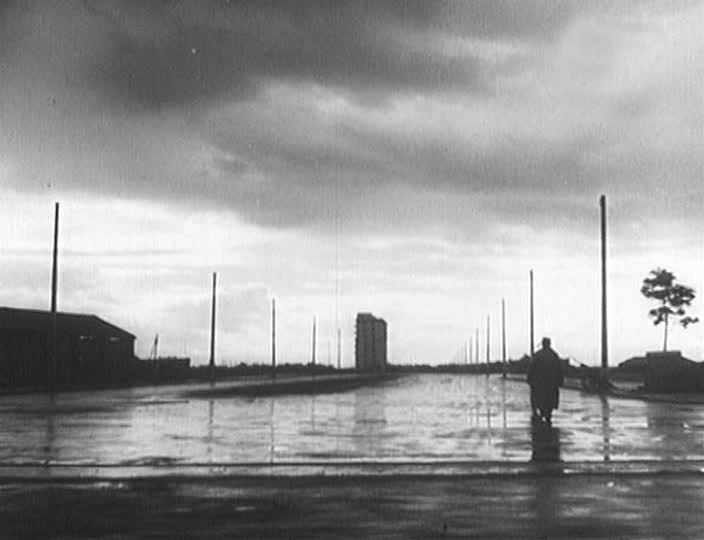
The film ends with a sweepingly romantic image of a solitary street-cleaner walking home after work, a black silhouette in the darkening evening, the city stretched out around him in a long shot that perfectly captures the urban romanticism of this image, very unlike later Antonioni but not unlike his noir-influenced feature debut Story of a Love Affair, which he would make two years later. The image also recalls Charlie Chaplin's Tramp figure, a suggestion that the romanticized homeless people and laborers of this film are derived from the example of the movies as much as from real life. Antonioni, making these small documentaries to observe the lives of ordinary people, was already crafting the foundation for the films he'd make as a mature filmmaker, already laying the groundwork for a cinema dealing with people and their surroundings, with the importance of work in modern society, and with the isolation and alienation of the individual in a society where individual lives are increasingly marginalized, like the ignored street-sweepers and bums of this short.

Red Desert


Michelangelo Antonioni is the cinema's greatest chronicler of the modern era's disconnection and dehumanization, of the existential dilemmas created by the modern way of life. His first color film, Red Desert, is yet another entry in his peak period's run of intense, stylistically profound variations on that signature theme. The film is set in a modern industrial zone, not an urban center but a desolate country harbor colonized by smoke-spewing factories, massive ships that drift by in the omnipresent fog, oil drilling platforms out in the ocean, barely visible from shore. The landscape of the region is a cold, foggy, smoke-filled wasteland, a bleak territory of small mud-puddle lakes with sleek black surfaces, chemicals glistening in multiple colors, green scum leaving behind a thick crust on the shore. It's always overcast. There's always a thick fog hanging in the air, making everything fuzzy and gray. The credits roll over a series of out-of-focus shots of the region, of smokestacks and gray factory buildings and grim landscapes that nearly look post-apocalyptic in their indistinct desolation. The first in-focus shot, after the credits, is a closeup of a plume of fire erupting from a factory smokestack. The symbolism could not be more obvious: this is Hell, a strange Hell where the air is cold and the only heat comes from the factories' never-ending industrial processes, from the burning of chemicals.

Wandering through this landscape is Giuliana (Monica Vitti), her crisp green coat a striking contrast against the colorlessness of the land around her. She seems to be dazed, utterly lost, acting in inexplicable ways. She's walking with her son, but seems to keep forgetting about him and leaving him behind, letting him wander off by himself, then belatedly remembering that he's with her. As the film progresses, it becomes apparent that she's losing her mind, a not so surprising state of affairs in a place like this. Giuliana's husband, Ugo (Carlo Chionetti), is an industrialist himself, a manager at one of the local factories, so in a sense the environment that's poisoning Giuliana is in part created by her own husband, who doesn't seem to understand his wife at all. Ugo seems to think of his wife's odd behavior and increasingly obvious depression as inconveniences, minor female hysteria that would go away if only she'd stop thinking about it. He is constantly away on business, leaving her alone, and when he hears that she's been in a car accident and is in the hospital (an event that happens before the start of the movie but lingers over everything that happens subsequently), he doesn't even return from a business trip once he learns that she's going to be alright.

Initially, it seems like Ugo's friend Corrado (Richard Harris) might be able to wake Giuliana out of her misery and aimlessness. He takes an immediate interest in her, really looking at her and trying to engage with her in a way her husband doesn't. They begin to seem like a couple, as wherever they go, Corrado walks with her at her meandering, dawdling pace while her husband impatiently strides ahead, all business. Corrado is also involved in industry, but unlike Ugo he seems conflicted by his work; he's been in many different businesses, always moving from place to place, simply abandoning his life and starting anew somewhere else. In one early scene, Ugo makes calls around to several factory managers he knows, trying to find workers for Corrado's newest project. Antonioni cuts to each place Ugo calls in turn, emphasizing the similarities between them: wherever he calls, smoke spews in the background, the clatter of industrial machinery nearly drowns out the conversations, huge pipes and banks of electronic devices with blinking lights and gauges dwarf the human workers. This is industry, this is progress, making every place the same, erasing the distinctions between places to install a uniformly sleek and gray modern façade that covers up one place after another. Maybe that's why Corrado is never satisfied no matter where he moves; each new home, each new city, is modeled on the old one.


If Ugo is indifferent to the costs of modernization — even laughing at a story of a restaurant customer who complained about fish that taste like petroleum — Corrado seems to feel a small measure of the discontentment that affects Giuliana so dramatically. In a meeting with his new workers, towards the end of the film, Corrado's gaze wanders over the workers' faces but drifts away from them towards the stacked crates behind them, towards the cracked paint on the walls of the warehouse. Antonioni's images create the impression that in this environment, the faces of the men, often filmed out-of-focus, are simply another part of this inhuman landscape, and the gaze inevitably glosses over them to look at the surroundings instead. It is a glimpse of how Giuliana sees her world, as a place where humanity itself is being effaced by its own creations, by its piles of consumer goods and the massive factories dedicated to their production.

Antonioni's aesthetic constantly reflects this dehumanization and destabilization. The ugly gray surroundings of the area are reflected in Antonioni's bleak, strikingly composed images, in which the color seems to have been drained out of almost everything, leaving behind pale, washed-out hues. Often, the background is made blurry and abstract, isolating Giuliana from her surroundings, so that her crisply focused face is contrasted against the out-of-focus haze of factories and industrial parks. The omnipresent fog adds to that hazy feeling, especially in a scene by the docks when Giuliana, Ugo and their friends run through the fog, disappearing into the gray tendrils that wrap around them. Standing in the fog, the people seem to be fading in and out of view, partially obscured, their expressions unreadable due to the filtering overlay of the fog. Giuliana faces her friends and her husband and sees only the uncomprehending blankness of their faces; they seem separated from her by an uncrossable gulf.

This is a potent depiction of a world in which human connection seems impossible. At best, there are cheap and tawdry facsimiles of connection, like a party that Giuliana, Ugo and Corrado go to with some friends, where everyone talks incessantly about sex and the whole thing seems constantly on the verge of breaking out into an orgy. The orgy never happens, though, in part because all these upper-class blank slates seem too lazy, too bored, even to really have sex — their lascivious but empty chatter is contrasted against a young working class girl who says she'd "rather do certain things than talk about them." But talk is all these bored bourgeois can muster. Even Giuliana's interactions with the men who love or want her seem oddly impersonal. Her husband, who ignores all her concerns and doesn't seem to know what to make of her depressed manner, paws at her and kisses her while she sobs and moans; unable to understand her pain, he tries to smother it with sex, not getting — or not caring — that she isn't likely to be soothed in this way. Ultimately, Corrado can only resort to the same solutions; when Giuliana comes running to Corrado for help late in the film, he takes advantage of her confusion and sorrow by taking her to bed, caressing her and stripping her while she cries, alternately pushing him away and seeming to pull him closer. Her isolation and anguish is so intense that she needs some companionship, some comfort, but none of these men can offer it to her in any real and lasting way.


After Giuliana and Corrado make love, the hotel room, which had previously had white walls, is suddenly painted a pale pink, and even the coffee cups on the bedside table are pink, as though the whole room had become a womb of flesh, encompassing the lovers, as though their skin-on-skin contact had begun to spread to the objects and constructions around them. This is a film about how environments and surroundings affect human relations and psychology, but the reverse is also true: modern people create the environments in which they live. Just as it's humanity's obsession with progress that leads to industrial expansion and pollution, this scene reflects the wish that human connection, however fleeting, could counteract the suffocating and alienating effects of the world. Instead, sex and "love" only offer up more pain and disappointment. Even motherhood is unsatisfying to Giuliana, whose son is virtually a mute prop, as disconnected as his mother, and who already shows signs of his mother's unpredictable responses to this alienating environment.

There is at least one beacon of light in this desolate world: the human imagination and the capacity for hope, the capacity to dream of a better world. At one point, trying to keep her son entertained while he's ill, Giuliana tells him a story, but it's no light bedtime story. It's a haunting parable of unspoiled natural peace and the constant threat of disruption that arises from human presence. In this story, there's a beautiful beach with pink sand and clear, blue water, and the only person around is a young girl with darkly tanned skin who swims in that bright blue water and lounges on the beach all day, as long as the sun is out. The style of this sequence differs drastically from the rest of the film, as the bright colors and clean, bold images contrast against the drab tones and fog that persist outside of this dream world. As Giuliana's voiceover describes the beauty of this place, the images present an idyllic paradise, totally unspoiled, no human activity except for the girl's unhurried, isolated enjoyment of the place's beauty. The only sound is the water lapping up on the shore, a hushed whisper accompanied by Antonioni's remarkably sensual closeup of the tiny waves lapping up against the shore, kicking up swirls of pink sand that turn the crests of these wavelets a pinkish hue.

This idyll is interrupted by the appearance of a mysterious boat, unpopulated by any visible human crew, which simply turns into the inlet, seems to look around, then sails away. It is an obvious indication that this isolated place could be spoiled at any time, that the big ships of industry, so inhuman and strange, could pull in at any time, muddying up that crystal-clear water, spewing filth to cover up the delicate pink of the sand. After the ship leaves, the story goes, the whole cove sings as a kind of beautifully sad warning, or a protest, a song of heartache and fear. As Giuliana's voiceover says that the cove was like a living being, Antonioni films the curved pink rocks surrounding the water like a woman's body, admiring the glistening accretions of sand and crystal in these rocks, admiring their graceful curves that at times look like a woman's breasts or the curve of her hips. In this deeply affecting parable, this place of natural beauty becomes a woman, welcoming and pure, whose beauty is threatened by the rape of industry.


That story is a vision of the world's beauty that seems far removed from reality as Giuliana knows it — but not from reality altogether. It's the world as it could be, and the world as it still is in some places. The mere possibility of this fantastic beauty, of this total communion between humanity and nature, is enough to soften the hard edges of industrial existence. Another scene, earlier in the film, seems like a slightly surreal dream but with a much less optimistic message. Giuliana wakes up in the middle of the night and finds, in her son's room, a grinning robot running back and forth on autopilot, crashing backwards into the wall and then running up against her son's bed, grinning all the while. Giuliana turns off the robot, which remains in the lower left corner of the frame, staring at the camera with glowing eyes, as she checks on her son. When she leaves and shuts the door, restoring the room to darkness, those glowing eyes are all that remain, two yellow orbs floating in the dark, an eerie mechanical stare watching over the sleeping boy.

That image is indicative of the film's general tone of industrial malaise. The soundtrack buzzes and hums with the sounds of machinery, the high-pitched subliminal whine of power transformers, these real sounds matched in the low-key electronic score of Vittorio Gelmetti, which burbles up every so often to further deepen the sense of anxiety. Antonioni carefully calibrates every aspect of the film so that each image becomes an expression of the characters' isolation, and the weight of the world that they feel so acutely. The scenery is almost studiously bland and gray, sometimes literally, as when Giuliana sees a fruit vendor whose wares are all painted gray, as though covered in a layer of ash. In Corrado's hotel, the whole lobby is a clean, clinical white, even the plants, their white stalks emerging from white soil and white pots. Antonioni has crafted a precise and deeply affecting portrait of the destruction of the human soul in the metal jaws of industry — and the nature of the continuing psychological and physical struggle against the oppressive environs we've created for ourselves as a society.

La Notte


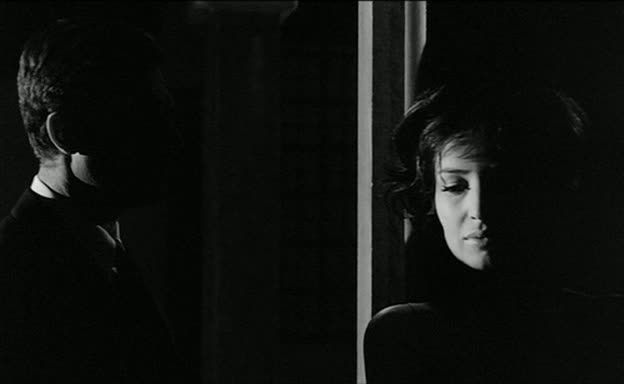
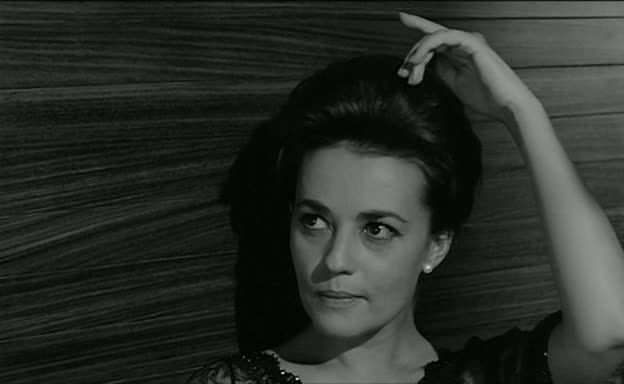
La Notte is perhaps Michelangelo Antonioni's most complete portrait of the deadened emotions that constitute his essential subject, the boredom and disconnection and lack of communication in a drastically changing modern world. In the first twenty minutes of the film, the married couple of Lidia (Jeanne Moreau) and Giovanni (Marcello Mastroianni), a novelist, don't say a word to one another as they go to visit their dying friend Tommaso (Bernhard Wicki). They turn to one another occasionally, seemingly about to speak, their lips starting to move, a rueful smile reflecting their uncertainty with one another, but they never say anything. With Tommaso, they each speak to him independently but still say nothing to one another, as though they're each dealing with their individual grief and sadness over their friend's illness. They're together and yet locked off from one another, and when Giovanni is assaulted by a young "wild woman" in an adjoining room, a sexy lunatic in a black slip who fixes him with a dark, unrestrained stare and throws herself onto him, he allows her to lead him into her room, kissing her and letting her pull him down onto her bed until the nurses discover them and restrain the girl. This moment of unhinged passion, crazy and illicit, reflects what's missing from the married couple's life, and the same point is made when Lidia and Giovanni go to a club together where a black woman, assisted by a muscular and shirtless black man, performs a striptease with contortionist maneuvers, hypnotizing Giovanni, who ignores his wife to watch this display of physicality and open eroticism.

La Notte follows this couple through the remainder of this troubled night and into the next morning. It's about their distance from one another, their distance from their own past. After their visit with Tommaso, they spend much of the film apart from each other, occasionally coming together only to split apart again, to go off on their own, each suffering and thinking in solitude. Lidia wanders the city, exploring the neighborhood where the couple had lived together earlier in their relationship, as though nostalgia could help her to recover some of that earlier happiness, or at least to understand what had gone wrong. Later, they go to a party together, where they each flirt with other people, losing one another on the sprawling grounds of the mansion where the party takes place.

The film both captures and embodies their alienation and their ennui, their feelings of aimlessness and abstracted loss. La Notte is often boring, as Giovanni and Lidia wander around the party, exchanging banalities with the other guests, meaningless chit-chat that only augments the sense of pointlessness pervading everything. That's why Antonioni has made the ultimate portrait of modern boredom, risking boredom in the process: he incorporates boredom into his film. He allows his audience to be bored right along with Giovanni as the host, the rich real estate developer Gherardini (Gitt Magrini), tries to position himself as a kind of artist, tries to pretend that he's like Giovanni, that he doesn't care about money. But the man is a bore, a self-important fraud who just likes to hear himself talk — and who tries to hire Giovanni to apply his literary talents to writing press releases and advertising copy for his business, a fairly naked example of commerce attempting to seduce and co-opt art, and art wavering on the verge of acceptance, out of indifference and insecurity.


Giovanni's disaffection as a writer mirrors the disaffection in his life: just as he feels that he no longer knows how to communicate in writing, he fails to communicate with his wife, and a gulf opens up between them, represented in the film by their isolation from one another, by the sense that for much of the film they're each engaged in their own individual stories rather than coming together for a single story as a married couple. During the early sequences of the film, Lidia wanders the city alone, pausing to watch some boys shoot off rockets in a park and to break up a violent fight between some other young men, but mostly just silently walking through a modern urban landscape. The film has a strong vertical feeling in these scenes, an upward tension in the compositions, which seem to be constantly drawing attention toward the top of the frame. Lidia is often positioned in the lower portion of the frame, with large blank walls filling the space above her. The sounds of airplanes and helicopters passing by overhead call her attention — and the audience's — towards the sky, as do the skyscrapers looming around her, stretching up towards the top of the frame seemingly without end. When she watches the boys shooting off rockets, the camera tilts up to watch one of the rockets spiraling up until it disappears, leaving behind a gray corkscrew barely differentiated from the pale, featureless gray of the sky itself.

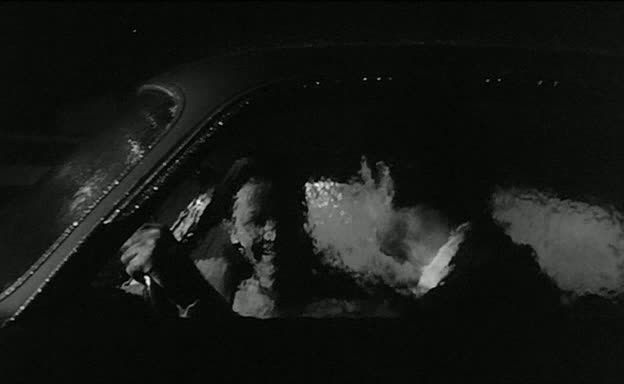
Later, at the party, Giovanni grows enamored of the younger Valentina (Monica Vitti), while Lidia is slowly pursued by Roberto (Giorgio Negro). The boredom and isolation of the party is then broken up by scenes of sensuousness and charming flirtation, scenes that hint at a break in the endless disconnection and lack of communication plaguing all of these characters. A rainstorm is greeted, not as an end to the festivities but as an excuse for the embrace of excess and carnality, as the guests jump in the pool, writhe about in the rain, run around laughing and screaming as they're soaked. Roberto takes Lidia for a ride in his car, and Antonioni's camera follows alongside the car in a lengthy tracking shot, the rain streaming down the windows and distorting their faces into impressionistic blurs, which are alternately illuminated by streetlights or swathed in darkness so that they create silhouettes in the dark. They're talking and laughing in the car, but there's no sound of their dialogue on the soundtrack, so this moment of connection and warmth, so unlike the quiet, standoffish scenes between Lidia and Giovanni, is presented from a formal distance, allowing the pair their private intimacy.


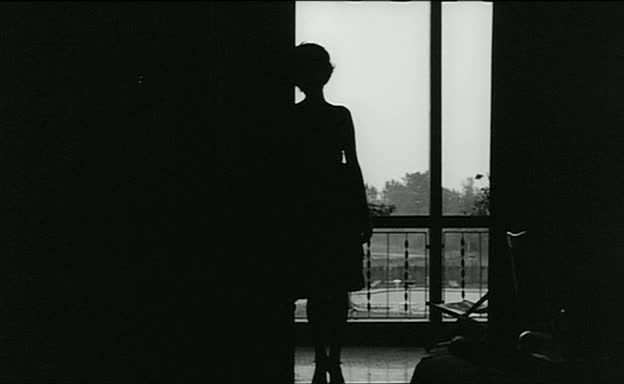
Once the titular night falls, indeed, shadows and silhouettes predominate in the film's visual vocabulary, as in the sequence where Valentina, half veiled in shadows, tells Giovanni that she doesn't want to break up his marriage, the shadows suggesting that she's only telling half the truth. Later, when Giovanni and Lidia leave the party, Valentina bids them both goodbye together, as a couple, and then stays behind, a silhouette against the window, her curved body blending into the darkness left in her room as the early morning light seeps in from outside. These poetically beautiful images add to the sensation of picturesque ennui: these deeply sensual images capture the characters' isolation and loneliness, their disconnection from each other. When Giovanni first sees Valentina, it's through reflections, a false image of the woman hovering like a ghost within a large glass pane. Giovanni's own reflection is superimposed into the window so that it almost looks like he's walking directly towards the woman, and then the camera pans right and the reflections shift, and the geography is completely reconfigured as Giovanni steps in from another angle. Such misleading images, in which perceptions shift and reflections create doubled or tripled doppelgangers, suggest that even at such junction points of potential connection, there are multiple layers separating and confusing these people, like the glass that divides them and projects them outside of themselves.

As Valentina says, in a moment of confession that could apply just as well to either Giovanni or Lidia, "whenever I try to communicate, love disappears." That's the central dilemma here, this inability to maintain connections through communication. These people, dwarfed by the clean, unadorned surfaces of urban living, shrouded in shadows, fenced in by concrete and split in two by glass, look to the past — the railway that ran through the neighborhood where Giovanni and Lidia once lived, the tracks now overgrown with weeds and decaying from disuse — but find no comfort or stability there, either. When, at the end of the film, Lidia reads Giovanni a very moving love letter he once wrote her, he doesn't even recognize the words as his own, asking her who wrote it. He can't communicate that passionately or that clearly anymore. In the final shot, the couple embraces, going through the motions, half struggling against one another and half trying to recapture that depth of feeling, as the camera pulls back and pans discretely away, leaving them increasingly small and isolated, together, lying in the sand trap of a golf course.

Blow-Up


Michelangelo Antonioni's Blow-Up is an unsettling, mysterious film that seems to be hiding multiple secrets beneath its glossy, impenetrable surface: the grainy, Rorschach blot photographs blown up by fashion photographer Thomas (David Hemmings) in his search for clues to a murder provide a blueprint for the film as a whole. Strange encounters, clues and red herrings, inexplicable happenings: the film is disconnected and radiates a zombie-like vibe right from its opening sequence, in which a troupe of mimes, faces caked with pasty white makeup, are contrasted against the deadened faces of factory workers clocking out for the day. Blow-Up is often summarized as being about a photographer who comes to believe that some photographs he took hold the evidence of a murder, but in fact more than half the film passes by before the pivotal moment when Thomas becomes obsessed with uncovering the clues in these photos. Before that point, he takes fashion photos, berating and verbally abusing the confused models, and has a nearly silent scene with Patricia (Sarah Miles), the wife of his painter friend, in which body language and exchanges of looks suggest some kind of longing between the two, and goes shopping for antiques, impulsively buying a giant wooden propeller. Antonioni prepares for Thomas' obsession with the details of a seemingly innocent photograph by patiently building a portrait of a man dissatisfied and adrift in his own life. Several times there are intimations of hidden homosexuality, as when Thomas seems disturbed by the "queers and poodles" infiltrating his neighborhood, or when his complaints about women are answered with the retort, "it would be the same with men."

Thomas, it seems, doesn't know what he wants. He's a vile and abrasive man, and midway through the film his encounter with two giggly would-be models (Jane Birkin and Gillian Hills) keeps teetering on the brink between playful flirtation and stormy violence. It's a disturbing sequence, since at times it seems like Thomas is on the verge of raping the girls, while at other moments they're playing along, flirting and joining his game. A similar dynamic is at work in the crucial scene between Thomas and Jane (Vanessa Redgrave), the woman in the pictures that drive the narrative in the film's second half. Thomas stumbled across Jane with an older man in a small park, and was moved to take photos, hiding in the bushes as the man and the woman walk along, talking, kissing, embracing. But when Jane sees the photographer, she confronts him, and later somehow tracks him down to his studio, where she alternates between cajoling and seducing him to give her the photos he took. It's such an interesting scene because, while Thomas initially seems fully in control, holding back against the tearful and increasingly desperate pleas of this woman, as they interact further she subtly gets the upper-hand, climaxing with the moment when she offers herself to him by removing her top, shaming him into at least pretending to give in.

There are a lot of subtle threads running through this film in scenes like this, notably the dynamic of male/female relationships and the balance of control and domination. Thomas is used to ordering women around, posing them how he wants, getting just the image of them that he wants, manipulating them into presenting a surface that's compelling to his camera — and beneath that surface, he doesn't care what lurks. But Jane is different, a woman who obviously has a story, and secrets, that never escape from beneath the surface she presents to Thomas. She disappears from the film after this scene, and her secrets disappear with her. The second half of the film has a fascinating arc. First, Thomas decodes the photographs he's taken, printing them out and using magnification and selective viewing to locate key points within the photos, following Jane's gaze in one photo and extrapolating in another to the point where she might be looking. His wall is eventually covered in photographic enlargements, blow-ups that reveal previously hidden details. At the end of this process, Antonioni inserts a montage of the photographs in an order that tells a story: the two lovers walking, eventually reaching a spot where another man, previously unseen, lurks in the bushes with a gun, waiting to kill Jane's companion, and then a shot of what may be the corpse lying in the bushes once the deed is done.


This montage is a kind of model for the cinematic art, the construction of a story through the arrangement of still images in sequence. The order in which the images appear, and the details highlighted in each image, determine what story is told. And the process also establishes the complicity of the artist in what he documents, in that Thomas' mirror image is surely the man with the gun: two men lurking, hidden, in the bushes, pointing something at the couple walking out in the open air of the park. Snapping a picture, or firing a bullet. The remainder of the film represents the reversal of this cinematic process of narrative construction, calling into question everything that had been created through this montage. The pictures disappear, stolen from Thomas' studio. The body in the park disappears as well, although not before Thomas sees, or imagines he sees, it with his own eyes one night. Jane disappears, the phone number she left behind a fake, her identity still a total mystery by the end of the film. Thomas' narrative of murder is ultimately ephemeral, removed as it is from concrete reality. When Thomas shows Patricia the only remaining photo he has, a grainy blow-up of what might be a corpse lying on the ground, she compares it to her husband's abstract paintings, inscrutable and open to interpretation. Earlier, the painter had explained what he liked about one of his own paintings by pointing to a single rectangular segment and praising it as a good leg, implying that this abstracted geometric tangle is actually a figure drawing.

There's a similar interplay between abstraction and representation in Thomas' photographs, a concept that overturns the simplistic understanding of photography as a documentary art, as the simple art of capturing the reality in front of the lens. Blow-Up suggests that even photographic art can lie and distort and hide the reality, that even a photograph can be abstract and dissembling. In the end, Thomas, like the film itself, winds up questioning what's real at all. In the final scene, the mimes from the beginning of the film return, playing a pretend game of tennis, and at one point silently instruct Thomas to "retrieve" a "ball" that has supposedly gone flying into the grass off the court. Thomas complies, pretending to throw a ball back to the players, but as they resume their pantomime, the shot remains trained on Thomas as he watches. The sound of a tennis ball bouncing back and forth on the soundtrack suggests that we create our own reality, that sometimes the mind is more powerful than the vision, that sometimes what we see or think we see is not to be trusted.

This is a compelling, mysterious film that uses such symbolic images — heavy-handed, perhaps, but nonetheless effective — to probe the ideas of photographic deceit, narrative, voyeurism and masculine exploitation that lie at the film's center. The sequence of Thomas desperately trying to piece together a narrative in still images is the film's core, and contains by far its most powerful material. But if the rest of the film is more scattershot, more unfocused, that's because it's documenting and critiquing a lifestyle that's similarly unfocused and empty. This becomes most clear in the weird scene where Thomas, looking for his manager, goes to a concert by British blues-rock band the Yardbirds. As the band plays their poppy, rollicking song, the audience looks disinterested and joyless, standing utterly still, their faces bored and bland, until one of the band members smashing his instrument provokes a frenzied riot. It's as though the music isn't enough, the crowd needs the visceral thrill of the violence, and they go wild trying to get the shattered guitar neck that's thrown into the mob — a souvenir that Thomas escapes with seemingly without realizing it, and discards as soon as he's out of the crush of the crowd. The guitar fragment serves the same purpose as the photographs, for a moment at least: a material object in which to invest great meaning, a thing to provide structure and forward momentum to an otherwise aimless existence.

L'eclisse


The typical descriptions of Michelangelo Antonioni's great L'eclisse make it sound like an unbearably dull affair, a true product of the 60s art film era. It's about "alienation," right? And disconnection, and the isolation of people from one another in the modern age. Given the typical critical wisdom surrounding Antonioni and this film, one could be forgiven for expecting a bracing, obtuse, rather chilly affair, a humorless intellectual statement that maintains its distance from its characters. Upon seeing the film, of course, one begins to suspect that this is an instance of too much critical discourse threatening to smother the life out of a vibrant, complex work of art. L'eclisse pulses with energy and beauty, with the formal ingenuity of Antonioni's images, which have a lush, sensuous quality. This is a film about the disconnected modern era, yes, but much more importantly it's about the people who have to live in this age, people who aren't willing to take alienation and lack of communication as a given, who fight against the sometimes suffocating constraints placed upon their lives.

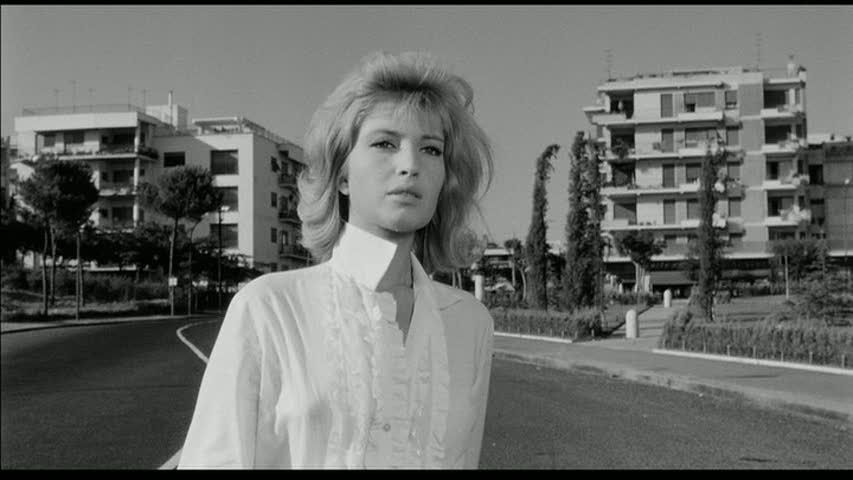
Specifically, it's about the lovely Vittoria (Monica Vitti), who breaks up with her lover Riccardo (Francisco Rabal) in the film's extended opening set piece, which masterfully creates tension solely out of the manipulation of space and movement. As Vittoria and Riccardo pace around his apartment together, they are engaging in a dance of disconnection, their words flying past unheard even as their bodies clang off one another whenever they're on the verge of coming together. Antonioni accentuates these disjunctions with his camera, which purposefully creates jarring angles within which the quarreling lovers are awkwardly fitted. At one point, an abrupt cut pushes the lovers out of the frame almost completely, so that a large gray lampshade fills most of the empty space, until Vittoria turns away from Riccardo to face the camera again. It's a great, raw scene, all abstracted motion and hard lines, but its rigidity is contrasted against the equally wonderful sequence in which Vittoria commiserates after the breakup with her girlfriends Anita (Rosanna Rory) and Marta (Mirella Ricciardi). At the apartment of Kenyan native Marta, Vittoria is delighted to study the photos and memorabilia of the other girl's homeland, and she and Anita playfully dress up as blackface natives and dance to the rhythms of an African drum music record, their snaking limbs making fluid "S" shapes in the air.

Despite the racial obliviousness of these middle-class Italian women — Marta puts a stop to the game, seemingly offended, but then derisively calls the blacks she grew up with "monkeys" — they're trying to have fun, and Vittoria at least possesses a genuine spirit of intellectual curiosity, a desire to absorb learning from her surroundings, to learn about other people. She's a woman who will randomly follow strangers on the street to see what they'll do, or who will be suddenly struck by the quality of a person's face. She has a playful, whimsical spirit, a perhaps unconscious desire for something more that drives her to leave Riccardo at the beginning of the film. She's a product of her time and her culture, and she shares the flaws of her milieu, but she's also a spirited and independent woman who isn't willing to settle for the dreary existence that's seemingly plotted out for her: a discontented marriage, like her friends have, to some man who's perpetually away on business.

She's more in touch with the world: a night-time chase through the streets for her friend's lost dog leads to a wonderful shot of her laughing, unguarded, as the dog walks on its hind legs away from her. Later, she's drawn to the clanging sound of tall metal poles bouncing off each other in a strong wind; she has a sensual sensibility that appreciates the urban poetry of these subtle moments. Antonioni is, like Vittoria, attuned to the sensuality of the world, to the puffed cotton wisps of a cloud bank or the ripples spiraling out from a finger as it breaks the surface of stagnant water. His images reflect engagement with the world, even when he isolates Vittoria in pale gray expanses of nothingness that visualize her loneliness and alienation. He's able to find beauty even in a construction site lit by street lamps, in a splinter of wood floating in a barrel filled with rain water, in the abstract lines of an apartment block set off against the vast empty sky.


Despite her free spirit and thirst for more, almost immediately after breaking up with Riccardo, Vittoria finds herself being drawn into the orbit of the stock trader Piero (Alain Delon), a driven, intense young man who spends his days in the relentlessly fast-paced world of the stock exchange, where he shouts into phones and races back and forth across the office's floor placing frantic buy and sell orders. He's completely immersed in the world of money all day long, and is sometimes just barely able to peek his head above the water by night. Vittoria meets him because she goes to the stock exchange to see her mother (Lilla Brignone), who spends all day there as though playing a game — she's a precursor to those old ladies who today would be found sitting in front of a Las Vegas slot machine for endless hours at a stretch. Vittoria has nothing but contempt for this world, and she's pushed away whenever Piero can't resist talking about his new car or the money he's made or lost in the course of the day. And yet she also feels a strange attraction to him, a slowly sparking connection.

The slow, halting courtship between Vittoria and Piero is warm and human and touching, marked by hesitations and withdrawals and false starts. Antonioni is a master at portraying the difficulty of love, the incredible psychological and sociological obstacles to forging a connection between two independent beings. But what's too often overlooked is the hope and beauty that are also contained within his vision of the world: despite the difficulties, despite the seemingly insurmountable barriers separating us, we frequently do make connections, if only momentary ones. The playful wrestling and cuddling of Vittoria and Piero, their stylized come-ons and maneuvers, are a dance of desire, a response to the hard-edged dance of disconnection between her and Riccardo in the film's opening minutes. In contrast to the earlier scenes, the love scenes with Piero often dissolve into frantic, messy movements, uncontrolled and passionate — two reserved people letting go with one another.

There is, of course, a sense even at the height of their love affair that this cannot work in the long term. One knows instinctively that there is little room in Piero's busy work schedule for true, enduring love, and that Vittoria will not have the patience of Piero's less serious old girlfriends for his habitually broken dates and long, unpredictable working hours. And yet Antonioni allows the couple their moments of happiness, then lets them drift out of the film altogether. The final seven minutes of the film are a poetic, dialogue-free collage of quiet, unassuming street scenes from around the city, scenes of urban life going on, no matter what the fate of this one couple might be. This is a sublimely humanist statement, a refusal to give his attractive movie star couple their proper denouement, focusing instead on the ordinary people who get on and off of buses, reading papers, walking to or from work, sitting in a park. Antonioni even includes a clever joke halfway through, a shot of a blonde woman's head from behind, briefly giving the audience the impression that Vitti's character has returned, until the woman turns around, revealing someone else altogether. The main couple are represented again, symbolically, only in the penultimate shot, a haunting nighttime image of the construction site where they planned to meet, empty and desolate, lit only by a single street lamp, perhaps the site of an unkept date, the onset of their disconnection.