Showing posts with label Iranian cinema. Show all posts

The Traveler


The Traveler was one of Abbas Kiarostami's earliest features; the director himself considers it his first true feature. In a direct, pseudo-documentary style, the film chronicles the adventures of the young schoolboy Qassem (Hassan Darabi), an undisciplined kid who plots to run away to Tehran to see a big soccer match. The rough, grainy black-and-white aesthetic of the film gives it the impression of an observational documentary shot in working class neighborhoods; its schoolboy looseness and rebellious humor recall the French youth dramas of Jean Vigo and François Truffaut. Qassem is a bad kid who coasts through school, rarely paying attention in class, never doing his homework, repeatedly failing all his classes. He cares only about soccer, whether he's running around town playing pickup games with gangs of similarly rowdy kids, or splurging all his money on soccer magazines (which promptly get taken away by his teachers because he reads them in class).

His parents are ineffectual, as demonstrated in a shrilly funny scene where Qassem's mother visits the school to check up on her son and gets scolded and reprimanded by the principal for not doing enough to curb her son's lack of discipline and disinterest in school. Qassem's mother is constantly yelling at him, but he simply dodges out of the house to go play soccer; as she tells the principal, she can't read or write herself, so she's unable to help him with his work or even check that he's doing it. Kiarostami is hinting at the difficulties of developing a respect for education among working class people who are mostly uneducated. The generation gap is widened when people with no learning send their children to school, but in Qassem's case it seems that he's not likely to advance very far beyond his parents' station despite his education. If his mother is unable to do much to help, his father seems simply disinterested: his mother keeps threatening that his father will beat him for failing, but in actuality the father sits quietly, listening patiently to his wife's complaints about their son's problems, and never saying a word or doing a thing.

Class is a big part of the film. The bulk of the first half is dedicated to Qassem's attempts to scrounge up enough money for a trip to Tehran for a big soccer game. He calculates how much he'll need for a bus ticket, a ticket to the game, and some cab fare, and then starts scheming to gather the money. He outright steals a small sum from his mother, but the rest he tries to get together by selling whatever broken trinkets he can find. Kiarostami emphasizes the haggling with local shop owners, the difficulty of slowly building up a little money. In one scene, Qassem uses a broken camera — which he had earlier failed to sell — to pretend to take pictures of kids coming out of school, charging them a few cents for each photo, and planning to tell them later that the pictures didn't come out. Qassem's scheming is alternately sad and funny, and in this scene it's the latter, as the kid gets into his role, bantering with the subjects of his fake photos, calling one girl a "cutie" and joking with a mother who poses with her baby.
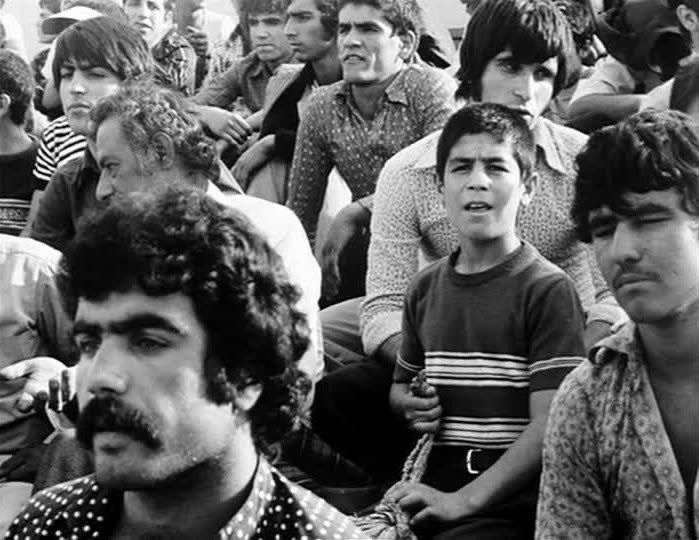

Qassem finally gets the money he needs by selling the soccer equipment that he and his friends had saved up for; he gets only a small fraction of the money they'd paid, but it's enough for his Tehran trip. In the second half of the film, Qassem finally makes his trip to Tehran, riding by night on a bus, its light cutting through the eerie darkness. Once there, however, he experiences nothing but further delays and problems in his quest to get into the game, waiting in a ticket line for hours only to just miss the cutoff before they stop selling tickets. He finally does get a ticket from a scalper, and enters the stadium through the rush of the crowds only to find that he's gotten there way too early and must wait for three boring hours before the game even starts. His conversation with an older fan suggests some of Qassem's alienation: he has few friends and sees himself as an outsider, a country boy who the city kids would never want to have anything to do with.

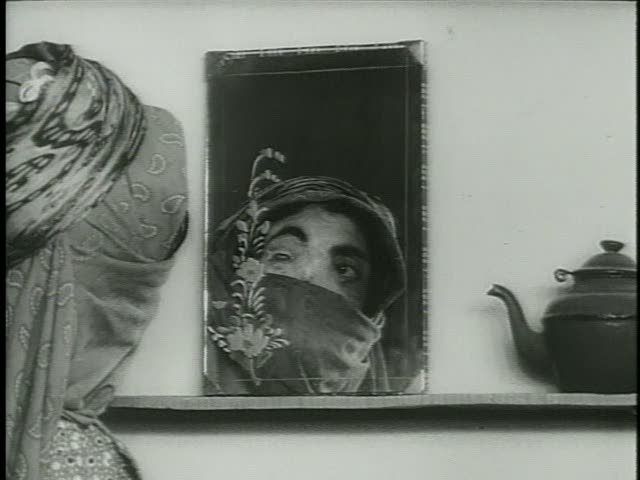
This note of melancholy infuses the broad irony of the film's ending. One of the film's final sequences is a dialogue-free, near-silent dream sequence in which Qassem imagines himself back in his hometown, suffering the punishments and disapproval of his parents and teachers, as well as the hatred of all his classmates, who he'd schemed against and cheated in order to make this trip. In one of the most striking sequences, Kiarostami holds a closeup of Qassem's face as he lays on the ground, screaming and thrashing around as the other students beat him and drag him along the ground. They're clustered all around him, their faces masks of anger, their eyes cold and staring. He sees his mother among those in the crowd observing his torment, her face hidden behind a wrap, only her eyes looking on, just as earlier she'd watched as a teacher beat the boy at her behest for stealing money from her. After the low-key humor and disarmingly casual aesthetic of the rest of the film, this dream sequence stands out for the way it suddenly externalizes all of Qassem's previously hidden insecurity and fear, the emotional turmoil churning within this disobedient, insolent kid.

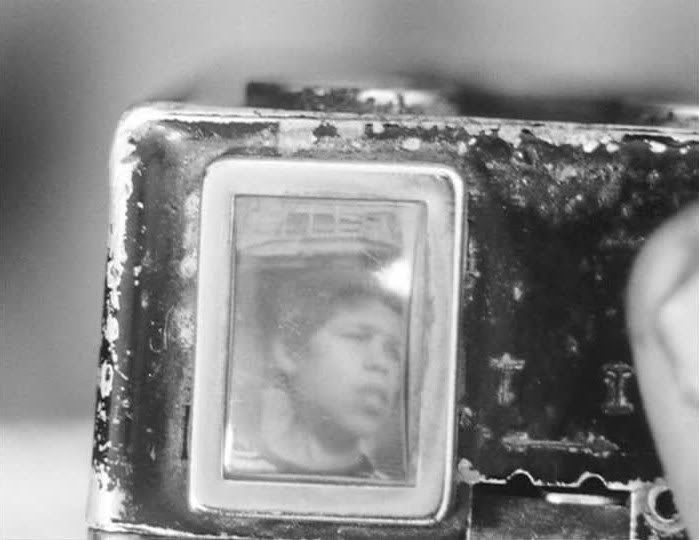
The Traveler is a lovely, quietly moving film with some unexpected moments of sharp visual poetry. In one scene, Qassem looks through a camera's viewfinder at his friend as the other boy tries to convince him to sell the camera for a cheap price; the image in the viewfinder is cloudy and washed out, as though the other boy is far away rather than right next to his friend. Later, when Qassem finally gathers enough money for his trip, he celebrates by leaping onto the back of a horse-drawn carriage, sitting on the rear of the carriage as it speeds away, leaving his friend behind. Kiarostami draws the moment out into a poetic celebration of motion and speed, focusing on the horses' hooves, the look of pleasure on the boy's face, the shadow of the carriage's driver moving along the ground as the horses pull the vehicle onward. It's a crucial moment, and Kiarostami beautifully communicates the sense of freedom and accomplishment that Qassem feels at this point, finally liberated from his working class context, his disciplinarian school, his seemingly uncaring parents. This, and not the actual (and disappointing) trip to Tehran, is the real climax of the film, the real heart of Qassem's story. His youthful yearning for freedom, his desperation for something of his own, is vividly felt through Kiarostami's calm, stripped-down aesthetic.

Close-Up


Abbas Kiarostami's Close-Up is a marvelously compelling documentary that, in the process of following the trial of a poor man accused of fraud, winds up delving into the nature of art and the relationship between fiction and deceit. The film is built around a real incident, the case of Hossain Sabzian, who impersonated the famous Iranian director Mohsen Makhmalbaf in order to ingratiate himself with the Ahankhah family, pretending that he was going to film a movie in their home with the family as actors. The family was initially trusting but came to suspect him more and more, finally exposing him by inviting over a friend of a friend, the journalist Hossain Farazmand, who knew the real director by sight and instantly recognized that Sabzian was a fraud. Kiarostami's film is partially a documentary of the resulting trial, and partially a reconstruction — using the real participants in the events as actors, including Sabzian himself and the family he conned — of the events preceding Sabzian's arrest.

The film opens with a re-enactment of the reporter taking a taxi to the Ahankhah house to arrest Sabzian. Farazmand and the taxi driver sit in the front, while two soldiers sit in the back, and during this lengthy opening sequence the men chat casually, talking about the case they're going to deal with, about film, about journalism, and about incidents from Iranian history that happened in the areas they pass through. The conversation is casual and seems unrehearsed, though this is a re-enactment of the real events that led up to Sabzian's arrest. Once the cab arrives at the house, Farazmand goes inside, but Kiarostami's camera remains in the cab, observing as the driver chats amiably with the two soldiers in the back seat, asking them about their families and their homes. Then the soldiers go inside too, and again Kiarostami remains outside with the driver, as the man gets out of the car, picks up some flowers from a pile of trash, sniffs the flowers, and kicks an aerosol can so it rolls noisily down the street. The can rolls along the concrete, and Kiarostami's camera pans after it, eventually following it as the can starts to drag sideways across the ground in an unnatural movement, presumably pulled along by an unseen string from off-camera.

In this way, the subtle naturalism and observational aesthetic of the opening scenes gives way to a sense that things are being tweaked by the filmmakers, that not everything is necessarily as it seems. It's a reminder that the film's re-enactments are only playing at realism; they are in fact carefully arranged and scripted, based on real events but not in themselves "real" or unmediated. The naturalism of the opening is further deconstructed when, after Sabzian's arrest, the reporter remains behind, frantically running from door to door in the neighborhood to ask to borrow a tape recorder. The scene is farcical and surreal, as Farazmand rings doorbells at random, introduces himself, and asks for a tape recorder. One starts to wonder what kind of reporter shows up for a big story like this, planning to do an interview, and then has to beg for a tape recorder from complete strangers. It's comical and strange, especially when Farazmand finally gets his tape recorder and goes scurrying off down the street, pausing just once to give the aerosol can lying in the road a savage kick that sends it flying into the air, coming down and once again rolling along as the reporter disappears down a side street. As the credits finally roll, ushering in the meat of the subsequent film, concerning Sabzian's trial, Kiarostami leaves the audience to wonder about this strangely unprepared reporter, about con men, about reportage, about lies and fictions.


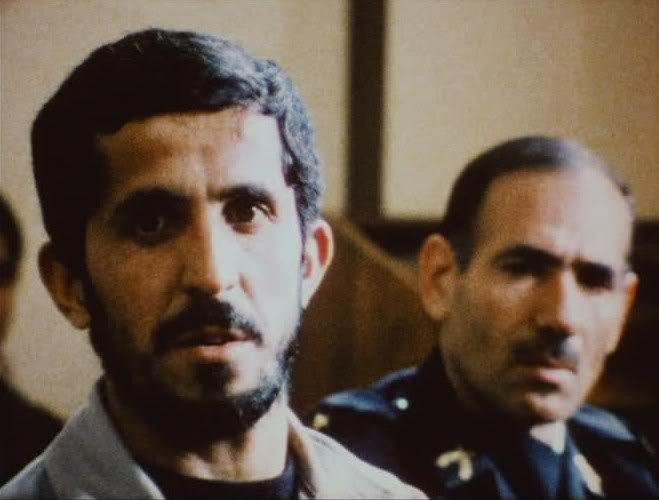
The images of the trial itself, captured in grainy footage that contrasts against the crisp, clean images of the re-enactments, are focused on Sabzian and his explanations for what he did. Kiarostami had remarkable access in the surprisingly relaxed courtroom where the trial takes place — or else not all of the trial footage is genuine, which only further blurs the film's interesting perspective on reality versus fiction, truth versus lies. Kiarostami seems too involved, too active in the trial's progress, for all of this footage to be real, unless Iranian courts are significantly less controlled than Western courts. The judge sits across the room, asking questions of Sabzian and the Ahankhah family, but for the most part Kiarostami's camera remains focused on Sabzian's face. At the beginning of the trial, Kiarostami explains to the defendant that this camera has a close-up lens and will remain trained on Sabzian, to capture his reactions and to provide him with a way to speak his mind and make his ideas clear. Kiarostami is making explicit what this film is about: he wants to give Sabzian an opportunity to express himself, to help others understand why he did what he did. During the trial, Kiarostami frequently even intervenes (or seems to intervene) in the proceedings himself, asking Sabzian direct questions and prompting the defendant to speak at length about the feelings and ideas that were behind his actions.

These close-ups of Sabzian are astonishingly moving, especially since the defendant's words reveal that he was no simple con man, that he was not trying to bilk the family out of money or otherwise exploit them. He did what he did, he says, because it made him feel respected. He is a poor man, divorced from his wife because of his inability to provide for his family very well, and he still struggles, constantly in and out of work, living a very poor and simple life with few real pleasures. His only pleasure, it seems, is the stimulation provided by the cinema, by art: he goes to the movies, especially the movies of Makhmalbaf, and finds a voice dealing with the kind of "suffering" that he himself feels in his own life. He is especially moved by the director's film The Cyclist, about which he says, "It says the things I wish I could express." With Kiarostami's prodding, the trial becomes a discourse on the purpose of art, the ways in which art can reach into people's lives in surprising ways. It becomes obvious that Sabzian impersonated Makhmalbaf because he wanted to feel as though he could reach people in that way, that he could express the things he feels with such clarity and beauty. As he struggles to express himself, to explain his actions, the subtext is the idea that art communicates. Sabzian's halting but often poetic descriptions of his "suffering," his poverty and feelings of uselessness and desperation, are a form of art, shaped and crafted by Kiarostami in turn.

The film is not only a commentary on the purpose of art but a subtle piece of social commentary as well, suggesting the hopelessness of poverty and unemployment that affects so many people. Even the Ahankhah family, who seem reasonably well-off in their large house, are not unaffected, as they have two sons who went to school for engineering, only to find that neither of them could get a job in the field after graduation. Instead, one son works in a bakery and the other is still unemployed. Sabzian's inconsistent work and constant struggles with money are even more extreme, and in court one of the Ahankhah sons, forgiving the defendant at the end of the trial, says that he blames "social malaise and unemployment" for Sabzian's actions. Kiarostami doesn't draw quite that straight a line between cause and effect, but it's obvious that he too thinks that this odd story is at least partially about class and economic hardship. Sabzian didn't commit his crime for money, even though he did borrow some money from the family at one point. He wanted to be Makhmalbaf not to get money, but in order to escape from his pathetic real life. He was playing a part and relishing the attention and respect he earned from the family who believed him to be a famous artist.

As he says himself at the end of the trial, at Kiarostami's prompting, he was more of an actor than a director, though. He was playing a part, he says repeatedly, and the structure of Kiarostami's film reinforces the connection between lying and acting, between the art of fiction and the art of the con man. The re-enactments in Close-Up, bringing together the real participants in these events to play out their scenes again, insert a further layer of fiction and artifice. In the reconstructions, Sabzian is playing at playing, pretending to pretend, while the rest of the actors are engaged in the same deceit. They play at reality, staging seemingly casual conversations that in fact are anything but unmediated. It is the flipside of the film's idea that art can reveal truths and speak to people about their own lives: art is also lying and pretending, and in that sense Kiarostami's film makes a very moving, strangely beautiful artist of Hossain Sabzian.

The Mirror (1997)

[This is a contribution to the Iranian Film Blogathon hosted by The Sheila Variations. The blogathon is inspired by imprisoned Iranian director Jafar Panahi, and focuses on both his own films and those of other important Iranian directors. The blogathon will run from February 21-27, so check out all the related posts at Sheila's blog during this week.]

The Mirror uses a clever conceptual device as a way to observe, in pseudo-documentary fashion, the day-to-day rhythms of life in the city of Tehran. For the first half of the film, a young girl (Mina Mohammad Khani) tries to find her way home after her mother fails to pick her up after school. The girl gets a ride from a friendly stranger who calls himself the General, until his motorcycle gets smashed in an accident. Then she gets rides in various buses, seemingly picking them at random, hoping that they'll get her home. As she rides, she listens in on various conversations going on around her, and the film provides a glimpse into the lives of the ordinary people of the city, capturing attitudes in flux and the small complaints and pleasures of everyday life. Then, halfway through the film, the girl suddenly turns to the camera and says, "I'm not acting anymore," rips off her fake cast and the coat she'd been wearing, and storms off the bus, refusing to take part in the film anymore. After a hesitant interlude in which the film crew, including director Jafar Panahi, try to decide how to deal with their young star's sudden bout of anger, Panahi decides to continue following Mina anyway. As a result, the second half of the film mirrors the first, as the film crew follows Mina as she continues to try to find her way home — supposedly to the actress' real home now.

The film's structure calls attention to the continuity between fiction and reality, as the staged scenes of the early part of the film are mirrored by the supposedly "real" scenes of the latter half (even though it's doubtful that anything in the film is actually unscripted). Both halves of the film concern a girl trying to get home, lost in the city, and Mina's character — stubborn, independent, wise in her childish way — hardly changes when she says she's going to stop acting. At one point, in the second half of the film, Mina meets an old woman who had been on a bus with her earlier, talking about her uncaring children and her feeling that her life is miserable. Mina sits with the woman and finds out that she hadn't been acting earlier, that though she'd been paid to be in the film, everything she'd said had been a description of her actual life and her actual feelings. Later in the film, someone who'd been watching the filming compliments Mina on her acting but especially singles out for a praise a scene where, supposedly, she hadn't been acting, a scene after she broke character and quit the film. The line between fiction and reality is blurry here, and it seems to be Panahi's assertion that, in both fiction and documentary, artists are attempting to capture the essence of reality, and in that sense it hardly matters if something is factual as long as it's true to the emotional and social reality that the camera captures. And in spite of the metafictional gimmick at the heart of the film, it's obvious that The Mirror is true to reality, that Panahi is trying to present a portrait of life in the city with all its complexity.

One interesting aspect of this portrait is the emphasis on the role of women. During a cab ride towards the end of the film, the driver and some passengers debate the roles of men and women in a society where tradition remains ingrained even as a few changes are beginning to shake things up. A woman in the cab passionately argues that women shouldn't be slaves to their husbands, that it's not the woman's duty to be a maid or a housekeeper, and that men should help out their wives. The driver and another man argue against her, trying to maintain that men earn the money while women should stay at home and keep the house in order. But as the woman points out, this strict division of labor is no longer always true, as women begin to work outside of the home, too — a situation that calls into question the codification of the man as the worker and the woman as the child-rearer and housekeeper. This exchange suggests a society in flux, a society where new situations and new values are threatening the traditional understanding of men and women. This open, honest exchange is juxtaposed against the buses, where men and women are segregated from one another in separate sections, with one of the film's most charming moments being Mina's observation of the shy, sweet smiles exchanged between a young man and a young woman, separated from one another across the bus but connecting anyway with their glances.


The subtext of the film is rebellion against what's expected. Mina rebels against the film crew, against the instructions of her male director — and Panahi continually inserts little jokes at his own expense, to undermine his authority as director. Mina is a fiercely independent young girl, in both incarnations of her character. She is occasionally helped along in her long odyssey home, but more often she resists the condescending help of the adults around her. She wants to find her own way, even though she's hopelessly lost and doesn't know the names of any streets, only being able to navigate by her memory of certain landmarks. Though dwarfed by her surroundings — she has to clamber up the wall of a phone booth to put her coin into the phone's slot before making a call — and obviously overwhelmed by the rushing traffic and chaotic crowds that surround her everywhere in the city, she tries to contain her fear. She asks many people for help, but she wants only limited assistance. She doesn't want to be delivered anywhere, she just wants directions and then she can go running off, her head down, her little feet pumping rapidly as she runs with a sense of purpose even when she has no real idea where she's going. The patter of her feet on pavement, captured by the microphone that the film crew leaves on her when they follow the rebelling young actress, is a recurring sound on the soundtrack, even when Mina herself dodges out of view behind traffic or gets lost in the crowds on the sidewalk.

More than anything else, the film is about the frenetic energy of Tehran, packed with cars and bikes and pedestrians, a dangerous and active city where frequent accidents — at one point a smashed car is lifted out of the center of a traffic jam with a crane — only add to the confusion. The people Mina meets on her journey home are often interesting in their own right, with their own stories and their own concerns, from the General's anxiety about his relatives' fashion choices at his son's wedding (he seems to think that their old-fashioned style will embarrass him) to the musician who used to earn his living by dubbing the voice of John Wayne in imported American films. Although overt commentary is impossible, Panahi seems to be implicitly examining the state of modern Iran, suggesting submerged clashes between modernity and tradition, between homegrown and outside influences.

Panahi, who was recently arrested by the Iranian government and effectively banned from making films, uses his unassuming pseudo-documentary style to consider the changing roles of women in this traditionalist country. The film is utterly apolitical on its surface, and yet at the same time it is unquestionably a film with a real social consciousness, an alertness to the ways in which ordinary people live their lives, the pressures they face from the intersections of religion, tradition and more modern influences. Mina, though she wears the head-scarf and clothes of a traditional woman or girl, seems like a thoroughly modern woman in terms of attitude: self-sufficient, bold, reluctant to bow to the demands of her elders. Panahi, from behind the camera, displays the same traits, the same determination, and if he is truly prevented from making any more films by the Iranian government, it will be a great loss, not only to the Iranian people — who need an artist this sensitive, this perceptive, this creative — but to the entire world.

The House Is Black


Forugh Farrokhzad's The House Is Black is a harrowing, horrifying, artfully made documentary, the only film made by the Iranian poet Farrokhzad. Her subject here is leprosy, and she looks directly, unflinchingly, at the devastation caused to the human body by this disease. She does not look away, not from the worst deformations this disease creates. Her purpose was to expose the cruel and unnecessary way that lepers continued to be treated in Iran, herded into isolated leper colonies where their disease went untreated, causing them to slowly and painfully disintegrate. Farrokhzad's film was intended to raise awareness about these conditions, and to stress that this situation need not be. A male narrator dispassionately lists facts about leprosy while Farrokhzad cuts quickly and abruptly between some of the most horrifying images of the disease's effect: limbs that seem to have been worn away, as though by erosion; noses caved in, creating crater-like gaps in the patients' faces; skin that flakes off, scraped away by a doctor's instrument. And yet the narrator says: "leprosy is not an incurable disease." He says it twice, once at the beginning and again at the end of this montage, repeating it to make sure that the meaning of his words is not lost. These people, suffering so greatly, could be cured. The unspoken implication is that their country, their government and their social structures and their medical system, have failed them. They could be cured, if only someone was willing to take the initiative to cure them, rather than herding them into isolation to prevent the spread of the disease and then forgetting about them.

There are two narrators in the film, the first the male narrator mentioned above, who appears sporadically to deliver straight facts in an objective tone. The second narrator is Farrokhzad herself, who delivers a lilting, poetic, religiously tinged voiceover. One of the most subversive undercurrents in the film is its subtle criticism of Islam, and religion in general, for failing to take a more compassionate and helpful interest in these forgotten and suffering people. Farrokhzad continually shows the lepers praying and giving thanks to God, and she purposefully contrasts their faith and devotion against the abjection of their condition. Again, her method is not to state her ideas directly, but to generate tension between a seemingly straightforward voiceover narration and the bracing power of the images she pairs with these texts.

In this way, she calls attention to the irony of the lepers' religious devotion, their continued praise of God even as they needlessly suffer and rot away. One man, leading the prayers, holds up his arms, which have been reduced to twisted and skeletal stumps, and prays to God with words that include "my two hands," hands he no longer has because of his disease. Other lepers unironically thank God for giving them both a father and a mother, even though most of them are here without families. There's a heartbreaking scene in a schoolhouse where a school teacher asks one of his pupils why they should thank God for giving them a father and a mother. "I don't know," the boy responds, "I have neither." There's something about this scene that makes it seem staged — it's too pat, too perfectly suited for the messages Farrokhzad wants to send — but it is a devastating critique of religion anyway. Why, Farrokhzad asks, do these people worship a God who has seemingly abandoned them? Why do they thank God for blessings that he has not bestowed on them? It is as though their religious fervor is abstracted from the actual conditions of their lives, as though they are hardly even thinking about the words they're saying.


Farrokhzad, though, is particularly attuned to the meanings of words. She was a poet, after all, and thus very sensitive to words and the disjunctions between language and reality. As a filmmaker, however, her skills are hardly just verbal. Her visual sensibility is relatively straightforward on the surface, and yet she creates rather complex effects with editing and the relationships between the soundtrack and the images. The House Is Black is entirely the product of her sole sensibility in a way that few films are: she not only wrote and directed the film but, crucially, edited it herself as well. Her editing is crisp and deliberate, and she frequently returns to images that have appeared already, inserting them into rapidly paced montages where their meaning is changed or intensified by the images around them or the content of the voiceover.

Two of the most poignant segments in the film are two sequences where Farrokhzad focuses on the ways in which life in the leper colony mirrors life in the outside world. The first is a montage of women prepping themselves, combing their hair or rubbing kohl around their eyes, making themselves "beautiful." It's a moving sequence, an indication of how these people, shut off from the rest of the world by their disease, attempt to retain some connection to their previous lives — and to the concepts of "beauty" and "ugliness" as defined by society. In another scene, Farrokhzad shows a group of children playing with a ball, all of them laughing and cheering, jockeying for position in the game they're playing, having fun, oblivious to the sores and deformities scarring their bodies. In their smiles and their body language, they look like any other children, cheerful and carefree as kids are supposed to be. But their distorted faces are hard to ignore, and Farrokhzad immediately cuts from this scene to images of older lepers, crippled and badly deformed, as though suggesting that these happy children will grow up into misery if their condition is not treated.

The House Is Black is a powerful, unforgettable film, a documentary whose forthright and unblinking look at life in a leper colony casts light on the suffering of people living in darkness, away from society's attention. Farrokhzad does not allow society to forget the lepers, does not allow her audience to look away or to take pity without also taking action. Her film does not merely wallow in suffering but calls for something to be done about it.